Stock Analysis · The Gap Inc (GAP)
Overview
The Gap Inc. is a global apparel retailer that designs, sources, markets, and sells clothing, accessories, and personal care products. The company operates through a portfolio of well-known brands that target different customer segments and price points, and it sells through a mix of company-operated stores, franchise locations, and digital commerce.
From a business model point of view, Gap generates revenue mainly by selling its products directly to consumers (online and in stores). It also uses third-party arrangements in some markets (such as franchise partners), which can expand brand reach without the same level of store investment, but typically comes with different economics than company-owned retail.
Main revenue sources (brand-based reporting is typically the primary way the company explains performance):
- Old Navy
- Gap
- Banana Republic
- Athleta
In addition, revenue is supported by a mix of online sales and physical stores, plus international and franchise arrangements in certain regions. (Exact percentages vary by fiscal year and are presented in the company’s segment reporting.)
Over the last several fiscal years shown, total revenue moved from about $16.7B (FY2021) down to $14.9B (FY2023), then back up to roughly $15.4B (FY2025). Profitability also shifted materially: operating income was negative in FY2022, then improved to over $1.2B in FY2024, with net income around $816M in FY2025. This pattern highlights a business that can rebound when product, inventory, and cost execution improves—but that has also experienced periods of pressure.
Key Figures
| Metric | Value | Industry ⓘ |
|---|---|---|
| Date | Mar 09, 2026 | |
| Context | ||
| Sector | Consumer Cyclical | |
| Industry | Apparel Retail | |
| Market Cap ⓘ | $8.66B | |
| Beta ⓘ | 2.24 | |
| Fundamental | ||
| P/E Ratio ⓘ | 10.49 | 14.87 |
| Profit Margin ⓘ | 5.31% | 8.32% |
| Revenue Growth ⓘ | 2.10% | 8.90% |
| Debt to Equity ⓘ | 147.62% | 92.83% |
| PEG ⓘ | 1.38 | |
| Free Cash Flow ⓘ | $976.00M | |
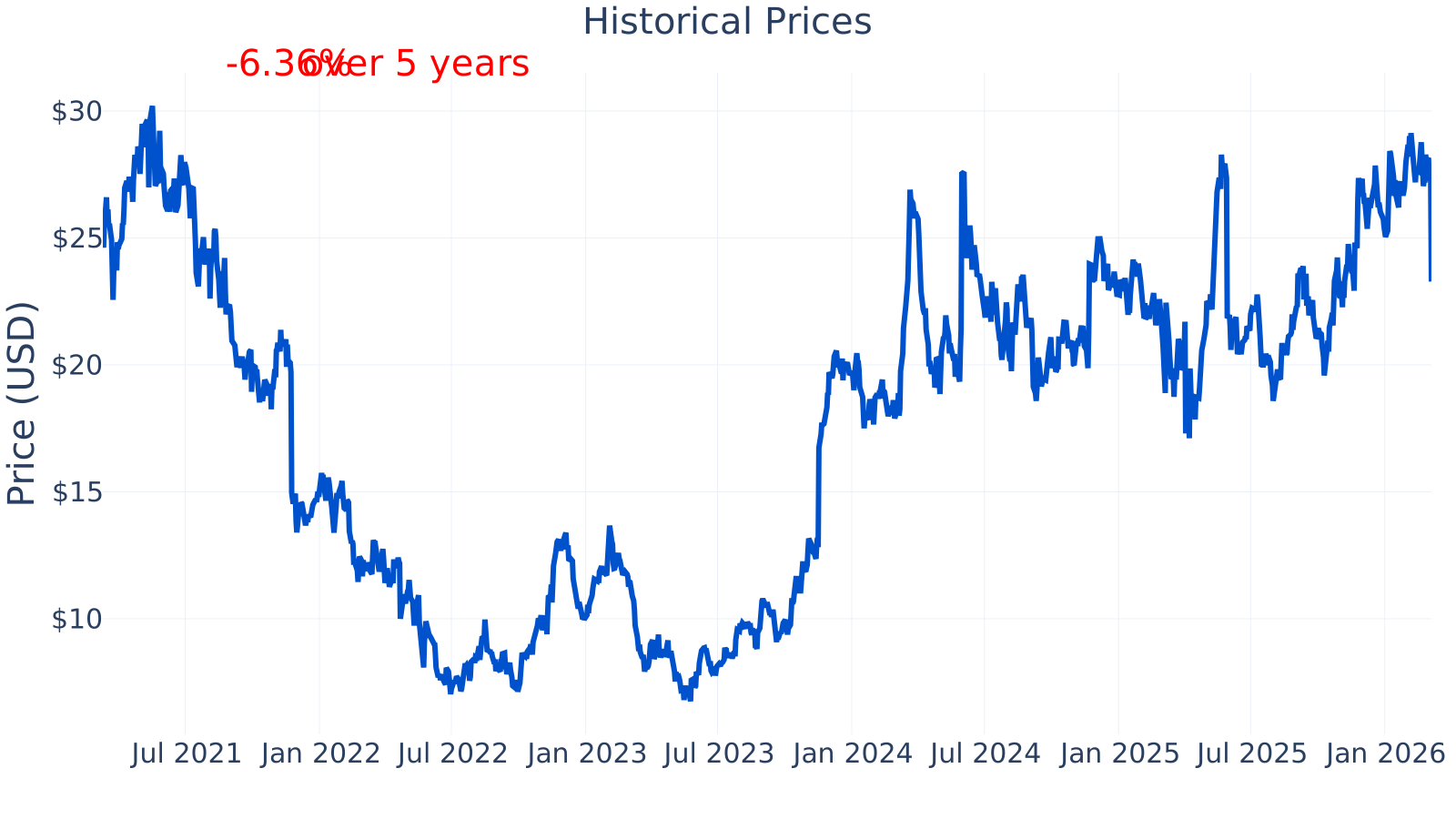
The Gap Inc. has a market capitalization of about $8.7B and a relatively high beta (~2.24), which indicates the stock has historically moved more than the overall market (up and down). The current P/E ratio is ~10.5, below the industry median (~14.9). Profitability is positive with a ~5.3% profit margin, though still below the industry median (~8.3%). Recent year-over-year revenue growth is ~2.1%, also below the industry median (~8.9%). Leverage is higher than peers with debt-to-equity ~148% versus an industry median near 93%. Free cash flow over the last twelve months is about $976M, which suggests meaningful cash generation in the most recent period.
Growth (Medium)
Apparel retail is a large, mature industry where long-term growth usually depends less on overall market expansion and more on brand strength, product relevance, pricing power, supply chain execution, and customer loyalty. Demand is also influenced by consumer confidence and discretionary spending. In that context, sustained growth for Gap tends to come from improving brand momentum, increasing full-price selling (less discounting), strengthening digital and omnichannel capabilities, and keeping inventory aligned with demand.
Recent revenue growth has been modest. After several quarters of declines, the company returned to small positive year-over-year growth in multiple periods, with the latest shown at roughly 2.1%. This is consistent with a business in a stabilization or gradual recovery phase rather than a high-growth phase, and it also lags the industry median growth rate in the table.
Cash generation has been a notable brighter point. Free cash flow improved from negative levels (around -$78M at one point) to a much higher level (peaking above $1.1B), with the most recent trailing twelve months at about $976M. For a retailer, stronger free cash flow can support reinvestment (stores, technology, supply chain), debt reduction, and shareholder returns, though it can also fluctuate with inventory movements and the timing of payments.
Potential catalysts (in a neutral, factual sense) generally revolve around execution: maintaining improved profitability, continuing inventory discipline, and sustaining demand across its largest brands. Because the business is brand-led, product cycles and merchandising performance can have an outsized effect on results compared with many other industries.
Risks (High)
Gap operates in an intensely competitive part of consumer retail where switching costs are low and fashion risk is real: customers can move quickly to other brands or retailers if product, price, or marketing misses the moment. This makes sales and margins sensitive to merchandising decisions and promotional activity across the sector.
Financial leverage is an additional consideration. The latest debt-to-equity is roughly 148%, higher than the industry median (~93%). While this measure can be affected by accounting items and balance sheet structure, higher leverage generally means the company has less flexibility if sales weaken, costs rise, or credit markets tighten.
Profitability has improved from earlier lows, but the company’s net profit margin (about 5.3%) remains below the industry median (~8.3%). The historical pattern also shows that margins were negative in parts of 2022–2023 before recovering. This matters because retailers often face sudden margin pressure from discounting, freight and input costs, wage inflation, and inventory write-downs.
Competitive positioning is mixed. Gap has scale and brand recognition, but it is not the clear leader across all categories it plays in. Competitive advantages in apparel retail tend to be “soft” (brand equity, customer loyalty programs, distribution scale, sourcing relationships), and they need constant reinforcement. Key competitors include:
- Large mass and value retailers with apparel offerings (often competing heavily on price and convenience)
- Fast-fashion and trend-driven players (competing on speed and newness)
- Global athletic and athleisure brands (particularly relevant for categories adjacent to Athleta)
- Department stores, off-price retailers, and online-first brands that compete for the same discretionary spending
Beyond competition, additional risks include supply chain disruption, tariff and sourcing exposure, shifts in consumer spending, and execution risk in keeping each brand’s identity clear while also capturing efficiencies at the corporate level.
Valuation
On an earnings multiple basis, Gap’s current P/E (~10.5) is below the industry median (~14.9) shown in the table. Historically, the P/E has swung widely (including periods where it spiked), which can happen when earnings temporarily fall and then recover. That variability is common in cyclical retailers, where profits can change meaningfully from year to year.
Whether the current valuation is “high” or “low” in context depends largely on durability: how stable revenue proves to be, whether margins can remain positive through different consumer environments, and how the balance sheet is managed given the higher leverage. In other words, the valuation appears to reflect a business with improved recent profitability and cash generation, but also meaningful operating and competitive risk typical of apparel retail.
Conclusion
The Gap Inc. is a multi-brand apparel retailer with recognizable names and a large revenue base. The recent period shows a recovery in profitability and strong free cash flow generation, alongside modest revenue growth. At the same time, results have historically been volatile, and current metrics indicate higher leverage than the industry median and profit margins that remain below many peers.
For a long-term, fundamentals-focused view, the central issues to track are whether the company can sustain its improved margins, keep inventory and promotions under control, and maintain brand relevance in a highly competitive market—while also managing leverage so that the balance sheet remains resilient across economic cycles.
Sources:
- The Gap, Inc. — Annual Report (Form 10-K) (most recent filing available on SEC EDGAR)
- SEC EDGAR — The Gap, Inc. filings (10-K, 10-Q, 8-K)
- The Gap, Inc. — Investor Relations (earnings materials and press releases)
- Wikipedia — “Gap Inc.” (basic company background)
This article is for informational purposes only and does not constitute financial advice. Some content is AI-generated. See Disclaimer


