Stock Analysis · The Gap Inc (GAP)
Overview
The Gap, Inc. is a global specialty retailer that sells apparel, accessories, and personal care products. It operates through a portfolio of well-known brands—Old Navy, Gap, Banana Republic, and Athleta—and reaches customers through both company-operated stores and digital commerce. The company also uses a mix of sourcing partners and long-term supplier relationships to design, produce, and distribute products across multiple regions.
Revenue primarily comes from selling merchandise under its brands. In its financial reporting, Gap typically describes revenue through its brand segments rather than breaking sales into detailed product categories (for example, men vs. women) in a single universal percentage split. Based on the company’s segment reporting approach, the main sources of revenue are:
- Old Navy (largest brand by sales in recent years)
- Gap
- Banana Republic
- Athleta
In addition to brand-driven sales, results are influenced by how much demand flows through stores vs. online channels, and by promotions/discounting (which can raise sales but compress profits).
The recent income structure shows a business where profitability has depended heavily on controlling operating costs (such as store labor, marketing, and corporate overhead). From fiscal 2024 to fiscal 2025, operating income and net income improved markedly, while total revenue stayed in a similar range, indicating that margin and cost execution played a larger role than top-line expansion.
Key Figures
| Metric | Value | Industry ⓘ |
|---|---|---|
| Date | Feb 07, 2026 | |
| Context | ||
| Sector | Consumer Cyclical | |
| Industry | Apparel Retail | |
| Market Cap ⓘ | $10.83B | |
| Beta ⓘ | 2.27 | |
| Fundamental | ||
| P/E Ratio ⓘ | 13.12 | 17.99 |
| Profit Margin ⓘ | 5.57% | 8.42% |
| Revenue Growth ⓘ | 3.00% | 7.30% |
| Debt to Equity ⓘ | 151.25% | 104.73% |
| PEG ⓘ | 1.73 | |
| Free Cash Flow ⓘ | $779.00M | |
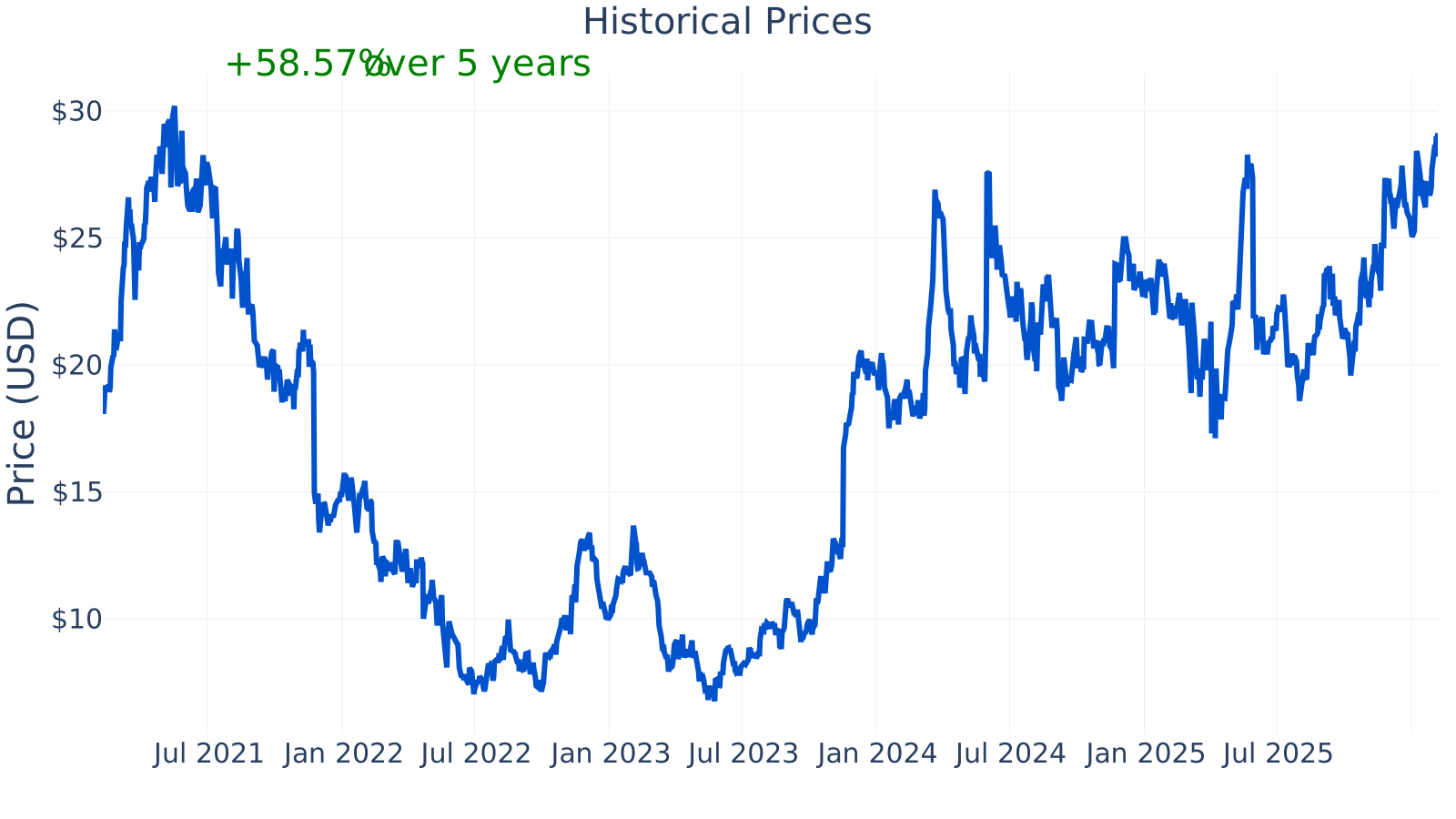
Gap’s market capitalization is about $10.8B. The stock’s beta (~2.27) suggests it has historically moved more than the broader market (higher volatility). The company’s P/E ratio (~13.1) is below the industry median (~18.0), while its profit margin (~5.6%) is below the industry median (~8.4%). Year-over-year revenue growth is around 3.0%, also below the industry median (~7.3%). Leverage is relatively elevated: debt-to-equity ~151% versus an industry median near 105%. Over the trailing twelve months, free cash flow is about $779M, reflecting meaningful cash generation in the recent period.
Growth (Medium)
Apparel retail is a large, mature industry where growth tends to be driven less by overall category expansion and more by brand relevance, product innovation, pricing discipline, and operational execution (inventory management, sourcing costs, and store productivity). In this environment, durable growth usually requires consistent customer demand and the ability to avoid heavy discounting.
Revenue growth has been uneven over the past several years, including multiple periods of decline followed by a return to modest growth more recently (low single digits in the latest periods shown). This pattern is consistent with a retailer navigating shifting demand, promotional pressure, and brand-level performance differences.
Free cash flow improved significantly from fiscal 2023 (negative) to fiscal 2024 and fiscal 2025 (strongly positive), which can be important for long-term resilience because it supports reinvestment in the business and strengthens financial flexibility. That said, in retail, cash generation can be sensitive to working-capital swings (especially inventories) and the level of promotions required to move product.
Potential catalysts for longer-term improvement are typically tied to execution rather than one-time events: maintaining better inventory discipline, keeping product assortments aligned with demand, improving the online-to-store shopping experience, and sustaining cost controls while protecting brand positioning.
Risks (High)
This article is for informational purposes only and does not constitute financial advice. Some content is AI-generated. See Disclaimer