Stock Analysis · USA TODAY Co. Inc (TDAY)
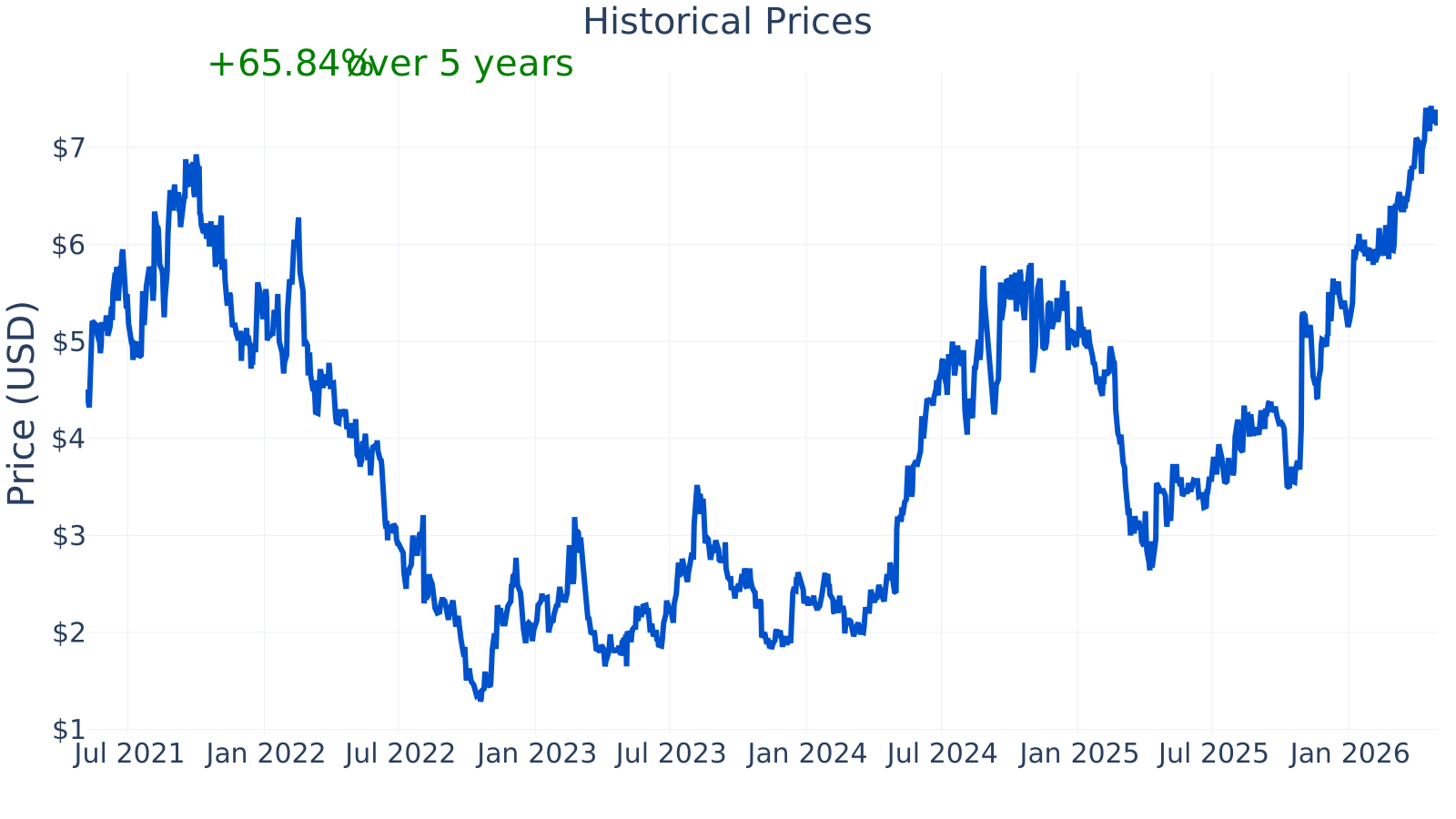
Overview
USA TODAY Co. Inc (TDAY) operates in the Communication Services sector, within the Publishing industry. In simple terms, the company is part of the business of producing and distributing written content and related products, and monetizing audiences primarily through advertising and paid offerings.
In publishing-oriented business models, revenue is typically generated by combining paid readership (subscriptions/single-copy sales) with advertising, and sometimes with related services. The exact split by percentage can vary by year and is usually disclosed in detail in official filings by business segment and revenue category.
Main revenue sources (typical for publishing companies, ordered from most common/largest to smaller):
- Advertising and marketing services (print and digital)
- Paid circulation / subscriptions (digital and print)
- Other revenue (ancillary products and services, licensing, and related activities as applicable)
From the company’s consolidated financials, total revenue has been trending lower over the last several years, which puts more importance on cost control, digital mix improvements, and maintaining audience engagement.
Across recent years, total revenue declined (about $3.21B in 2021 to about $2.30B in 2025). Over the same period, operating income moved around but did not show a steady upward trend, while interest expense remained a meaningful cost (roughly around $100M+ per year). Net income was negative for multiple years before turning slightly positive in 2025, suggesting profitability has been fragile and sensitive to operating performance and financing costs.
Key Figures
| Metric | Value | Industry ⓘ |
|---|---|---|
| Date | May 04, 2026 | |
| Context | ||
| Sector | Communication Services | |
| Industry | Publishing | |
| Market Cap ⓘ | $1.09B | |
| Beta ⓘ | 1.44 | |
| Fundamental | ||
| P/E Ratio ⓘ | 41.00 | 21.28 |
| Profit Margin ⓘ | 1.27% | 9.24% |
| Revenue Growth ⓘ | -4.00% | 1.30% |
| Debt to Equity ⓘ | 797.56% | 52.00% |
| PEG ⓘ | 0.94 | |
| Free Cash Flow ⓘ | $59.52M | |
The company’s market capitalization is about $1.09B, and the stock has a beta of ~1.44, which indicates it has tended to move more than the broader market. The latest P/E ratio is ~41 versus an industry median near 21.3, while the latest profit margin is ~1.27% versus an industry median near 9.24%. Recent year-over-year revenue growth is about -4.0% compared with an industry median near +1.3%. Leverage stands out: debt-to-equity is ~798% versus an industry median near 52%. Free cash flow over the last twelve months is about $59.5M.
Growth (Low)
Publishing is generally considered a mature industry, and many publishers have faced long-running structural pressures such as print declines and shifts in advertising spending toward large digital platforms. In that context, a realistic growth strategy often relies less on rapid expansion and more on execution: stabilizing audiences, improving digital products, growing subscription revenue, and increasing efficiency.
Recent revenue growth has been consistently negative across multiple periods, with the latest reading around -4%. Even if the pace of decline changes from quarter to quarter, a multi-year pattern of contraction typically means the company must work harder to generate growth—either by building higher-value digital revenue streams, improving retention, or expanding into adjacent offerings.
Free cash flow has been positive most recently (about $59.5M TTM), and it has improved versus a negative period in 2023. For long-term business health, sustained positive free cash flow can matter because it can support debt repayment, reinvestment in products and technology, and resilience during weak advertising cycles. The key question for durability is whether that cash generation can remain consistent while revenue is declining.
Potential catalysts in a publishing business model (described generally) can include improved digital subscription performance, stronger digital advertising execution, meaningful cost reductions, and refinancing or debt reduction that lowers interest expense. The financial profile here suggests that financial structure (debt and interest) is an important variable in how much operating improvement can translate into bottom-line results.
Risks (High)
A central risk is structural revenue pressure. When revenue trends down for extended periods, the company must continually offset that decline through efficiency gains, product changes, or mix shift—otherwise profitability can remain thin.
Leverage is a major consideration. The latest debt-to-equity is about 798%, substantially above the industry median near 52%. This can increase sensitivity to interest rates, refinancing conditions, and earnings volatility. It also means that even if operating performance improves, a meaningful portion of economic value can be absorbed by financing costs and debt servicing needs.
Profitability has been inconsistent. The latest profit margin is about 1.27%, below the industry median near 9.24%. The historical pattern includes multiple periods of negative margins before returning to small positive levels. Thin margins can reduce flexibility, because normal business fluctuations (advertising weakness, cost inflation, or one-time charges) can push results back into losses.
Competition is another important risk. Publishing competes for both audience attention and advertising budgets. Major competitive forces often include:
- Other publishers (national and local, print and digital)
- Digital platforms that capture significant ad spending and user time
- Subscription-based media competing on differentiated content and brand loyalty
Competitive advantages in publishing typically come from brand recognition, audience scale, local or niche content strength, distribution relationships, and the ability to convert readers into paying subscribers. Based on the financial indicators shown (notably revenue contraction and below-median margins), the company’s advantage is not clearly reflected in superior profitability at this time, which increases the importance of execution and operating discipline.
Valuation
Valuation is best interpreted alongside profitability quality and balance sheet risk. A P/E ratio can be less informative when earnings are volatile or have only recently turned positive, because small changes in earnings can cause the ratio to swing sharply.
The latest P/E is about 41, above the industry median near 21.3. Historically, the P/E values shown have been uneven, reflecting periods where earnings were likely weak or inconsistent. When a company has thin margins and high leverage, a higher-than-median P/E can imply that the market is pricing in a meaningful improvement in operating performance, improved stability of earnings, and/or successful balance sheet progress. If those improvements do not materialize, valuation can be vulnerable to resets.
Because free cash flow is positive recently, investors often also look at cash generation relative to debt and the sustainability of that cash flow through business cycles. In this case, the combination of declining revenue and high leverage makes the “context” around valuation especially dependent on whether the company can keep producing cash while maintaining (or improving) margins.
Conclusion
USA TODAY Co. Inc is a publishing business operating in a mature environment where long-term growth often depends on digital execution and efficiency rather than broad industry expansion. Financially, recent years show a declining revenue base and historically inconsistent profitability, with margins only recently returning to modestly positive territory.
The company does show a constructive element in its recent positive free cash flow, which can support operations and financial flexibility. However, the balance sheet profile stands out as a key factor, with debt-to-equity far above the industry median and ongoing sensitivity to financing costs. On valuation, the latest P/E above the industry median sits alongside lower profitability metrics, meaning the overall picture relies heavily on continued stabilization and improvement in operating performance.
Sources:
- U.S. Securities and Exchange Commission (SEC) EDGAR — Company filings for USA TODAY Co. Inc (Form 10-K, 10-Q, 8-K)
- Wikipedia — “USA Today” (basic background and general reference context)
This article is for informational purposes only and does not constitute financial advice. Some content is AI-generated. See Disclaimer


