Stock Analysis · GameStop Corp (GME)
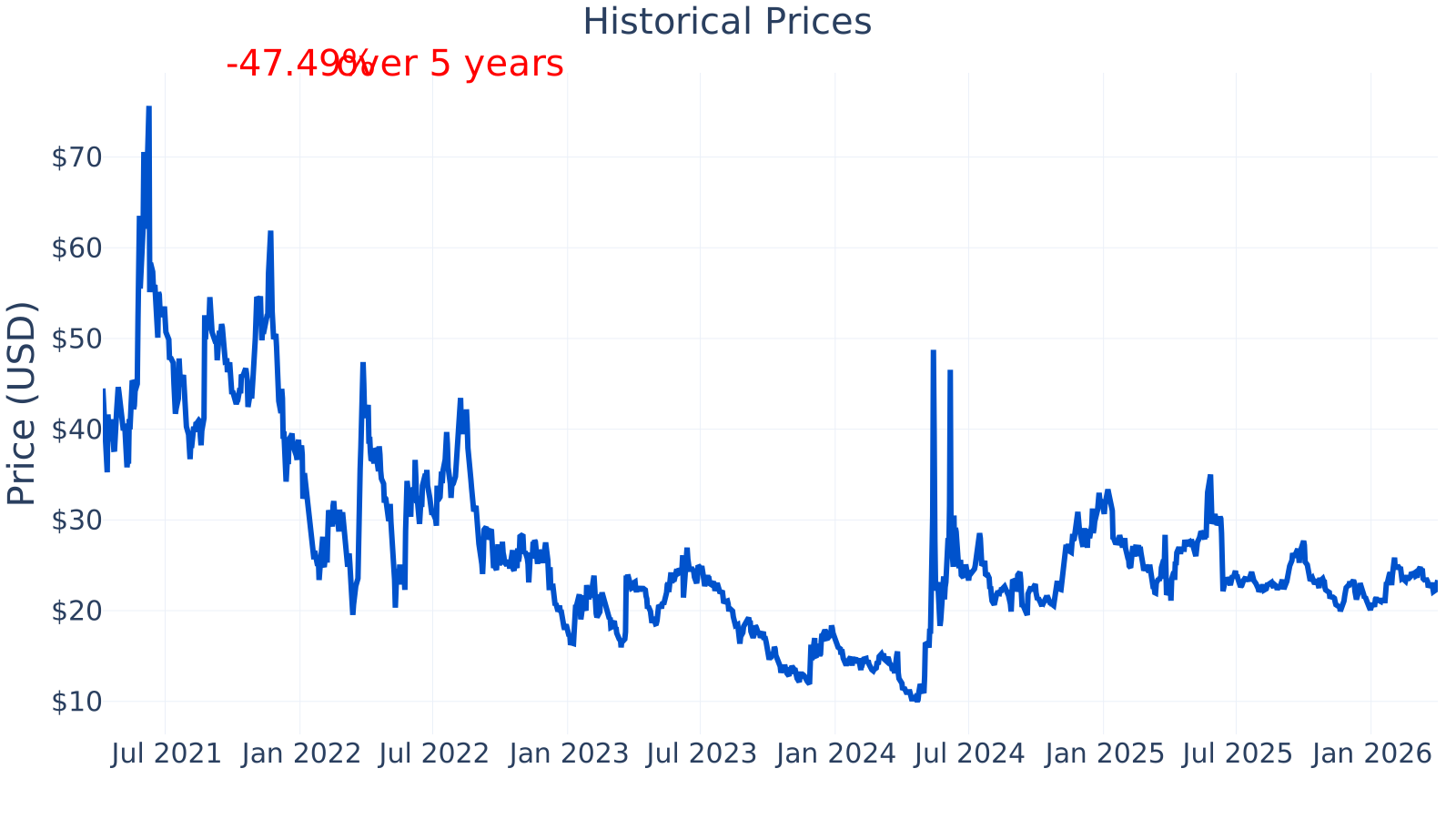
Overview
GameStop Corp (GME) is a specialty retailer focused on video game hardware, software, and accessories, along with collectibles and other consumer products. It sells through a network of physical stores and e-commerce channels, and it also has a trade-in model where customers can exchange used products for cash or store credit (a long-standing part of the brand’s retail offering).
In its financial reporting, GameStop’s sales are commonly described through broad product categories rather than a large number of separate business lines. Based on how the company describes its operations in its filings, the main revenue drivers typically include:
- Hardware and accessories (consoles, controllers, PC gaming items)
- Software (physical video games and related products)
- Collectibles (licensed merchandise and related items)
- Other (can include smaller or transitional categories depending on the reporting period)
Exact percentages by category can change meaningfully from year to year (for example, depending on console cycles and release schedules) and are best taken directly from the latest annual report segment disclosures.
Over the last several fiscal years shown, total revenue declines materially, while operating expenses (especially selling, general, and administrative costs) also fall. That cost reduction appears large enough to move operating results from negative territory to positive by the most recent year shown.
Key Figures
| Metric | Value | Industry ⓘ |
|---|---|---|
| Date | Apr 06, 2026 | |
| Context | ||
| Sector | Consumer Cyclical | |
| Industry | Specialty Retail | |
| Market Cap ⓘ | $10.47B | |
| Beta ⓘ | 1.85 | |
| Fundamental | ||
| P/E Ratio ⓘ | 30.34 | 20.59 |
| Profit Margin ⓘ | 11.53% | 4.93% |
| Revenue Growth ⓘ | -13.90% | 3.70% |
| Debt to Equity ⓘ | 80.12% | 92.65% |
| PEG ⓘ | 0.31 | |
| Free Cash Flow ⓘ | $597.30M | |
GameStop’s market capitalization is about $10.5B, and the stock’s beta of 1.85 indicates it has tended to move much more than the broader market. The company shows a profit margin of ~11.53% versus an industry median near 4.93%, which suggests materially stronger recent profitability than many peers (noting that profit margin can swing meaningfully for retailers depending on costs, demand, and one-time items). At the same time, year-over-year revenue growth is about -13.90% compared with an industry median around +3.70%, meaning sales contraction remains a key part of the current picture. Leverage, measured as debt-to-equity of ~80%, is below the industry median near 92.65%. The company’s P/E ratio is ~30.34, above the industry median around 20.59. Trailing twelve-month free cash flow is about $597M, a notable improvement versus earlier periods shown.
Growth (Medium)
GameStop operates in the broader gaming ecosystem, which remains culturally relevant and supported by ongoing hardware refresh cycles, major game releases, and accessory demand. However, the company’s core challenge is structural: over time, the industry has shifted toward digital downloads, subscriptions, and direct-to-consumer purchasing, which can reduce foot traffic and the importance of physical game retail—especially for software. This makes GameStop’s end-market feel mixed: gaming demand can be resilient, but the format of distribution has changed in ways that are not naturally favorable to traditional physical retail.
A central question for future growth is whether GameStop can stabilize sales while protecting profitability through a smaller, more efficient store footprint and stronger online execution. The financial pattern visible in recent years is consistent with a company that has prioritized cost control and operational tightening, and that can be a rational approach when demand is not reliably expanding.
The revenue trend shown is volatile but leans negative for several periods, including the most recent year shown at roughly -13.9%. That suggests that, even with operational improvements, the business is still working against shrinking top-line demand (or a smaller footprint), which can limit how far expansion can go without a clearer sales re-acceleration.
Free cash flow improves substantially over the period shown, moving from negative levels to approximately $597M in the most recent trailing twelve months. For long-term fundamentals, sustained positive free cash flow can matter because it supports reinvestment, balance sheet flexibility, and resilience during weaker demand cycles. The key uncertainty is how much of the improvement is driven by durable operating performance versus working-capital swings or temporary factors.
Risks (High)
The largest business risk is the continued long-term shift toward digital game distribution and platform-holder ecosystems that do not require a physical retailer. If software sales keep migrating to digital, it can pressure store traffic and reduce opportunities for add-on purchases. Hardware cycles can provide periodic boosts, but they are not constant, and demand can be uneven.
Another major risk is execution risk. Improving profitability while revenue declines is difficult to sustain indefinitely; if cost cuts run ahead of the company’s ability to maintain customer demand, future performance can become more volatile. Retail also carries inventory and demand-planning risks, where mismatches can pressure margins.
The debt-to-equity level is about 80% most recently, which is somewhat below the industry median near 92.65%. The historical pattern shown includes periods where leverage was much lower before rising again, indicating the capital structure has shifted over time. Lower leverage than peers can help reduce financial stress, but it does not remove the underlying operational risks tied to demand and channel change.
Profit margin improves dramatically over the period shown, moving from negative values to approximately 11.53% most recently, above the industry median near 4.9%. This points to meaningful recent progress in profitability. The risk for long-term evaluation is whether those margins remain stable if revenue stays under pressure, since retail margins can compress quickly in promotional environments or when sales volumes soften.
On competitive positioning, GameStop is a well-known specialist brand in physical game retail, but it faces heavy competition from:
- Console platform digital stores (direct purchasing on PlayStation, Xbox, Nintendo ecosystems)
- Large e-commerce and big-box retailers that sell hardware, accessories, and collectibles
- Direct-to-consumer channels from brands and publishers
Because many competitors can bundle gaming products into broader retail offerings (and because digital storefronts are built into consoles), GameStop’s competitive advantages depend heavily on in-store convenience, trade-in economics, customer engagement, and disciplined cost structure rather than clear category exclusivity.
Valuation
The most recent P/E ratio is about 30.34, compared with an industry median around 20.59. A higher P/E can be consistent with expectations of improving earnings quality, a turnaround narrative, or unusual investor positioning, but it can also mean the market price is assigning more value per dollar of current earnings than typical peers.
The chart history shows periods where the P/E is not meaningful (for example, when earnings were negative), followed by very elevated readings (well above typical retail ranges) before settling closer to the current level. This history highlights a key point for interpretation: for a company that has recently transitioned from losses to profits, valuation multiples can swing sharply as earnings normalize. In that context, whether the current multiple is “high” or “low” depends heavily on whether recent profitability and free cash flow prove durable while revenue trends remain challenged.
Conclusion
GameStop today looks like a business that has recently delivered a notable improvement in profitability and free cash flow, alongside a multi-year pattern of declining revenue. The long-term backdrop includes structural pressure from the industry’s move to digital distribution, which can limit growth for traditional physical retail models even when gaming demand remains healthy overall.
From a fundamentals perspective, the main items to watch over time are whether revenue contraction stabilizes, whether improved margins persist through different demand conditions, and how consistently the company can generate positive free cash flow. The valuation picture, reflected in a P/E above the industry median, suggests the market is assigning a relatively higher multiple than many peers, which places more weight on sustained execution rather than a one-time improvement.
Sources:
- SEC EDGAR — GameStop Corp filings (Form 10-K, Form 10-Q)
- GameStop Investor Relations — Press Releases and SEC filing links
- Wikipedia — “GameStop” (basic company background)
This article is for informational purposes only and does not constitute financial advice. Some content is AI-generated. See Disclaimer


