Stock Analysis · GameStop Corp (GME)
Overview
GameStop Corp (GME) is a specialty retailer focused on video games and related products. The company sells hardware (such as consoles and accessories), software, and collectibles, using a mix of physical stores and e-commerce. In recent years, GameStop has also emphasized cost reductions and operational discipline while continuing to adjust its store footprint and online offering to match how consumers increasingly shop for gaming products.
GameStop’s revenue is primarily generated from retail sales to consumers. In its financial reporting, the business is typically described through major product categories rather than many separate business lines. Based on company filings, the main revenue sources are generally organized as:
- Hardware and accessories (often the largest category; includes consoles, controllers, and related gear)
- Software (physical and, where applicable, digitally sold game software and related items)
- Collectibles (toys, apparel, trading cards, and other licensed merchandise)
Exact percentages can shift meaningfully year to year and by console cycle, and they are best read directly from the company’s most recent annual report segment/category discussion.
Over the last several fiscal years shown, total revenue declined materially (from about $6.01B in fiscal 2022 to about $3.82B in fiscal 2025), while selling, general, and administrative expenses fell even faster (from about $1.71B to about $1.13B). That cost reduction helped move results from large net losses (about -$381M in fiscal 2022) to positive net income (about $131M in fiscal 2025), even though operating income remained slightly negative in fiscal 2025 (about -$16.5M).
Key Figures
| Metric | Value | Industry ⓘ |
|---|---|---|
| Date | Feb 07, 2026 | |
| Context | ||
| Sector | Consumer Cyclical | |
| Industry | Specialty Retail | |
| Market Cap ⓘ | $11.19B | |
| Beta ⓘ | 2.12 | |
| Fundamental | ||
| P/E Ratio ⓘ | 28.39 | 23.78 |
| Profit Margin ⓘ | 11.08% | 6.27% |
| Revenue Growth ⓘ | -4.60% | 5.20% |
| Debt to Equity ⓘ | 82.81% | 103.28% |
| PEG ⓘ | 0.86 | |
| Free Cash Flow ⓘ | $568.70M | |
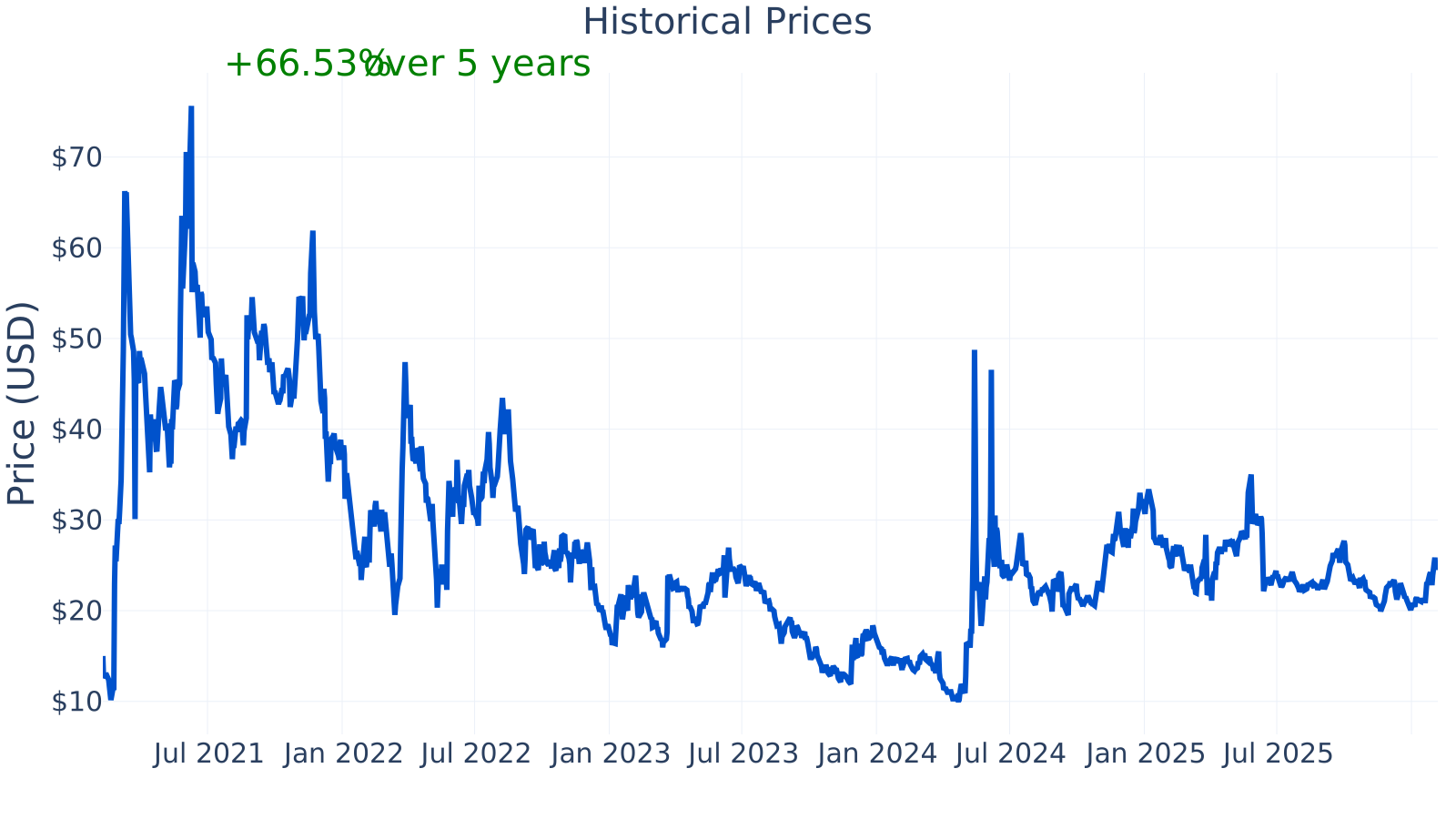
At the latest point shown, GameStop’s market capitalization is about $11.19B. The stock’s beta of ~2.12 indicates that it has historically been much more volatile than the overall market. The company shows a P/E ratio of ~28.4 versus an industry median near 23.8. The latest profit margin is ~11.1%, which is above the industry median (about 6.3%), while revenue growth year-over-year is -4.6%, below the industry median (about +5.2%). Leverage, measured as debt-to-equity, is ~82.8%, below the industry median (about 103.3%). Trailing twelve-month free cash flow is about $568.7M.
Growth (Low)
GameStop operates in the video game retail portion of the broader gaming industry. While gaming as entertainment has remained significant, the long-term mix has shifted toward digital downloads, subscriptions, and direct-to-console/PC distribution. That structural shift can limit growth for traditional physical retail of new game software and can pressure store traffic over time. For a retailer like GameStop, growth tends to depend more on execution, merchandising choices (including collectibles and accessories), trade-in/used dynamics, and cost structure than on a rising “tide” across the whole retail category.
The year-over-year revenue trend displayed is uneven and, in many periods, negative. After strong growth earlier in the timeline, the chart shows extended stretches of contraction, with several quarters around 2024 and early 2025 showing double-digit declines, followed by a temporary rebound and then a return to a slight decline (about -4.6% at the latest point shown). This pattern suggests that recent improvements in profitability have not been driven by consistent top-line expansion.
Free cash flow (a simplified way to view cash generated after operating needs and investments) also fluctuated. It improved from a large negative level in early 2022 (about -$496M) to modestly positive in early 2023 (about $52M), turned negative again in early 2024 (about -$239M), and then returned to positive in early 2025 (about $130M). This kind of swing can happen in retail due to profitability changes and working-capital movements (like inventory and payables), and it highlights that cash generation may not be stable from year to year.
Potential catalysts tend to be company-specific rather than industry-wide: continued expense discipline, improved merchandising and inventory management, growth in higher-margin categories, and sustained profitability. However, the visible trend in revenue indicates that a clear, durable growth engine is not yet evident from the top-line trajectory alone.
Risks (Very High)
This article is for informational purposes only and does not constitute financial advice. Some content is AI-generated. See Disclaimer


