Stock Analysis · Frontdoor Inc (FTDR)
Overview
Frontdoor Inc. (FTDR) is a home services company best known for home service plans (often called “home warranties”). These plans are typically annual contracts that help homeowners pay for the repair or replacement of covered home systems and appliances (for example, HVAC, plumbing, electrical, water heaters, or major appliances). When a covered item breaks down, the customer files a claim and Frontdoor coordinates service through a network of contractors and pays covered costs under the contract terms.
Frontdoor’s business model blends recurring-like contract revenue (customers renewing plans each year) with operational execution (managing claims efficiently, controlling costs, and maintaining a reliable contractor network). The company operates nationally and markets through direct-to-consumer channels as well as through partnerships (for example, real estate-related channels) as described in its SEC filings.
Revenue is primarily generated from home service plan contracts and related customer fees. Exact revenue splits can vary by year and are detailed in the company’s annual report, but the main revenue sources can be summarized as:
- Home service plan contract revenue (the core membership/plan revenue)
- Service fees and other ancillary revenue (fees paid by customers per claim and other program-related revenue)
Over the years shown, total revenue increases (from about $1.60B in 2021 to about $2.09B in 2025) and operating income rises meaningfully (from about $197M to about $417M). Interest expense also grows (from about $29M to about $79M), which is important context when thinking about the company’s use of debt and sensitivity to interest rates.
Key Figures
| Metric | Value | Industry ⓘ |
|---|---|---|
| Date | Mar 09, 2026 | |
| Context | ||
| Sector | Consumer Cyclical | |
| Industry | Personal Services | |
| Market Cap ⓘ | $4.85B | |
| Beta ⓘ | 1.32 | |
| Fundamental | ||
| P/E Ratio ⓘ | 19.08 | 21.52 |
| Profit Margin ⓘ | 12.18% | 12.59% |
| Revenue Growth ⓘ | 13.40% | 9.70% |
| Debt to Equity ⓘ | 500.83% | 131.43% |
| PEG ⓘ | N/A | |
| Free Cash Flow ⓘ | $390.00M | |
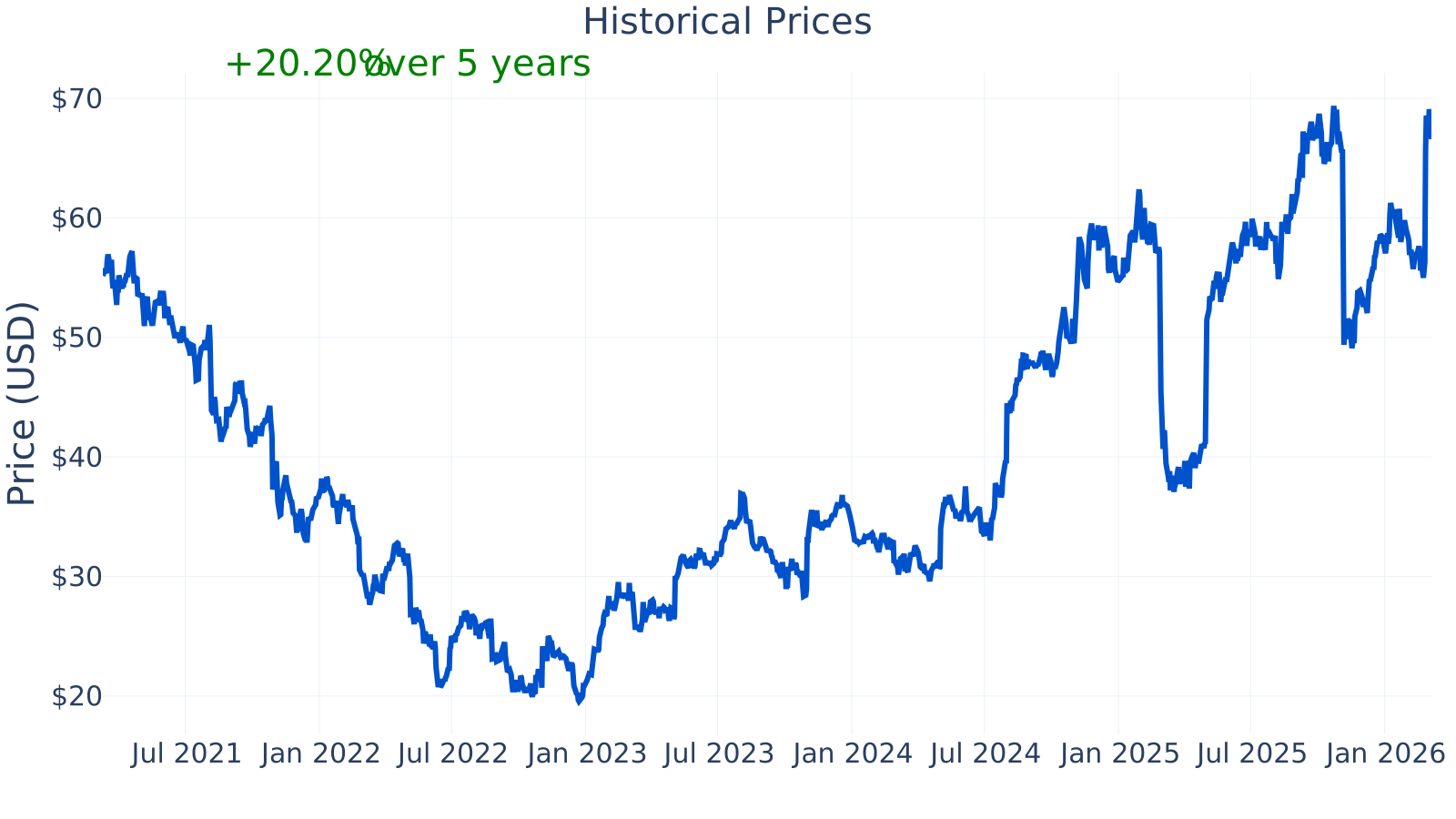
Frontdoor’s market capitalization is about $4.85B, and the stock’s beta of about 1.33 suggests it has tended to move more than the overall market. The company’s P/E ratio is ~19.1 versus an industry median of ~21.5, while profit margin is ~12.18%, close to the industry median (~12.59%). Recent year-over-year revenue growth is ~13.4%, higher than the industry median (~9.7%). A key point to note is leverage: debt-to-equity is ~501%, well above the industry median (~131%). Trailing twelve-month free cash flow is about $390M, indicating meaningful cash generation after operating needs and capital spending.
Growth (Medium)
Home service plans tend to sit in a steady demand category: homes age, systems break, and homeowners often prefer predictable budgeting for repairs. That said, growth is not purely “automatic.” It depends on customer acquisition, renewal rates, pricing versus competitors, claim frequency/severity, and the efficiency of service delivery through contractors.
For Frontdoor specifically, the recent pattern shown here points to improving momentum. Year-over-year revenue growth accelerates in 2025 into the low-to-mid teens, after slower growth rates in portions of 2022–2024. If sustained, that type of growth can matter because a large part of the cost structure is tied to claim activity and operating execution; scale and better cost control can support profitability.
The chart shows growth slowing to low single digits around late 2022, then strengthening again, reaching roughly 13%–14% in 2025. That rebound suggests either stronger customer adds/retention, improved pricing, or beneficial mix—factors that would be discussed in detail in Frontdoor’s 10-K and quarterly filings.
Cash generation is another potential growth enabler because it can support investments in marketing, technology (for example, improving the customer claim experience), and contractor network capability—without relying entirely on external funding.
Free cash flow trends upward over the period shown (about $169M in 2021 to about $275M in 2025, and $390M on a trailing basis in the latest snapshot). For many service-oriented businesses, sustained free cash flow can be a practical indicator of operating discipline, especially when paired with stable or improving margins.
Potential catalysts over time often relate to execution rather than one-time events: higher renewal rates, better claim cost management, more efficient customer acquisition, and product/service enhancements that reduce friction (faster dispatch, better contractor availability, clearer coverage terms). Company filings also commonly highlight channel partnerships (such as real-estate-adjacent relationships) as a way to reach homeowners at key moments (home purchase, move-in), though the durability of any single channel can vary.
Risks (High)
A central risk in this business is the balance between price (what customers pay) and claims (what the company pays out). If repair and replacement costs rise faster than pricing, or if claim frequency spikes (for example, weather patterns affecting HVAC demand), margins can compress. Service quality is also critical: delays, contractor shortages, or poor customer experiences can reduce renewals and raise complaint/regulatory exposure.
Financial leverage stands out as a notable risk factor. Debt can amplify results when operations are going well, but it can also reduce flexibility during periods of higher interest rates or weaker operating performance.
The latest debt-to-equity is roughly 501% versus an industry median near 131%. The time series also shows meaningful swings, which can happen when debt levels change and/or equity changes due to buybacks, earnings, or accounting items. In practical terms, higher leverage usually increases sensitivity to refinancing conditions and interest costs—consistent with the rising interest expense visible in the operating breakdown.
Profitability has improved versus earlier years, but margins can still be pressured by claim inflation and operating costs (including labor and parts). Monitoring whether margins remain stable across different housing and inflation environments is important for understanding resilience.
Profit margin rises from mid-single digits earlier in the period to around 12%–13% more recently, roughly in line with the industry median in the latest readings. This improvement suggests stronger operating performance over time, but it does not remove exposure to cost shocks inherent in repair-heavy service businesses.
Competition is another key risk. The home service plan market includes other national providers and regional players, and consumers can also choose alternatives such as saving for repairs, using retailer/manufacturer service plans, or relying on homeowners insurance for certain events (though insurance and service plans cover different things). Competitive advantages in this space tend to come from brand recognition, scale in contractor networks, call center/dispatch efficiency, pricing and coverage design, and customer experience that supports renewals. Whether Frontdoor is “the leader” depends on the specific segment and measurement (plans, members, geography), and leadership claims should be verified in the company’s filings; however, its scale and national footprint are commonly positioned as important strengths in this category.
Valuation
Valuation is often discussed in relation to earnings power, growth expectations, and risk. A common simple measure is the price-to-earnings (P/E) ratio. Frontdoor’s latest P/E is about 19.1, below the industry median of about 21.5 in the same grouping shown here. That relationship can indicate the market is assigning either slightly lower growth expectations, higher perceived risk (for example, leverage), or a more cautious view of durability versus peers.
Historically, the P/E ratio shown trends down substantially from the low 40s in 2021 toward the mid-to-high teens in later periods, often sitting below the industry median after 2023. Interpreting that change requires context: the multiple can fall because the stock price falls, because earnings rise, or a mix of both. In Frontdoor’s case, the same period also shows improving net income and operating income in the operating breakdown, which can contribute to a lower P/E even if the share price is stable.
A key point in whether the current pricing looks “expensive or not” is the trade-off visible in the fundamentals: improving profitability and cash generation on one side, and comparatively high leverage (plus rising interest expense) on the other. The market multiple appears to reflect both.
Conclusion
Frontdoor is a consumer services business centered on home service plans, where performance depends heavily on operational execution: managing claims efficiently, keeping customers satisfied so they renew, and maintaining a cost-effective contractor network. The financial profile shown here includes improving revenue growth in 2025, stronger profit margins than earlier years, and solid free cash flow generation.
At the same time, the risk profile is meaningfully shaped by leverage, with debt-to-equity well above the industry median and interest expense rising over the multi-year view. Competitive pressure and the potential for claim cost inflation remain ongoing business risks that can affect profitability and renewals.
On valuation, the company’s P/E ratio is below the industry median in the latest snapshot and has often been below peers in more recent periods, which is consistent with a business that shows improving results but carries higher balance-sheet risk. Overall, the long-term narrative is driven by whether Frontdoor can sustain growth and margins while keeping leverage and interest costs manageable through different housing and cost environments.
Sources:
- SEC EDGAR — Frontdoor, Inc. Form 10-K (Annual Report)
- SEC EDGAR — Frontdoor, Inc. Form 10-Q (Quarterly Reports)
- SEC EDGAR — Frontdoor, Inc. Form 8-K (Current Reports)
- Frontdoor, Inc. Investor Relations — SEC Filings & Investor Materials
- Wikipedia — “Frontdoor, Inc.”
This article is for informational purposes only and does not constitute financial advice. Some content is AI-generated. See Disclaimer