Stock Analysis · Freshworks Inc (FRSH)
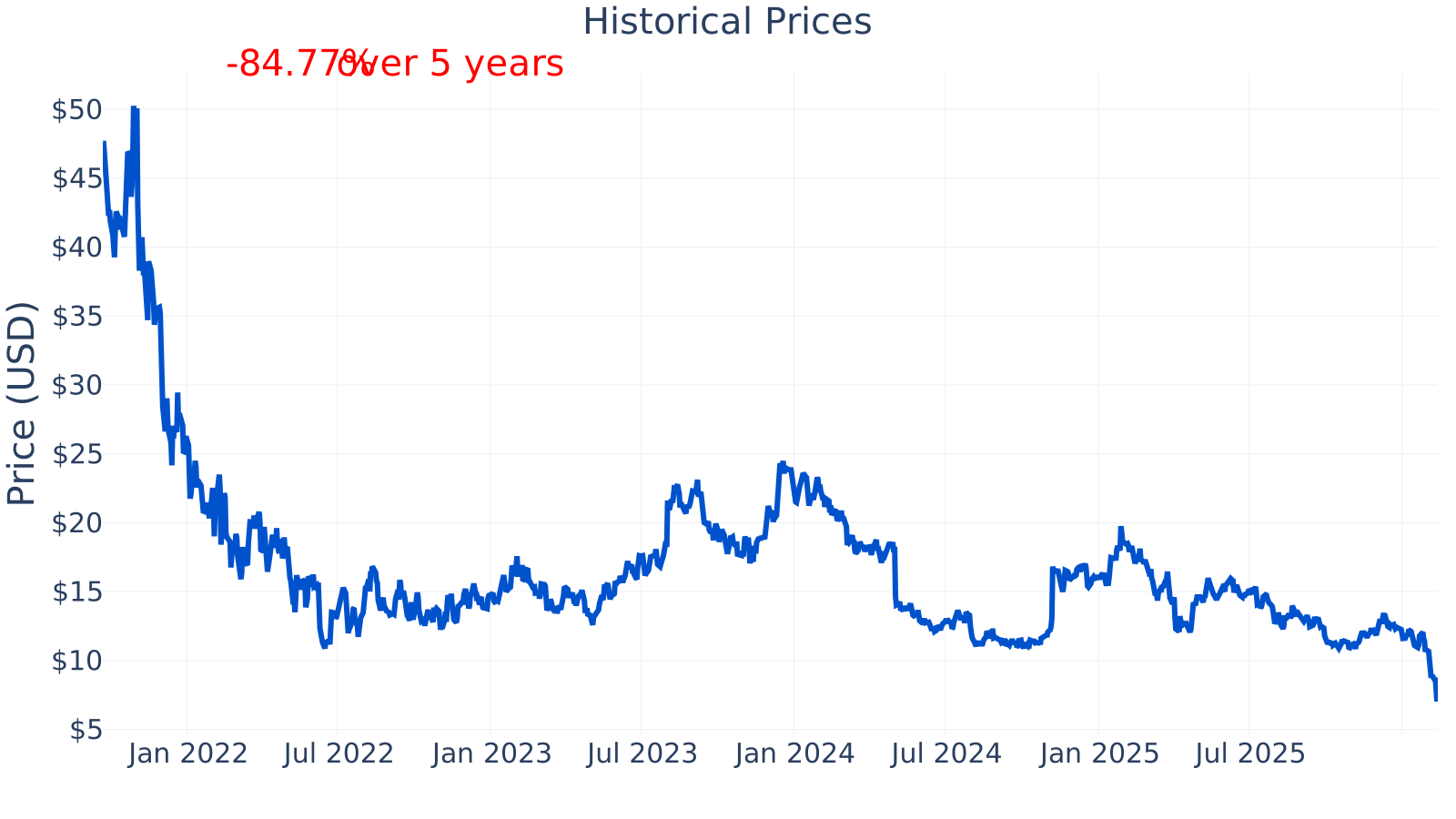
Overview
Freshworks Inc is a software company that sells cloud-based tools designed to help businesses manage customer support and internal IT service requests. In plain terms, it provides “help desk” and “service desk” applications that companies use to handle questions, incidents, and workflows across email, chat, phone, and web channels. The products are typically sold as subscriptions, which means customers pay recurring fees to keep using the software.
Freshworks positions its products for organizations that want an easier-to-deploy and simpler-to-use alternative to more complex enterprise software. Over time, the company has expanded from customer support into adjacent areas such as IT service management and broader customer relationship tools, aiming to sell multiple products to the same customer.
Based on the company’s filings, revenue is primarily generated from subscriptions (recurring software access), with a smaller portion coming from professional services (implementation and support services). Exact percentages can vary by year and are typically disclosed in annual reports.
The multi-year income flow shows revenue rising from about $371M (2021) to about $839M (2025), while net results improved from a sizable loss (2021–2024) to positive net income in 2025. It also shows operating expenses remaining significant, but with visible improvement in cost discipline (notably in selling, general, and administrative costs in 2025 compared with 2024) while research and development stayed meaningful.
Key Figures
| Metric | Value | Industry ⓘ |
|---|---|---|
| Date | Feb 16, 2026 | |
| Context | ||
| Sector | Technology | |
| Industry | Software - Application | |
| Market Cap ⓘ | $2.11B | |
| Beta ⓘ | 0.89 | |
| Fundamental | ||
| P/E Ratio ⓘ | 11.49 | 27.48 |
| Profit Margin ⓘ | 21.90% | 7.66% |
| Revenue Growth ⓘ | 14.50% | 15.80% |
| Debt to Equity ⓘ | 3.22% | 24.71% |
| PEG ⓘ | 0.43 | |
| Free Cash Flow ⓘ | $232.20M | |
Freshworks is shown with a market capitalization of about $2.11B and a beta of about 0.89, which indicates the stock has historically moved somewhat less than the overall market on average (though beta can change over time). The table shows a P/E ratio of about 11.5 versus an industry median near 27.5, alongside a profit margin of about 21.9% versus an industry median near 7.7%. Year-over-year revenue growth is about 14.5%, close to an industry median near 15.8%. Debt-to-equity is about 3.2% versus an industry median near 24.7%, and trailing twelve-month free cash flow is about $232M.
Growth (Medium)
Freshworks operates in application software, a broad area that has benefited from a long-term shift from on-premise software to cloud subscriptions. Customer support and IT service management are ongoing needs for businesses, and demand tends to persist because companies must keep serving customers and maintaining internal operations regardless of the economic cycle—though budget tightening can slow new purchases or expansions.
A key part of the strategy is “land and expand”: getting adopted by teams quickly (often with simpler setup) and then expanding usage across more employees, departments, or products. This approach can support durable growth if the software remains easy to deploy and proves valuable enough for customers to standardize on it.
The year-over-year growth trend shows a clear deceleration from very high growth rates in 2021 (around the mid-40% range) down to the mid-teens by late 2025 (about 14.5%). This pattern is common for software companies as they scale, but it also means future progress depends more on execution, product adoption, and retaining customers than on simply riding early-stage momentum.
Free cash flow has improved meaningfully over time, moving from around breakeven/negative levels in 2022–2023 to over $100M by 2024 and about $167M by early 2025 (TTM), with the latest metrics showing about $232M (TTM). For long-term business durability, this matters because positive free cash flow can help fund product development and growth initiatives without relying as heavily on external financing.
Risks (Medium)
Freshworks faces competitive pressure in software categories where switching costs can be meaningful but not always prohibitive. Businesses may compare vendors on price, features, integrations, security, and reliability. If a competitor offers better bundled pricing or if customers consolidate vendors, Freshworks may face slower expansion or higher churn (customer cancellations).
Competition is one of the central risks. In customer support and customer engagement software, well-known competitors include Zendesk and Salesforce (Service Cloud). In IT service management, ServiceNow is a major established provider, and Atlassian is also active in service management and team workflows. Relative to these large platforms, Freshworks is typically positioned as simpler to adopt and potentially more cost-accessible for mid-market customers, but it is not generally viewed as the category leader against the biggest incumbents.
Another risk is profitability consistency. Even when net income improves, software companies can see margins swing due to sales efficiency, cloud infrastructure costs, and ongoing investment in research and development. Maintaining product quality while controlling operating costs is a continuing balancing act.
The debt-to-equity trend is very low across the periods shown (roughly in the 2%–4% range), well below the industry median in the same periods. This suggests limited balance-sheet leverage, which can reduce financial risk in downturns, though it does not remove operating or competitive risk.
Profitability has improved substantially over time. The chart shows profit margins deeply negative through 2021–2024 and then turning positive by late 2025 (about 21.9%), above the industry median shown. A key question for long-term business stability is whether this improvement reflects repeatable operating performance (for example, sustainable sales efficiency and retention) rather than one-time effects.
Valuation
One common way to describe valuation is the price-to-earnings (P/E) ratio. Freshworks’ latest P/E in the table is about 11.5, compared with an industry median near 27.5. In simple terms, this indicates the market is valuing each dollar of Freshworks’ earnings at a lower multiple than the typical company in the same broad software application peer group.
The historical P/E chart is largely blank until the most recent point because P/E is not meaningful when earnings are negative (which aligns with the earlier periods of losses shown in the profitability trend). The recent appearance of a positive P/E (about 18.4 on the latest point in the chart) fits with the company moving into profitability. For context, valuation interpretation usually depends on whether earnings and free cash flow are expected to be durable and whether revenue growth stabilizes or re-accelerates.
Separately, the PEG ratio shown in the table (about 0.43) is a metric that relates valuation to growth expectations; it can look low when the P/E is low, when growth assumptions are high, or when the inputs are volatile. Because growth has slowed over time, and because profitability has recently shifted, this metric can be sensitive to the specific forecast and time window used.
Conclusion
Freshworks is a subscription software company focused on customer support and IT service management, with revenue that has grown substantially over the last several years. The business profile shown combines (1) moderating revenue growth (down to the mid-teens), (2) improving cash generation, and (3) a recent move into positive profit margins.
The main uncertainties are competitive intensity and the durability of the recent profitability improvement while continuing to invest enough to stay relevant in crowded categories. The balance sheet appears conservatively levered based on the low debt-to-equity levels shown, which can help reduce financial strain, but it does not eliminate execution risk.
Sources:
- SEC EDGAR — Freshworks Inc filings (Form 10-K and Form 10-Q)
- Freshworks Inc — Investor Relations materials (annual report materials and shareholder communications, as available)
- Wikipedia — “Freshworks” (basic company background)
This article is for informational purposes only and does not constitute financial advice. Some content is AI-generated. See Disclaimer


