Stock Analysis · Fox Corp (FOX)
Overview
Fox Corporation is a U.S. media company focused on producing and distributing news, sports, and entertainment programming. Its best-known assets include the FOX broadcast network, Fox News, Fox Business, the FOX Sports networks, and a portfolio of local television stations. The company generates revenue primarily by selling advertising (for example, around live sports and news), collecting fees from pay-TV and digital distributors for carrying its channels, and licensing content.
In its SEC filings, Fox generally describes its business through two operating segments: Television (broadcast network and local stations) and Cable Network Programming (primarily Fox News Media and FOX Sports). Revenue disclosure is typically presented by type rather than by individual brand. Based on how media networks commonly report in filings, Fox’s major revenue streams can be summarized as:
- Affiliate fees (payments from cable/satellite/virtual MVPDs and other distributors for carriage)
- Advertising (sold across cable networks, broadcast network, and local stations)
- Content and other revenues (including content licensing and other ancillary items)
The key long-term context is that Fox is positioned heavily in “live” viewing categories—especially sports and news—which tend to retain audiences better than many scripted entertainment categories in an era of on-demand streaming.
Across the periods shown, total revenue rises from about $12.9B (FY2021) to about $16.3B (FY2025). Over the same span, operating income and net income fluctuate but end higher in the latest year shown (operating income about $3.5B, net income about $2.3B), illustrating that profitability can vary year to year even when revenue trends upward.
Key Figures
| Metric | Value | Industry ⓘ |
|---|---|---|
| Date | Feb 16, 2026 | |
| Context | ||
| Sector | Communication Services | |
| Industry | Entertainment | |
| Market Cap ⓘ | $24.07B | |
| Beta ⓘ | 0.51 | |
| Fundamental | ||
| P/E Ratio ⓘ | 12.36 | 51.67 |
| Profit Margin ⓘ | 11.41% | 4.43% |
| Revenue Growth ⓘ | 2.00% | 5.50% |
| Debt to Equity ⓘ | 76.35% | 76.35% |
| PEG ⓘ | 12.93 | |
| Free Cash Flow ⓘ | $2.54B | |
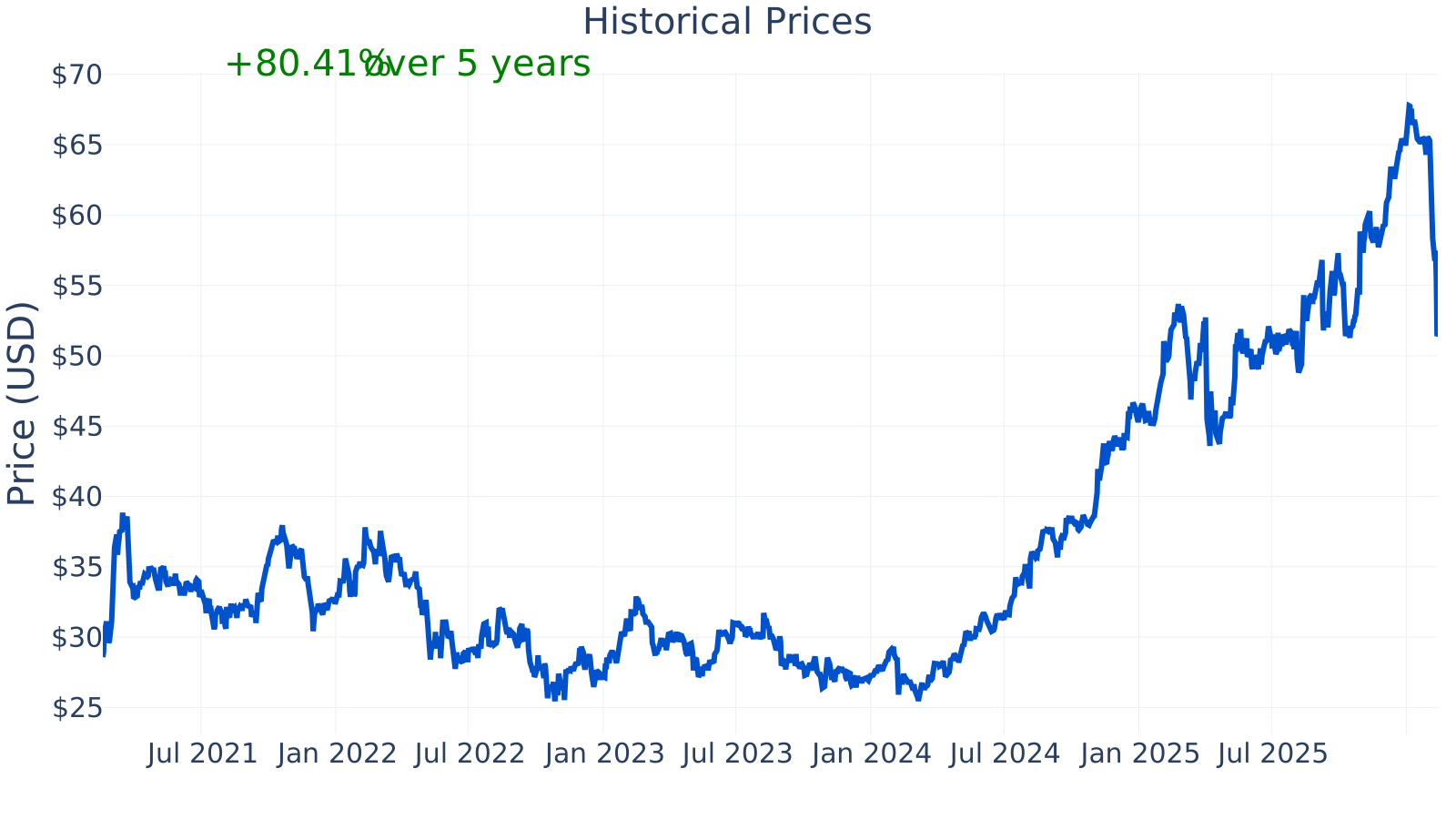
Fox’s market capitalization is about $24.1B. The stock’s beta of ~0.51 indicates that, historically, its price has tended to move less than the overall U.S. stock market. On valuation, Fox shows a P/E ratio of ~12.4 versus an industry median near 51.7, which is a notable gap (often associated with slower expected growth, higher perceived business risk, or both). Profitability appears comparatively strong in the snapshot: profit margin ~11.4% versus an industry median near 4.4%. Recent year-over-year revenue growth is ~2.0% versus an industry median around 5.5%, suggesting slower top-line expansion than peers on this measure. Leverage is moderate for the category with debt-to-equity ~76%, in line with the industry median. Trailing twelve-month free cash flow is about $2.54B, which can be important for funding operations, sports rights commitments, buybacks/dividends, and balance-sheet flexibility.
Growth (medium)
Fox operates in the U.S. media and entertainment industry, which has been reshaped by cord-cutting (declining traditional cable subscriptions), streaming competition, and shifting advertising demand. Within that landscape, categories that are watched live—especially sports and news—have tended to be more resilient than many other TV genres because real-time viewing supports advertising value and distributor willingness to pay carriage fees. Fox’s strategy (as described in filings) leans into these areas through FOX Sports and Fox News Media, alongside the FOX broadcast network and local stations.
The year-over-year revenue growth line shows meaningful swings: there are periods of contraction (notably in parts of FY2024) and periods of stronger growth (notably late FY2024 into FY2025), followed by a more modest rate most recently (about 2%). This pattern is consistent with a business that can be influenced by the timing of major sports programming, advertising markets, and comparisons against prior-year political advertising cycles.
Free cash flow also fluctuates across the timeline, ranging from roughly $1.08B (FY2024) to about $2.39B (FY2021 and FY2025). For long-term analysis, this variability matters because Fox’s content and sports rights ecosystem can require large, recurring commitments; strong free cash flow years can provide a cushion, while weaker years can tighten flexibility.
Potential catalysts that are commonly relevant for companies like Fox (and discussed at a high level in filings) include: the U.S. advertising cycle, the strength of live sports schedules, changes in distribution (traditional and streaming bundles), and contract renegotiations for channel carriage and sports/media rights.
Risks (high)
Fox’s main risks are structural and cycle-driven. A core long-term challenge is pay-TV subscriber erosion, which can pressure affiliate-fee revenue and negotiating leverage. Advertising is also cyclical and can weaken in economic slowdowns. In addition, media companies face ongoing audience fragmentation and competition for attention from large streaming platforms and digital video services.
Content costs are another major risk area. Sports rights in particular can be expensive and are often renegotiated periodically; unfavorable renewals can compress margins if affiliate fees and advertising do not keep pace. Regulatory and legal matters can also be financially material for news and broadcast businesses depending on circumstances, and reputational issues can affect audience and advertiser behavior.
Debt-to-equity trends mostly sit in a band around the mid-60% to low-90% range over the period shown, ending near 76%, roughly in line with the industry median. This suggests leverage that is not unusual for the peer group, but it still adds risk because interest costs and refinancing conditions can matter during periods of weaker advertising or heavier rights payments.
Profit margin is consistently above the industry median in the periods shown and ends around 11.4% versus an industry median near 5.0%. That relative profitability can be viewed as a sign of operational strength compared to many peers, although margins can still be pressured by ad downturns, rights-cost inflation, and distribution shifts.
On competitive position, Fox has clear strengths in specific categories: it is a major U.S. player in cable news and holds a meaningful position in sports broadcasting and local TV. However, it competes against very large media groups and platforms with broad ecosystems and deep content libraries. Key competitors typically include large diversified media companies (such as Disney, Comcast/NBCUniversal, Warner Bros. Discovery, and Paramount Global) as well as digital platforms competing for video time and advertising budgets. Fox’s advantage is concentration in live categories and a portfolio that is less dependent on financing a broad, global scripted streaming slate; the trade-off is exposure to the health of the U.S. pay-TV bundle and the economics of sports rights.
Valuation
Fox’s P/E ratio has generally stayed in the low-to-mid teens across the period shown, and it remains well below the industry median in the charted comparisons. In plain terms, that means the market has often priced Fox at a lower multiple of earnings than many “Entertainment” peers. This kind of valuation pattern can be consistent with a company that produces steady profits and cash flow but faces lower expected growth and higher structural uncertainty (for example, distribution disruption and sports-rights inflation).
Because valuation is ultimately tied to future outcomes, whether the current multiple is “high” or “low” depends on factors such as the durability of affiliate fees, the company’s ability to monetize live programming across new distribution formats, and how variable advertising and rights costs are over time. The company’s comparatively strong profit margin and sizable free cash flow are supportive fundamentals, while the slower recent revenue growth and industry disruption risks can help explain a lower earnings multiple versus peers.
Conclusion
Fox Corporation is a focused U.S. media business built around news, sports, broadcast entertainment, and local stations. The company shows comparatively strong profitability versus industry medians and has produced significant free cash flow, but its revenue growth has been uneven and, most recently, modest versus peers.
For long-term analysis, the central questions are less about whether video demand exists and more about how value is shared as audiences and distributors evolve: the pace of pay-TV declines, the economics of sports rights renewals, and the resilience of advertising and affiliate-fee streams. The stock’s consistently lower P/E versus the broader industry aligns with a business that can be cash-generative yet exposed to meaningful structural change and periodic earnings volatility.
Sources:
- SEC EDGAR — Fox Corporation Form 10-K (Annual Report)
- SEC EDGAR — Fox Corporation Form 10-Q (Quarterly Reports)
- Fox Corporation Investor Relations — SEC Filings and earnings materials (company-hosted)
- Wikipedia — “Fox Corporation” (basic company background)
This article is for informational purposes only and does not constitute financial advice. Some content is AI-generated. See Disclaimer