Stock Analysis · Fortive Corp (FTV)
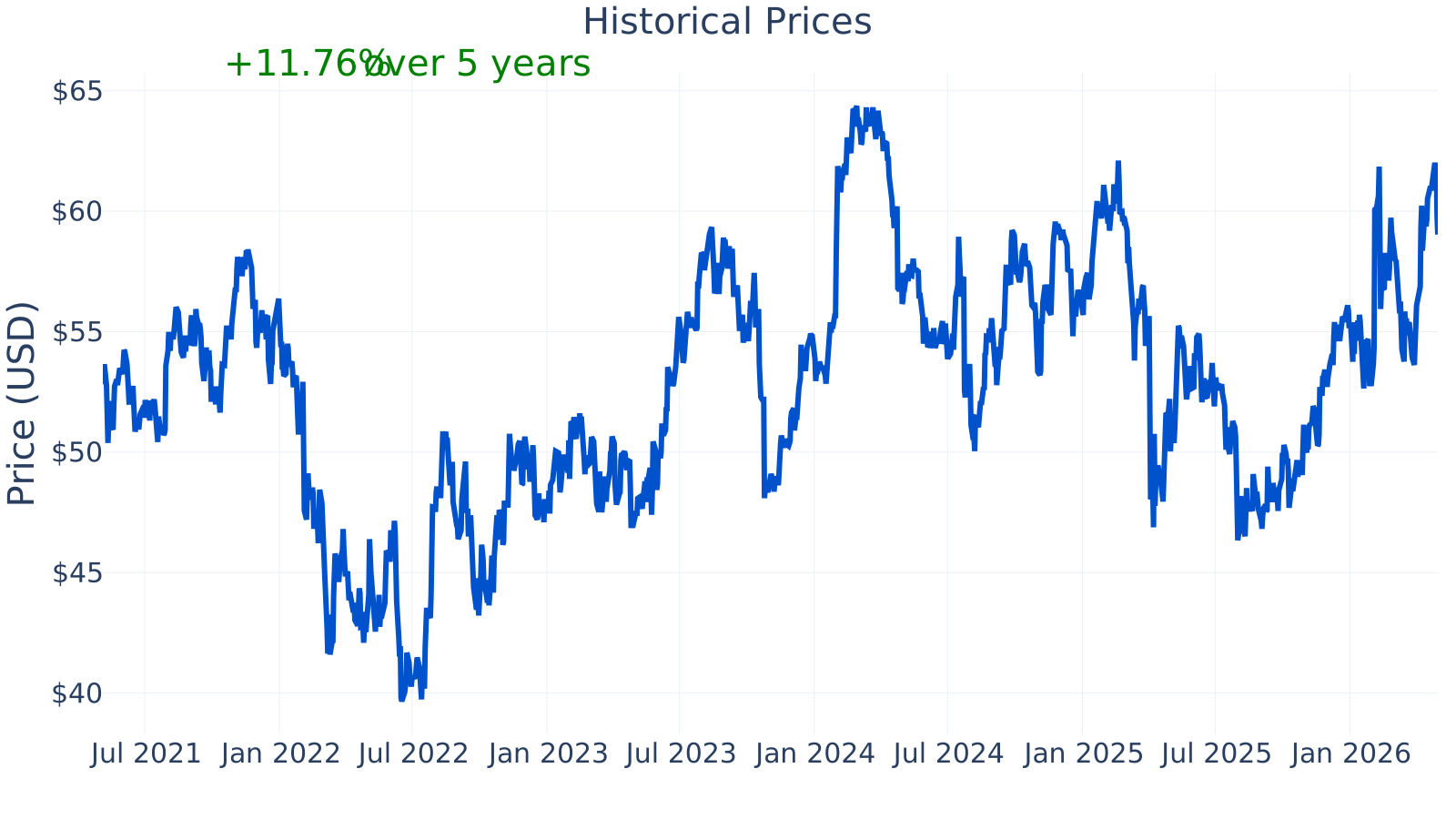
Overview
Fortive Corp (FTV) is a diversified industrial and technology company that sells equipment, software, and services used by businesses to measure, monitor, and improve how they operate. In simple terms, it provides tools that help customers work more efficiently, reduce downtime, improve quality, and stay compliant with safety and regulatory standards.
Fortive’s products and services are typically used in professional settings (manufacturing plants, laboratories, hospitals, utilities, and field service operations). This tends to make demand more tied to business investment cycles than to everyday consumer spending.
In its SEC filings, Fortive describes its business through operating segments (which can change over time as the company buys/sells businesses). Revenue is generally generated from a mix of:
- Products and instruments (hardware such as test, measurement, sensing, and specialized equipment)
- Software and subscription offerings (workflow and asset/service management tools in certain businesses)
- Services (maintenance, calibration, repairs, and related support)
Percentage splits by segment and by product vs. service are disclosed in annual reports and can vary year to year; the most reliable breakdown for any given year is the segment reporting section of Fortive’s latest Form 10-K.
Looking at the recent multi-year income statement mix, revenue rose from about $5.25B (2021) to about $6.23B (2024), before dropping to about $5.14B (2025). Over the same period, operating income and net income also declined in 2025, which suggests that the 2025 revenue reduction flowed through to profitability rather than being fully offset by cost reductions.
Key Figures
| Metric | Value | Industry ⓘ |
|---|---|---|
| Date | May 04, 2026 | |
| Context | ||
| Sector | Technology | |
| Industry | Scientific & Technical Instruments | |
| Market Cap ⓘ | $18.02B | |
| Beta ⓘ | 1.00 | |
| Fundamental | ||
| P/E Ratio ⓘ | 34.52 | 36.70 |
| Profit Margin ⓘ | 12.84% | 12.58% |
| Revenue Growth ⓘ | 7.70% | 8.10% |
| Debt to Equity ⓘ | 57.36% | 23.49% |
| PEG ⓘ | 1.29 | |
| Free Cash Flow ⓘ | $971.30M | |
Fortive’s market capitalization is about $18.0B, and its beta is ~1.01, which implies the stock has tended to move roughly in line with the broader market. The P/E ratio is ~34.5, slightly below the industry median shown here (~36.7). Profitability is close to peers, with a profit margin of ~12.8% versus an industry median of ~12.6%.
On growth, the latest year-over-year revenue growth shown is ~7.7% versus an industry median of ~8.1%, but the more recent quarterly trend (shown later) includes negative year-over-year readings. Fortive’s debt-to-equity is ~57%, which is notably higher than the industry median in this sample (~23%), and can be an important factor when comparing resilience across companies. The company generated about $971M in trailing twelve-month free cash flow, which is a key funding source for reinvestment, acquisitions, and shareholder returns.
Growth (medium)
Fortive operates in areas that are supported by long-term needs: industrial automation and reliability, quality and safety requirements, asset tracking and uptime, and more data-driven workflows. These themes can be durable over time because they are linked to cost reduction, compliance, and productivity, even if short-term spending fluctuates with the economic cycle.
A common element in Fortive’s strategy (as described in filings) is to improve operating performance and to reshape the portfolio over time through acquisitions and divestitures. This can create growth opportunities, but it can also make year-to-year comparisons less straightforward because the “same company” can change as businesses are added or removed.
The year-over-year revenue pattern shows a slowdown from strong growth in 2021–2022 to modest growth in 2023–2024, followed by negative readings in 2025 into early 2026 (roughly ranging from small declines to larger drops in certain quarters). For long-term context, this type of shift can reflect weaker end-market demand, business mix changes, or divestitures—investors typically confirm the “why” in the Management’s Discussion and Analysis section of the 10-K and in 10-Q updates.
Free cash flow increased from about $971M (2022) to about $1.39B (2025), then fell back to about $971M (2026 TTM). This matters because free cash flow is what remains after operating costs and capital spending, and it influences how much flexibility the company has to pay down debt, invest internally, or pursue acquisitions during weaker cycles.
Potential catalysts for future growth typically include: a recovery in customer capital spending, successful new product and software rollouts, and improved execution after portfolio changes. Another driver can be acquisitions, although their impact depends heavily on purchase price, integration quality, and whether growth and margins hold up after the deal closes.
Risks (medium-high)
Fortive’s end markets are largely business-to-business, so results can be pressured by slower industrial activity, delayed capital projects, and tighter customer budgets. In addition, because the company has used acquisitions and portfolio actions as part of its strategy, execution risk is meaningful: integration challenges, unexpected costs, and difficulties achieving planned synergies can affect margins and cash generation.
Leverage is a notable point. The latest debt-to-equity is about 57%, above the industry median shown (~23%). The historical trend also shows debt-to-equity rising into 2025–2026 compared with earlier periods (when it was closer to the high-20% to high-30% range). Higher leverage can increase sensitivity to interest rates and reduce flexibility during downturns, even when the business remains profitable.
Profit margins have generally been in the low-to-mid teens in recent years, and the latest value shown is about 12.8%. The chart indicates margins were stronger in parts of 2023–2024 (mid-teens at times) and then weakened into late 2025 and early 2026. If margins remain under pressure while revenue growth is negative, overall earnings power can be more volatile.
On competitive positioning, Fortive participates in multiple niches rather than one single market, which makes competition “segment by segment.” Competitive advantages often come from:
- Installed base and switching costs (customers may prefer to keep consistent measurement tools and workflows)
- Brand and reliability in specialized instrumentation and professional-grade tools
- Service and support capabilities that can reinforce recurring relationships
Competitors depend on the specific product category and segment, but large, well-resourced industrial and instrumentation companies commonly compete for similar customers. In many of Fortive’s niches, it may be a strong player without necessarily being the single dominant leader across the entire set of markets it touches. Assessing leadership is best done by looking at each reporting segment’s discussion in the 10-K, including market context and major customers.
Valuation
Fortive’s current P/E ratio is about 34.5, which is slightly below the industry median shown (~36.7). Historically, the chart shows Fortive’s P/E moved widely over time, with periods in the low 20s and more recent readings rising into the mid-30s. A higher P/E commonly implies the market is pricing in either stronger future growth, higher future margins, lower perceived risk, or some combination of these.
To judge whether that valuation level is justified, readers typically compare it with (1) the company’s growth trend, (2) stability of margins and free cash flow, and (3) balance sheet risk. In Fortive’s case, recent revenue growth has been weak to negative in the latest quarters shown, free cash flow has pulled back from prior highs, and leverage is higher than the peer median displayed here—factors that can matter when interpreting a mid-30s earnings multiple.
The PEG ratio shown (~1.29) is one simplified way to relate valuation to expected growth, but it depends heavily on forward growth assumptions. For long-term analysis, it is usually paired with a review of management’s guidance (if provided in filings and company materials), segment demand indicators, and the drivers behind recent margin changes.
Conclusion
Fortive is a diversified provider of professional-grade instruments, software, and services that help organizations run and maintain critical operations. The company has shown an ability to generate meaningful free cash flow across cycles, and profitability has generally been in line with peers in its industry group.
At the same time, the recent pattern shows slowing and then negative year-over-year revenue growth, pressure on profit margins compared with prior peaks, and a debt-to-equity level that is higher than the peer median presented here. These factors can increase sensitivity to economic conditions and make execution (especially around portfolio changes) more important.
From a valuation perspective, the current earnings multiple is near the industry range shown, so the market appears to be assigning Fortive a valuation consistent with many peers despite mixed near-term growth signals. A long-term assessment often centers on whether revenue growth and margins can re-accelerate while maintaining strong cash generation and keeping leverage at a comfortable level.
Sources:
- U.S. SEC — EDGAR: Fortive Corp Forms 10-K, 10-Q, and 8-K (Consolidated financial statements, segment reporting, risk factors)
- Fortive — Investor Relations materials and SEC filings (Annual report content and management discussion included in filed documents)
- Wikipedia — “Fortive” (Basic company background and history)
This article is for informational purposes only and does not constitute financial advice. Some content is AI-generated. See Disclaimer


