Stock Analysis · Fortinet Inc (FTNT)
Overview
Fortinet, Inc. is a cybersecurity company that helps organizations protect their networks, devices, cloud workloads, and applications. In simple terms, Fortinet sells tools that can block cyberattacks, manage secure access for employees and partners, and monitor suspicious activity across an IT environment.
A central part of Fortinet’s approach is the “Fortinet Security Fabric,” which is meant to connect many security functions together so customers can manage protection from a unified platform. The company is also known for building many of its security capabilities into purpose-built appliances (often called “next-generation firewalls”), while also offering software and cloud-delivered options.
From a revenue standpoint, Fortinet reports its business in two main categories (as described in its annual filings):
- Services (typically security subscriptions and support tied to its products; generally the larger portion of revenue in recent years)
- Product (hardware and software sold upfront; generally the smaller portion of revenue in recent years)
Fortinet sells globally, using a mix of direct sales and channel partners (such as distributors and resellers), which is common in enterprise technology markets.
Over the last several years, total revenue and net income both increased meaningfully. Operating expenses also rose, but profitability expanded, suggesting scale benefits as the company grew.
Key Figures
| Metric | Value | Industry ⓘ |
|---|---|---|
| Date | Feb 07, 2026 | |
| Context | ||
| Sector | Technology | |
| Industry | Software - Infrastructure | |
| Market Cap ⓘ | $63.42B | |
| Beta ⓘ | 1.05 | |
| Fundamental | ||
| P/E Ratio ⓘ | 34.20 | 25.66 |
| Profit Margin ⓘ | 28.58% | 6.68% |
| Revenue Growth ⓘ | 14.40% | 15.20% |
| Debt to Equity ⓘ | 80.51% | 19.82% |
| PEG ⓘ | 1.95 | |
| Free Cash Flow ⓘ | $2.23B | |
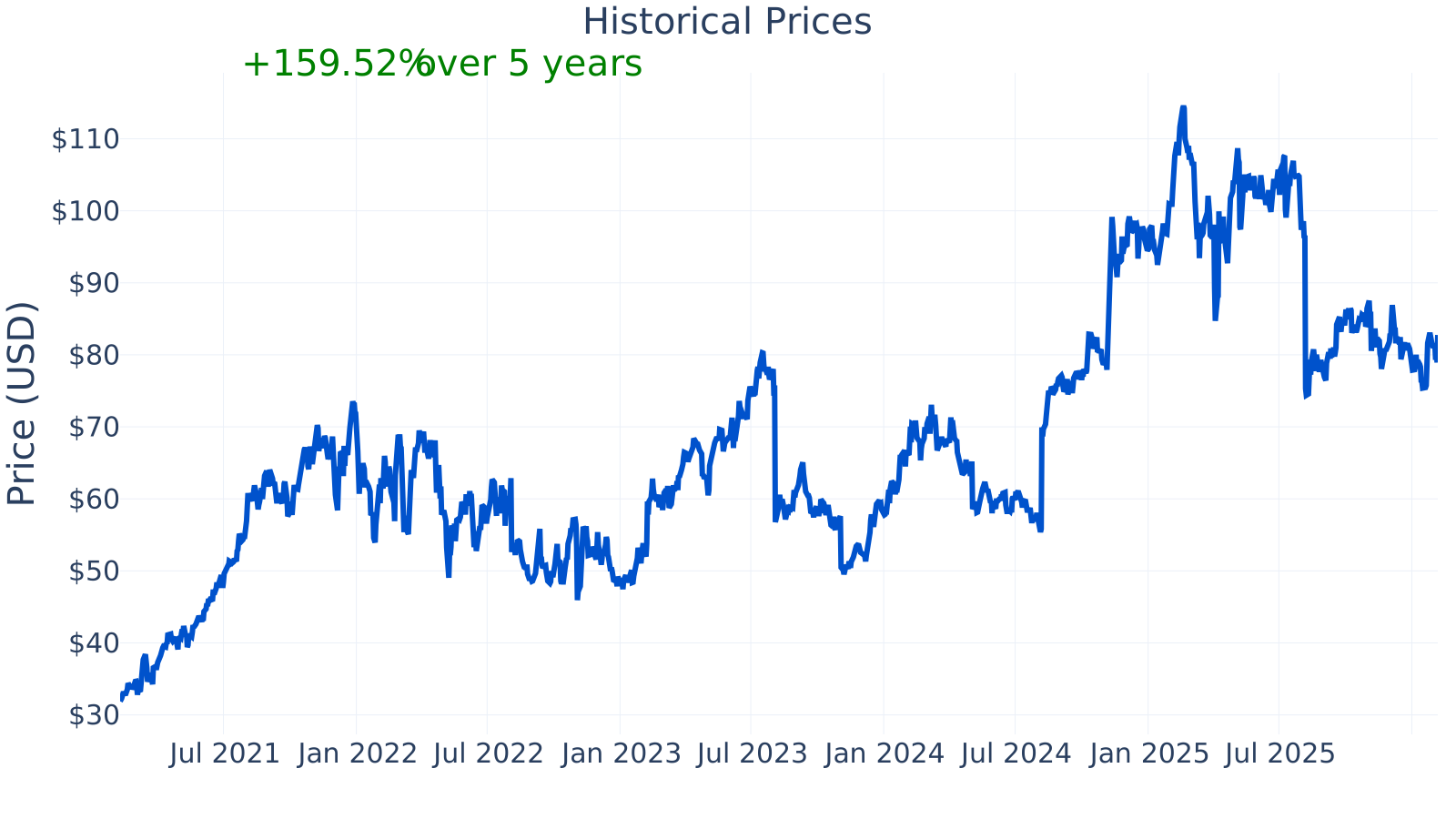
Fortinet’s market capitalization is about $63.4B. The stock’s beta (~1.05) indicates price moves that have been broadly similar to the overall market. Profitability stands out: the latest profit margin is ~28.6%, far above the industry median of about 6.7%. Recent year-over-year revenue growth is ~14.4%, close to the industry median (~15.2%). Leverage is higher than many peers: debt-to-equity is ~80.5% versus an industry median near 19.8%. Over the last twelve months, free cash flow is about $2.23B, indicating the business has been generating substantial cash after operating needs and capital spending.
Growth (Medium)
Cybersecurity is a structurally important area of technology because organizations continue to expand their digital footprints (cloud migration, remote/hybrid work, more connected devices) while cyber threats remain persistent. In that context, demand is often driven not only by “nice-to-have” projects, but also by ongoing risk management and compliance requirements.
Fortinet’s strategy focuses on offering a broad set of security capabilities that can be deployed across networks, endpoints, and cloud environments, with an emphasis on integrating them for simpler operations. This “platform” orientation can support growth if customers prefer fewer vendors and more consolidated security management—especially as environments become more complex.
The chart shows revenue growth slowing from very high rates earlier in the period to a more moderate pace recently (roughly the mid-teens in the latest points). That pattern can be consistent with a company scaling from a smaller base into a larger one, but it also means future results may depend more on execution, competitive positioning, and customer spending cycles than on early-stage expansion.
Free cash flow increased from roughly $0.93B (TTM ending 2021-03-31) to about $2.07B (TTM ending 2025-03-31), with the most recent value around $2.23B. For long-term business quality, steady cash generation can matter because it gives a company flexibility to invest in product development, go-to-market capabilities, and other strategic priorities.
Risks (Medium)
This article is for informational purposes only and does not constitute financial advice. Some content is AI-generated. See Disclaimer