Stock Analysis · FormFactor Inc (FORM)
Overview
FormFactor Inc. designs and manufactures specialized hardware used in semiconductor testing. In simple terms, its products help chipmakers and chip designers check whether chips work correctly and measure their performance during development and manufacturing. This testing step is important because modern chips are extremely complex, and small issues can cause major performance or reliability problems.
The company’s offerings are commonly described as:
- Probe cards used to electrically connect test systems to semiconductor wafers for wafer-level testing.
- Analytical probes and probe stations used in labs to characterize devices (measure behavior and performance) during research, development, and failure analysis.
- Related accessories and services that support installation, maintenance, and ongoing usage.
FormFactor reports revenue by product lines in its official filings, but the exact mix can shift over time with the semiconductor cycle and customer project timing. In general, probe cards have historically been the largest revenue contributor, with analytical systems and related products forming the remainder (exact percentages depend on the period and are disclosed in company filings).
Across the years shown, total revenue has fluctuated but remained in the same general range (roughly mid-$600M to high-$700M). Operating expenses have been fairly steady in absolute dollars, while profitability has moved up and down with revenue and gross profit changes—typical for companies tied to semiconductor capital spending and product cycles.
Key Figures
| Metric | Value | Industry ⓘ |
|---|---|---|
| Date | Feb 16, 2026 | |
| Context | ||
| Sector | Technology | |
| Industry | Semiconductor Equipment & Materials | |
| Market Cap ⓘ | $7.50B | |
| Beta ⓘ | 1.10 | |
| Fundamental | ||
| P/E Ratio ⓘ | 140.19 | 48.26 |
| Profit Margin ⓘ | 6.93% | 8.62% |
| Revenue Growth ⓘ | 13.60% | 12.90% |
| Debt to Equity ⓘ | 4.33% | 20.73% |
| PEG ⓘ | 0.71 | |
| Free Cash Flow ⓘ | $11.74M | |
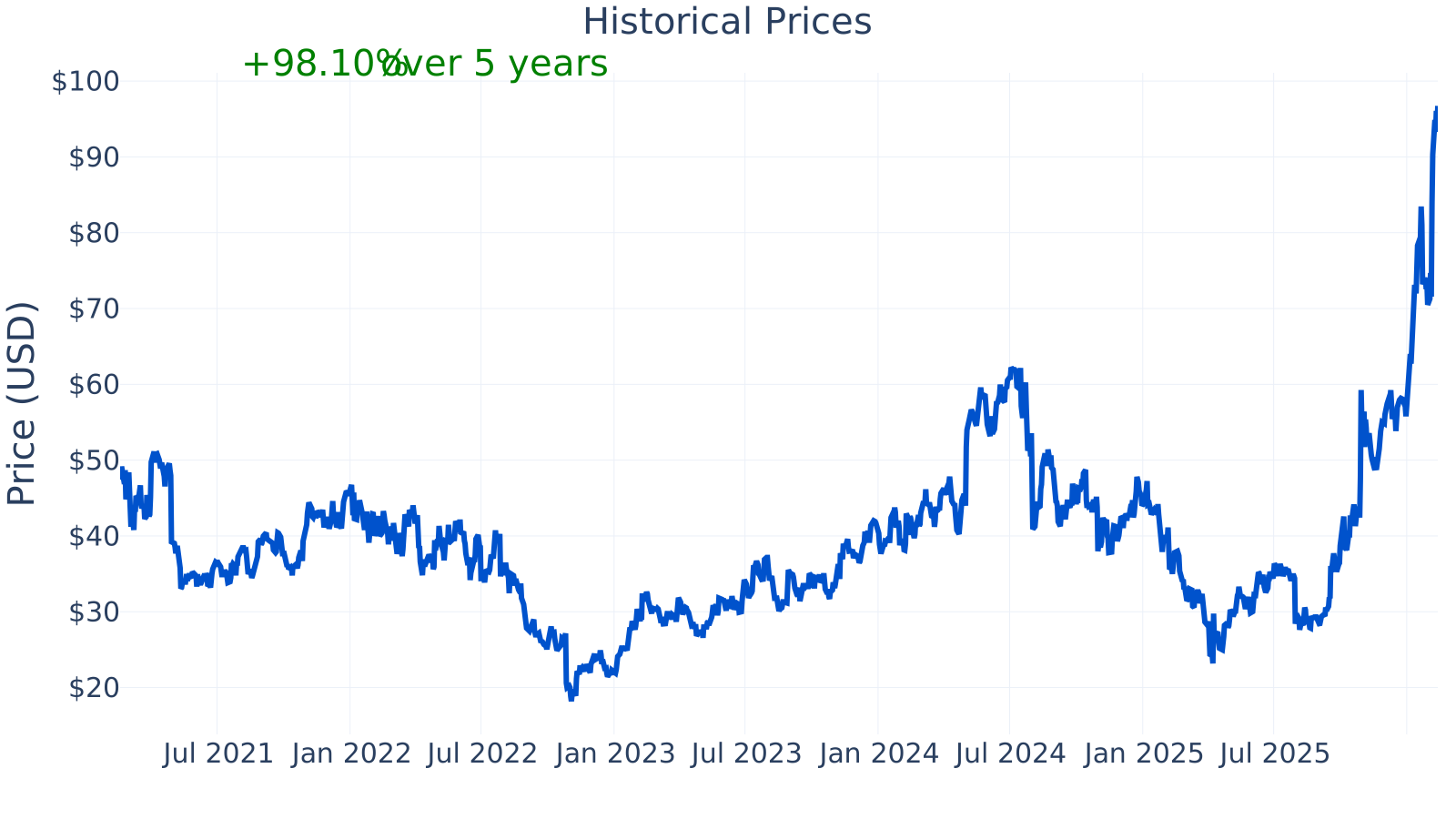
FormFactor’s market capitalization is about $7.5B. The stock’s beta of ~1.10 suggests price moves have been somewhat more volatile than the broader market. The latest P/E ratio (~140) is well above the industry median (~48), while the profit margin (~6.9%) is below the industry median (~8.6%). Revenue growth in the most recent year-over-year view is about 13.6%, slightly above the industry median (~12.9%). Balance-sheet leverage appears conservative: debt-to-equity is ~4.3% versus an industry median around 20.7%. Trailing twelve-month free cash flow is about $11.7M, which is positive but relatively modest for the company’s size.
Growth (Medium)
FormFactor operates in the semiconductor equipment and materials ecosystem, which is supported by long-term drivers such as continued growth in computing needs, rising chip complexity, and the increasing importance of advanced packaging and leading-edge process technologies. As chips become more difficult to design and manufacture, testing and measurement typically become more critical—supporting ongoing demand for sophisticated probing and lab characterization tools.
Potential catalysts are closely linked to semiconductor investment cycles and technology transitions. When customers ramp new chip designs (for example, moving to more advanced nodes, new memory generations, or more complex packaging approaches), testing requirements can rise, which may increase demand for higher-performance probe cards and related solutions. The company also invests in research and development, which can matter in a market where performance, precision, and time-to-market are key differentiators.
The year-over-year revenue growth pattern shows meaningful cyclicality: there were periods of negative growth around 2022–2023, followed by a rebound through parts of 2024, and mixed results again in 2025 before ending the year with a positive growth rate (about 13.6%). This unevenness is consistent with an industry where customer spending can shift quickly based on end-demand, inventory digestion, and the timing of new technology ramps.
Free cash flow over the trailing twelve-month periods shown declined from 2021 into 2023, then improved into 2024–2025. Even with improvement, the most recent trailing figure remains comparatively low versus earlier periods, highlighting that cash generation can vary substantially with profitability, working capital needs, and investment levels.
Risks (High)
The most important risk is cyclicality. Semiconductor equipment demand often rises and falls with customer capital spending, utilization rates, and the timing of large technology transitions. This can lead to uneven revenue, changing factory utilization, and swings in margins from year to year.
Customer concentration can also matter in semiconductor supply chains. Large chip manufacturers and foundries can represent significant portions of demand, and purchasing decisions may change with internal roadmaps, dual-sourcing strategies, or efforts to negotiate pricing. In addition, FormFactor’s products must meet strict technical requirements; execution risk includes quality, delivery timing, and maintaining performance leadership as chip architectures evolve.
Financial leverage appears relatively low. Debt-to-equity has generally trended down over the period shown and sits around 4% most recently, well below the industry median (roughly in the low-20% range). Lower leverage can reduce financial risk during downturns, although it does not eliminate operational cyclicality.
Profitability has been volatile. Net profit margin moved from low double digits in 2021–2022 to near zero/negative in parts of 2023, then rose strongly in 2024 before settling back to mid-single digits in 2025 (about 6.9% most recently). Compared with the industry median, margins were competitive during parts of 2024 but are currently slightly below the median.
Competition is another key risk. FormFactor competes with other probe card suppliers and companies offering probing/measurement solutions. Competitive positioning typically depends on factors such as test accuracy, ability to support advanced nodes, reliability at high volumes, lead times, and total cost of ownership. Leadership can vary by specific application (logic vs. memory, R&D vs. production, and different packaging approaches), so competitive advantage is best viewed as “segment-by-segment” rather than absolute across all semiconductor testing needs.
Valuation
Valuation signals look mixed. The company’s latest P/E ratio (about 140) is substantially higher than the industry median (about 48). The historical P/E line also shows that FormFactor’s multiple has at times moved well above the industry median, reflecting that earnings (the “E” in P/E) can swing materially with the cycle. When earnings temporarily fall, the P/E can rise even if the stock price does not increase, which can make P/E a less stable measure for cyclical businesses.
In this context, interpreting whether the current price is “expensive” or “cheap” depends heavily on expectations for future earnings normalization and the durability of growth drivers. The company’s relatively low debt levels reduce balance-sheet risk, but profitability variability and modest recent free cash flow add uncertainty to valuation comparisons that rely on a single-period earnings number.
Conclusion
FormFactor is a semiconductor testing-focused company whose results tend to follow industry cycles, with periods of strong profitability and periods of margin pressure. Long-term demand drivers for semiconductors and increasing chip complexity support the relevance of advanced probing and measurement, and recent year-over-year revenue growth is positive. At the same time, the business shows meaningful variability in revenue growth, profit margins, and cash generation.
From a fundamentals-only perspective, the balance sheet appears conservatively levered, while current valuation metrics (notably P/E) look elevated versus the industry median and can be sensitive to cyclical earnings. The main facts to weigh are the industry’s cyclical nature, FormFactor’s ability to sustain product competitiveness through R&D and execution, and whether future profitability can remain more stable than in prior down-cycles.
Sources:
- U.S. Securities and Exchange Commission (SEC) EDGAR — FormFactor Inc. filings (Form 10-K, Form 10-Q)
- FormFactor Inc. Investor Relations — SEC filings and quarterly/annual materials (company-hosted)
- Wikipedia — “FormFactor” (company background, high-level description)
This article is for informational purposes only and does not constitute financial advice. Some content is AI-generated. See Disclaimer


