Stock Analysis · Floor & Decor Holdings Inc (FND)
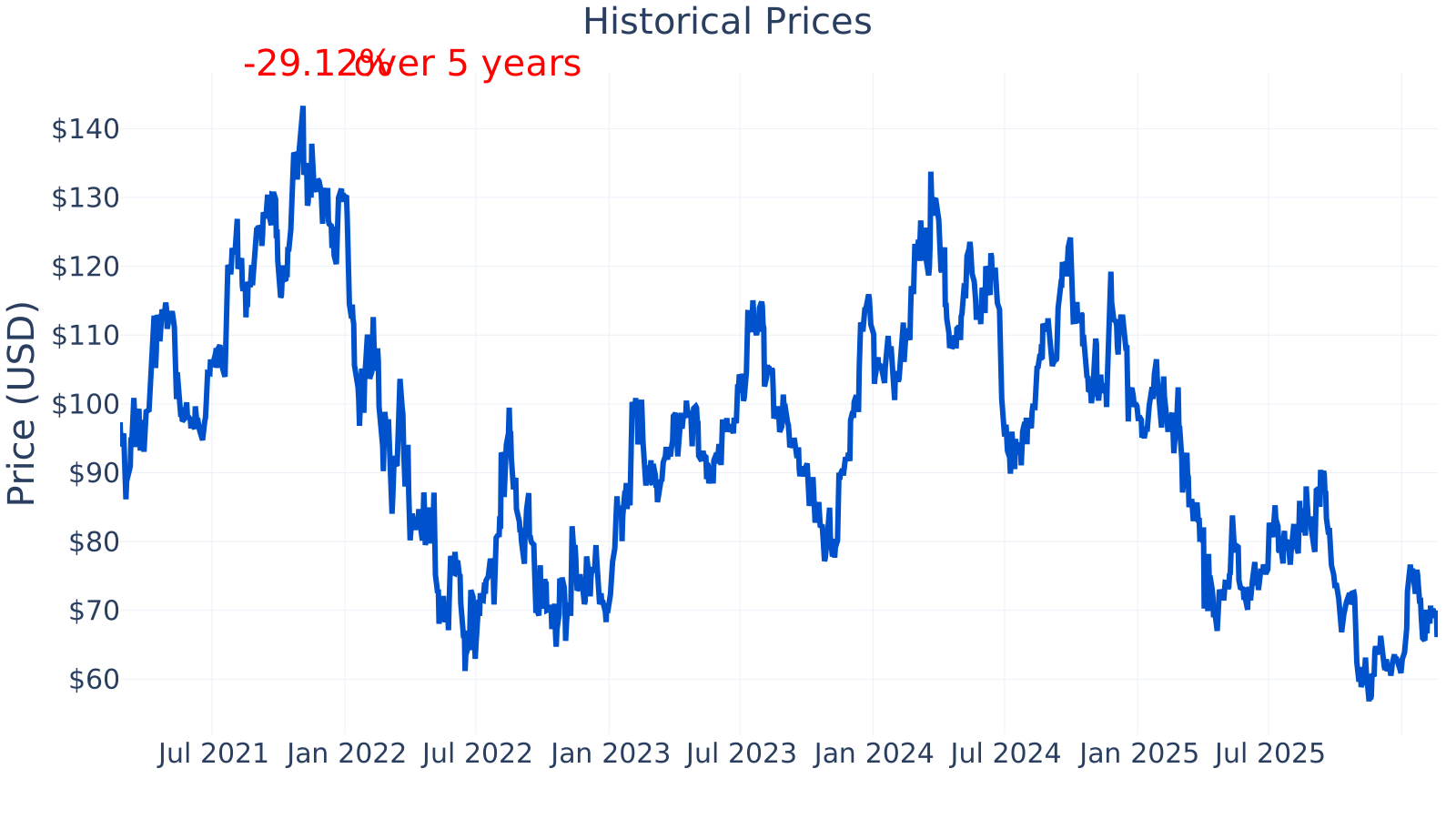
Overview
Floor & Decor Holdings, Inc. is a specialty retailer focused on hard-surface flooring and related accessories. It sells products such as tile, wood, laminate, vinyl, natural stone, and installation materials. The company’s stores are designed to carry a wide assortment at warehouse-style scale, serving both retail customers and professional installers/contractors.
Operationally, the business is built around large-format stores, centralized purchasing, and distribution capabilities intended to support in-stock availability across many product types. Demand for the company’s products is closely tied to repair-and-remodel spending and housing-related activity, because flooring purchases often happen during renovations, home turnover, or new construction finishing.
From a revenue perspective, Floor & Decor primarily earns money from selling merchandise (flooring and accessories) through its stores and digital channels. Public filings typically emphasize total net sales and comparable store sales rather than breaking revenue into many separate reportable lines.
Looking across recent years in the financial flow summary, total revenue increased from about $3.43B (2021) to about $4.68B (2025), while net income moved from about $283M (2021) to about $209M (2025). That combination suggests growth in sales alongside a lower bottom-line level than earlier years, which can happen when costs and operating expenses rise faster than revenue in a tougher demand environment.
Key Figures
| Metric | Value | Industry ⓘ |
|---|---|---|
| Date | Feb 23, 2026 | |
| Context | ||
| Sector | Consumer Cyclical | |
| Industry | Home Improvement Retail | |
| Market Cap ⓘ | $7.43B | |
| Beta ⓘ | 1.74 | |
| Fundamental | ||
| P/E Ratio ⓘ | 34.49 | |
| Profit Margin ⓘ | 4.45% | |
| Revenue Growth ⓘ | 2.00% | |
| Debt to Equity ⓘ | 150.74% | |
| PEG ⓘ | 2.20 | |
| Free Cash Flow ⓘ | $64.07M | |
Floor & Decor’s market capitalization is about $7.43B. The stock’s beta of 1.74 indicates it has historically moved more than the overall market (higher volatility). Profit margin is about 4.45%, which is a relatively thin net margin typical of many retailers. Year-over-year revenue growth is about 2.0%, indicating a slower growth phase compared with the higher growth rates seen earlier in the period shown later in this article. Debt-to-equity is about 151%, and free cash flow over the trailing twelve months is about $64.1M. The P/E ratio is about 34.5, and the PEG ratio is about 2.2, both of which are commonly interpreted as “growth is being priced in,” though they are not decisive on their own.
Growth (Medium)
Floor & Decor operates in home improvement retail, which is supported over the long run by housing turnover, aging housing stock, remodeling activity, and consumer spending on home upgrades. That said, the category is cyclical: when interest rates are high or housing activity slows, big-ticket renovation projects can be delayed. In other words, the industry can grow over time, but results can vary significantly year to year depending on the housing and remodeling cycle.
The company’s strategy centers on expanding its store base, increasing awareness with both homeowners and professional customers, and using scale to improve product sourcing and availability. For a retailer, a straightforward long-term growth engine is store expansion plus productivity improvements at existing locations (often discussed as “comparable store sales” in filings). If store openings continue at a healthy pace and new stores mature well, total sales can still trend upward even in periods when same-store demand is softer.
The revenue growth pattern shows a clear slowdown from very high growth rates earlier in the period (for example, triple-digit growth at one point in 2021) toward low single-digit growth more recently (around 2% at the latest point shown). This shift is consistent with a maturing base of stores and a less favorable home-improvement demand backdrop, and it raises the importance of execution (store economics, customer mix, and cost control) to sustain longer-term growth.
Free cash flow has fluctuated materially across the period shown, including negative periods and then a return to positive territory (about $64M on a trailing twelve-month basis). For a store-expansion retailer, uneven free cash flow can reflect investment in new stores, inventory, and distribution capacity. Over time, consistently positive free cash flow can provide more flexibility for reinvestment and balance sheet strength, while prolonged negative free cash flow can increase reliance on financing.
Risks (High)
A key risk for Floor & Decor is economic sensitivity. Flooring is often a discretionary purchase tied to renovations; if consumers delay projects, sales volumes can soften. The business can also face cost pressures (freight, labor, occupancy, and product costs), and retail competition can force pricing actions that affect profitability.
Competitive dynamics are another major consideration. Floor & Decor competes with large home improvement chains (such as The Home Depot and Lowe’s), specialty flooring retailers, and local/regional dealers. The company’s differentiation is its specialized assortment, focus on hard surfaces, and warehouse-style model, but competitors may respond with promotions, expanded assortments, or service offerings. Scale and purchasing power matter in retail; larger rivals may have advantages in distribution reach, brand recognition, and cross-category shopping trips.
In terms of competitive position, Floor & Decor is a leading specialist in hard-surface flooring retail in the U.S., but it is not the overall category leader in home improvement retail when compared with the largest big-box chains. That places extra emphasis on maintaining a clear value proposition (assortment depth, in-stock availability, and pricing) and continuing to execute store growth without diluting returns.
The debt-to-equity line shows a move from roughly the 80%–110% range through much of 2021–2024 to about 151% at the most recent point shown. A higher ratio can indicate increased financial leverage or a change in equity levels, and it can reduce flexibility during weaker demand periods, particularly if cash generation is uneven.
Profit margin has trended down over the period shown, from around 8%–9% in 2021 to roughly 4%–5% more recently (about 4.45% at the latest). For long-term outcomes, margins matter because small percentage changes in retail profitability can have an outsized impact on net income, especially when sales growth slows.
Valuation
Valuation is often discussed in terms of how much the market is paying for current earnings and expected growth. Floor & Decor’s current P/E ratio is about 34.5, which is commonly associated with companies where the market expects meaningful longer-term growth and/or a rebound in profitability. The PEG ratio of about 2.2 (a ratio that relates P/E to growth expectations) suggests that, under typical interpretations, the price may be embedding substantial growth assumptions rather than being priced purely on current, slower growth.
The historical P/E chart shows the multiple moving widely over time, reaching much higher levels earlier in the period and declining more recently to the low-to-mid 30s. This kind of swing can happen when earnings fluctuate (as margins change) and when market sentiment shifts about future growth. When profit margins and revenue growth are lower than in prior years, a higher earnings multiple generally requires confidence that growth and/or margins can improve over time; if not, valuation can look demanding relative to current fundamentals.
Conclusion
Floor & Decor is a specialized hard-surface flooring retailer with a store-expansion model and revenue tied to home improvement demand. Over recent years, sales have grown to a larger base, but profitability (net margin) has declined compared with earlier levels, and revenue growth has slowed to low single digits in the latest period shown.
The long-term narrative depends on execution through the housing/remodel cycle: sustaining productive new store openings, strengthening demand with professional customers, and improving cost discipline enough to stabilize or rebuild margins. The main areas to watch are the cyclicality of renovation spending, competitive pricing pressure from larger retailers and other specialists, the company’s ability to generate consistently positive free cash flow while investing for growth, and balance sheet leverage as reflected in the higher debt-to-equity level most recently.
Sources:
- SEC EDGAR — Floor & Decor Holdings, Inc. Form 10-K (Annual Report)
- SEC EDGAR — Floor & Decor Holdings, Inc. Form 10-Q (Quarterly Report)
- Floor & Decor Investor Relations — Press Releases and Shareholder Materials
- Floor & Decor Investor Relations — Earnings Call Materials / Transcripts (company-hosted, if available)
- Wikipedia — “Floor & Decor” (basic company background)
This article is for informational purposes only and does not constitute financial advice. Some content is AI-generated. See Disclaimer


