Stock Analysis · Five9 Inc (FIVN)
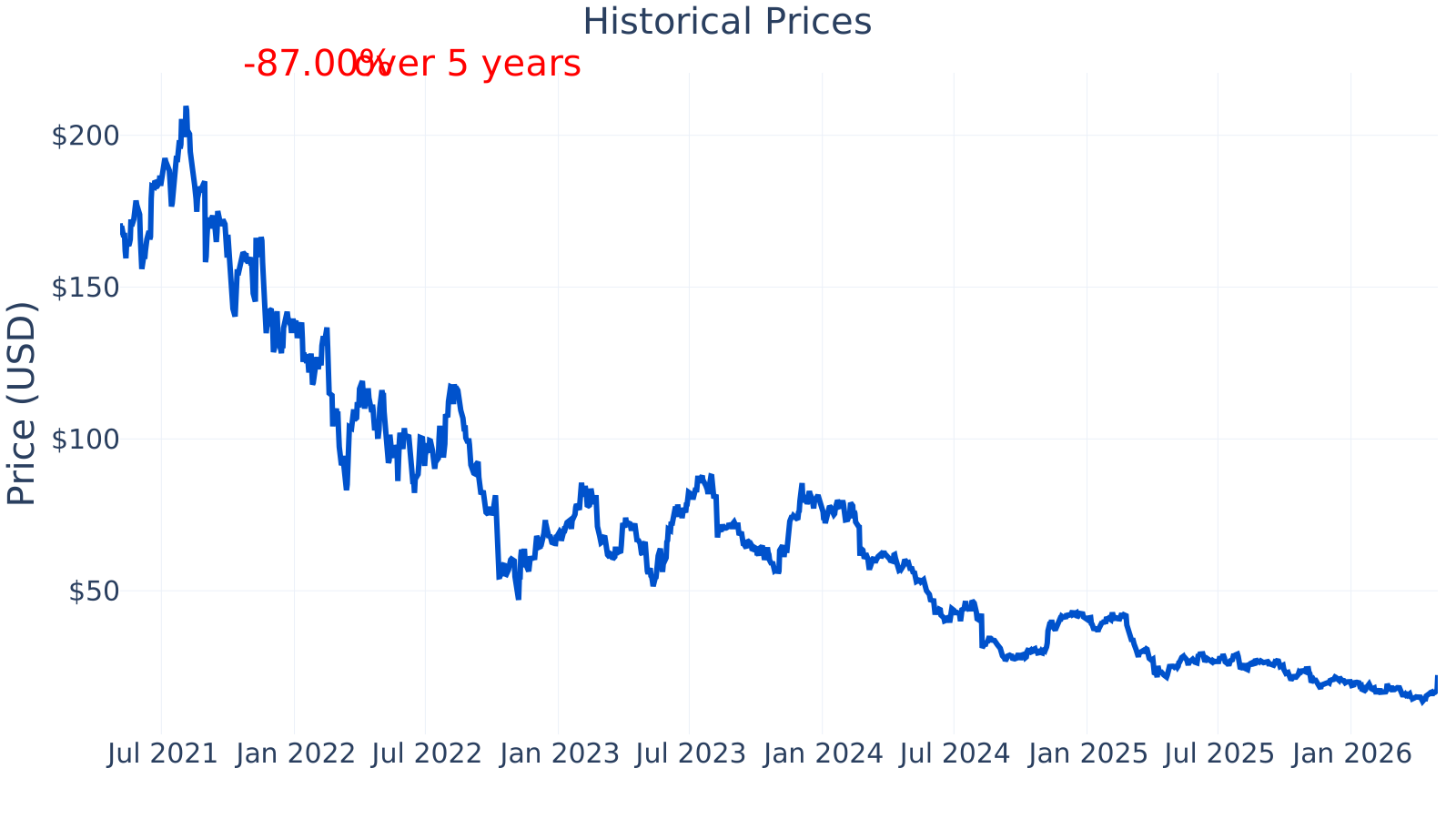
Overview
Five9 Inc is a software company focused on cloud-based contact center solutions. In plain terms, it provides the tools that businesses use to run customer service and sales interactions across phone, chat, email, and messaging, with features such as call routing, reporting, automation, and workforce tools. Five9 delivers its platform primarily as a subscription service (software delivered over the internet), which tends to create recurring revenue as customers pay over time rather than buying a one-time license.
In its SEC filings, Five9 typically describes revenue as coming primarily from subscription fees for access to its platform and related services, plus a smaller portion from professional services (implementation, training, and similar support work). Based on how the business is generally described in filings, the main revenue streams can be summarized as:
- Subscription revenue (recurring fees to use the cloud platform; typically the largest component)
- Professional services and other revenue (implementation, training, and related services; generally smaller)
From an overall profitability perspective, Five9’s income statement trend shows a company that has scaled revenue meaningfully over the past several years and has worked toward improved operating results, reaching positive operating income in 2025 after earlier losses.
Across 2021–2025, total revenue increased from about $610M (2021) to about $1.15B (2025). Over the same period, operating income moved from a loss (2021–2023) to a small profit in 2024 and a larger profit in 2025, while net income also turned positive in 2025. This pattern is consistent with a software business attempting to balance growth spending (research and development plus sales and marketing) with improving efficiency as scale increases.
Key Figures
| Metric | Value | Industry ⓘ |
|---|---|---|
| Date | May 04, 2026 | |
| Context | ||
| Sector | Technology | |
| Industry | Software - Infrastructure | |
| Market Cap ⓘ | $1.70B | |
| Beta ⓘ | 1.32 | |
| Fundamental | ||
| P/E Ratio ⓘ | 34.22 | 29.58 |
| Profit Margin ⓘ | 4.87% | 6.71% |
| Revenue Growth ⓘ | 9.20% | 18.30% |
| Debt to Equity ⓘ | 96.47% | 24.92% |
| PEG ⓘ | 0.22 | |
| Free Cash Flow ⓘ | $206.24M | |
Five9’s market capitalization is about $1.70B, which places it in the smaller end of publicly traded software companies. The stock’s beta of ~1.33 indicates it has tended to move more than the broader market (higher volatility). On profitability, the latest profit margin is ~4.9%, below the industry median (~6.7%), but notably improved versus prior periods when margins were negative. The latest year-over-year revenue growth is ~9.2%, also below the industry median (~18.3%), suggesting a slower growth profile than many peers at the moment. Leverage stands out: debt-to-equity is ~96% versus an industry median near 25%, meaning the balance sheet is more debt-heavy than the typical company in its software peer group. At the same time, Five9 shows strong cash generation recently, with trailing twelve-month free cash flow of about $206M.
Growth (medium)
Five9 operates in the contact center software market, which has benefited from long-term shifts toward cloud adoption and the modernization of customer service operations. Many organizations continue replacing older on-premises call center systems with cloud platforms to gain flexibility, easier upgrades, and more integrated digital channels (voice plus chat/messaging). This broader shift can support demand over multi-year periods, especially as businesses aim to improve customer experience and agent productivity.
Strategically, Five9’s approach aligns with these trends: it is a cloud-native platform and positions itself around enabling customer engagement across multiple channels, automation, analytics, and integrations with other enterprise software. Over time, the most important growth question typically becomes whether the company can keep expanding within existing customers (more seats, more features) and keep winning new enterprise accounts while maintaining pricing power in a competitive category.
Revenue growth has slowed substantially from earlier high rates. Quarterly year-over-year growth was above 30%–40% in 2021, stepped down through 2022–2024, and is most recently around 9% (2026-03-31). A slowdown like this can reflect maturation, tougher comparisons, or a more competitive selling environment; it also raises the importance of execution (retention, upsell, and new customer wins) to re-accelerate.
Cash generation has improved meaningfully. Free cash flow moved from slightly negative (about -$3.5M in 2022-03-31) to about $206M by 2026-03-31. For long-term business durability, sustained positive free cash flow can matter because it indicates the company is generating cash after operating expenses and capital needs.
Risks (high)
A key risk is competitive pressure in cloud contact center software. The category includes large software vendors and well-funded specialists, and buyers often run formal procurement processes where price, reliability, and feature breadth are compared. Competition can pressure growth rates and margins, and it can also increase sales and marketing costs if customer acquisition becomes harder.
Another important risk area is profitability consistency. While Five9 has recently moved into positive net income territory (based on annual figures), its margin history shows multiple years of losses before turning positive. If revenue growth remains slower, the company may have less room to increase spending while still expanding margins, which can make results more sensitive to execution.
Balance sheet structure is also a notable point of attention.
Debt-to-equity has improved dramatically from very high levels earlier in the period (above 300%–500% in 2021–2022) down to about 96% most recently, but it remains well above the industry median (roughly 19%–33% over the period shown). Higher leverage can increase financial risk, especially if interest expense rises or if operating performance weakens.
Profitability has improved from around -9% to -12% margins in 2021–2022 to a positive margin of about 4.9% most recently. However, the peer median is higher (around 7% recently), so Five9 still has ground to cover if it aims to match typical industry profitability.
In terms of competitive advantages, Five9’s strengths are generally associated with a specialized focus on contact center workflows, enterprise-grade features, and a cloud delivery model that supports recurring revenue. Still, leadership in this space is contested; the market includes both large platform companies and other specialists, and vendor position can vary by customer segment and deployment needs.
Main competitor groups commonly referenced in company filings and industry discussions include:
- Cloud contact center specialists (other providers focused primarily on contact center software)
- Large software and communications platforms (vendors offering broader suites that include contact center functionality)
- Legacy/on-premises vendors (incumbents modernizing or migrating customers to newer offerings)
Valuation
At a basic level, valuation is about how the market price compares to earnings power and growth expectations. Five9’s latest P/E ratio is about 34.2, which is above the software infrastructure industry median of about 29.6. When a company trades above the peer median on P/E, the market is often implying either stronger future growth, expanding profitability, lower perceived risk, or some mix of these factors.
The P/E history shown is limited because the ratio is not meaningful when earnings are negative (those periods are not displayed). In the most recent periods where earnings-based valuation is visible, Five9’s P/E moved down from a very high level (around 266.8 in 2025-08-11) toward 39.3 by 2026-02-10, which is closer to (but still above) the industry median near the high 20s to low 30s. This compression can happen when either earnings improve, the stock price declines, or both.
Whether today’s valuation is “expensive” depends heavily on forward outcomes that are uncertain: if revenue growth stays near the current high-single-digit pace, the valuation may rely more on continued margin expansion and durable free cash flow; if growth re-accelerates, a higher multiple can be easier to justify. The current setup shows a company with improving profitability and cash flow, but also with slower growth than the industry median and higher leverage than typical peers.
Conclusion
Five9 is a cloud software provider focused on contact centers, a category supported by long-term adoption of cloud-based customer engagement tools. Financially, the company has shown a clear shift toward improved operating performance: revenue has grown from roughly $610M (2021) to about $1.15B (2025), margins have moved from meaningfully negative to modestly positive, and free cash flow has increased to about $206M on a trailing twelve-month basis.
The main offsetting considerations are a notable slowdown in revenue growth to around 9% year-over-year, a competitive environment with strong rivals, and a debt-to-equity level that remains above the industry median despite improvement. On valuation, the stock’s P/E is modestly above the peer median, which places extra emphasis on sustained profitability gains and steady execution.
Sources:
- SEC EDGAR — Five9 Inc — Form 10-K (Annual Report) (business description, risk factors, financial statements)
- SEC EDGAR — Five9 Inc — Form 10-Q (Quarterly Report) (updates to performance, financial statements)
- Five9 Inc Investor Relations — SEC Filings (company-hosted access to 10-K/10-Q and related materials)
- Wikipedia — “Five9” (basic company background)
This article is for informational purposes only and does not constitute financial advice. Some content is AI-generated. See Disclaimer


