Stock Analysis · Fiserv Inc (FISV)
Overview
Fiserv Inc. is a financial technology company that provides payments and financial services technology to banks, credit unions, merchants, and other businesses. In simple terms, it helps move money securely and efficiently: processing card payments, enabling digital banking features (like mobile banking and account services), supporting core systems used by financial institutions, and offering tools that help merchants accept payments in-store and online.
The company’s revenue is largely tied to recurring, high-volume activity (such as payment processing), plus long-term client relationships with financial institutions and merchants. That type of business model can be resilient because it is linked to ongoing transaction flows and mission-critical software.
Main sources of revenue are typically described through Fiserv’s reporting segments (exact mix can change over time and is detailed in the company’s annual report):
- Merchant Acceptance (services that help businesses accept card and digital payments, including Clover-related offerings)
- Financial Technology (core processing and digital solutions for banks and credit unions)
- Payments and Network (card services, bill payment, and network-based payment solutions)
Across these areas, revenue tends to come from a combination of transaction-based fees (when payments happen), subscription-like software and service fees, and platform/service contracts.
Over the period shown, total revenue trends upward (from about $16.2B in 2021 to about $21.2B in 2025). Operating income also rises over time, while interest expense increases notably (from about $696M in 2021 to about $1.49B in 2025), which is consistent with a more debt-heavy capital structure and/or higher interest rates.
Key Figures
| Metric | Value | Industry ⓘ |
|---|---|---|
| Date | May 04, 2026 | |
| Context | ||
| Sector | Technology | |
| Industry | Software | |
| Market Cap ⓘ | $33.23B | |
| Beta ⓘ | N/A | |
| Fundamental | ||
| P/E Ratio ⓘ | 9.80 | |
| Profit Margin ⓘ | N/A | |
| Revenue Growth ⓘ | N/A | |
| Debt to Equity ⓘ | 112.91% | |
| PEG ⓘ | 1.01 | |
| Free Cash Flow ⓘ | $4.32B | |
Based on the latest metrics shown, Fiserv’s market capitalization is about $33.2B and its trailing P/E ratio is about 9.8. Free cash flow over the trailing twelve months is about $4.32B. The debt-to-equity ratio is about 113%, which indicates meaningful leverage. The table also shows a PEG ratio near 1.01 (a metric that relates valuation to growth expectations). Some fields (such as beta, and the table’s profit margin and revenue growth entries) appear blank/zero here, so the trend charts below are more informative for those items.
Growth (medium)
Fiserv operates in a long-term growth area: the ongoing shift from cash and checks to digital payments, plus the modernization of banking technology and customer-facing digital experiences. Even in mature markets, payments volumes can grow with economic activity, e-commerce penetration, and the expansion of digital wallets and real-time payment options.
Strategically, the company is positioned across both sides of the ecosystem—financial institutions and merchants—which can create cross-selling opportunities (for example, enabling a merchant to accept payments while also offering software tools to manage the business, or providing banks with digital features that drive more electronic transactions).
The year-over-year revenue growth rate generally trends down over time. It moves from double-digit growth (roughly 10%–17% in 2021) toward mid-single digits in 2024–2025, reaching very low single digits in the most recent points shown (around 0.6%–0.9% late in 2025). This pattern suggests the company’s recent growth has cooled, which makes future results more dependent on execution, product expansion, and broader transaction/merchant activity rather than strong tailwinds alone.
Free cash flow increases from about $2.64B (2022) to about $4.96B (2025), with a relatively stable level in 2023–2024 before the step-up in 2025. For a business like Fiserv, sustained free cash flow can matter because it supports debt repayment, share repurchases, and ongoing investment in technology.
Risks (medium)
Fiserv’s main risks are tied to competition, regulation, technology execution, and its capital structure. Payments and banking technology are heavily regulated and operationally sensitive—service outages, security incidents, or failures to keep up with evolving standards can harm reputation and client retention. In addition, merchant and payment volumes can be influenced by economic slowdowns, which may reduce transaction-based revenue growth.
Competition is intense. Fiserv faces large, well-funded rivals across different parts of its business (payments processing, merchant acquiring, and banking technology). Competitive pressure can show up as pricing pressure, higher sales/marketing costs, or the need for higher ongoing product investment. In terms of advantages, established scale, deep integration with clients’ systems, and switching costs (it can be difficult and risky for banks/merchants to change core providers) can support retention, but these advantages do not eliminate competition.
The debt-to-equity ratio rises over the period shown—from roughly 66% in mid-2021 to about 113% by the end of 2025. Higher leverage can amplify outcomes: it may enhance returns when business conditions are favorable, but it can also increase sensitivity to interest rates and refinancing conditions.
Profit margin improves meaningfully from about 7%–8% in 2021 to the mid-teens by 2023–2025 (roughly 15%–17% in many quarters shown). That suggests improved profitability and/or operating leverage, although margins fluctuate quarter to quarter. A key watch item is whether higher interest expense and competitive costs limit further margin expansion.
Valuation
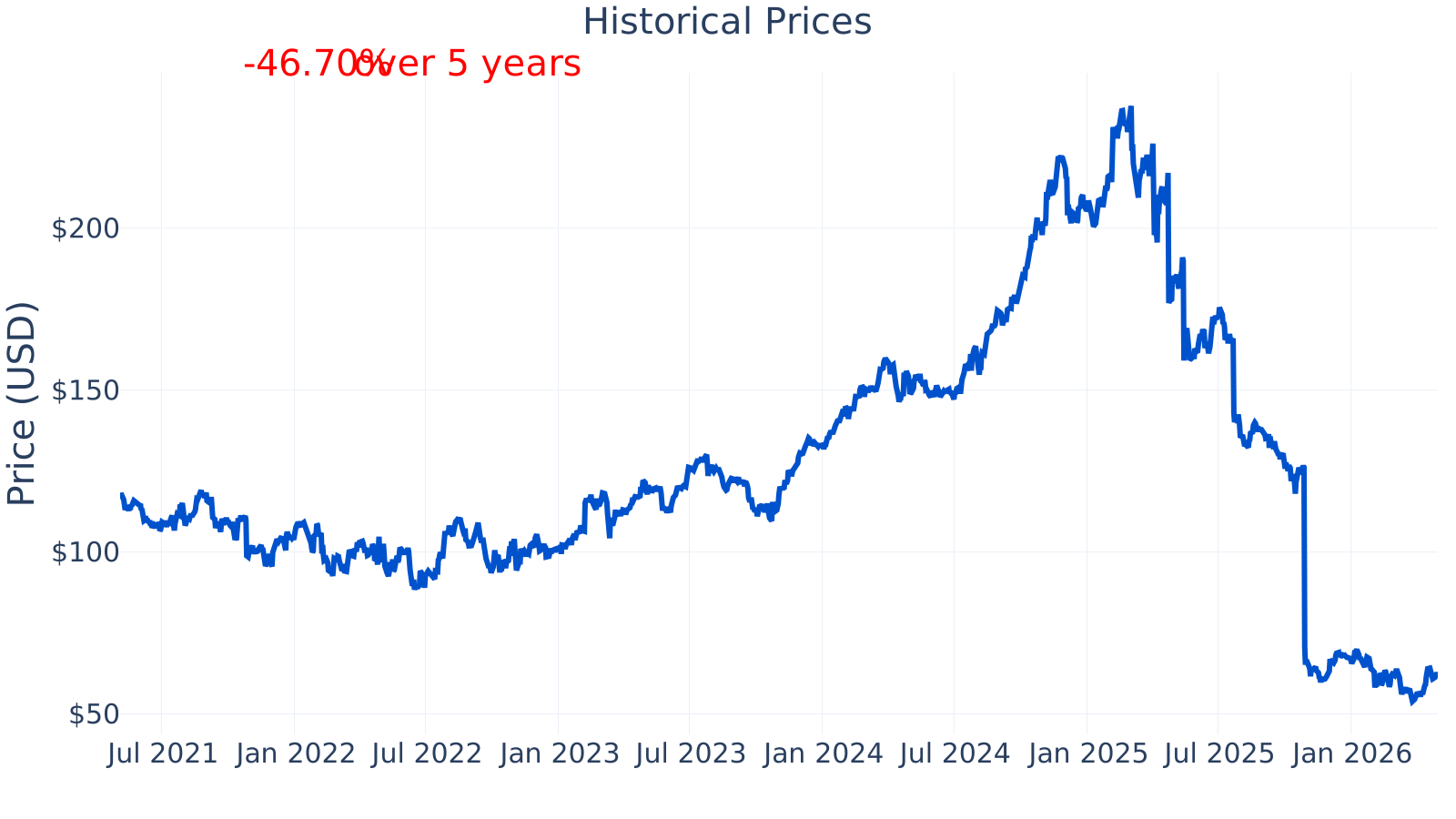
Valuation is often discussed using multiples such as the price-to-earnings (P/E) ratio, which compares the stock price to the company’s earnings. A lower P/E can indicate the market is pricing in slower growth, higher risk, or more uncertainty about future earnings durability—though it can also reflect stronger current profitability relative to price.
The P/E ratio trends sharply lower across the period shown, moving from very high levels in 2021 (above 50x and at times above 90x) down to around 9.9x by late 2025 and early 2026. This change can happen due to a combination of factors, such as rising earnings, a falling stock price, or both. Interpreting whether the current level is “expensive” or “cheap” depends on how durable earnings are, whether growth re-accelerates, and how the market weighs leverage and competitive pressure. In this context, the combination of slower recent revenue growth and higher leverage can lead to more conservative valuation multiples, while expanding margins and strong free cash flow can support the earnings base.
Conclusion
Fiserv is a large financial technology provider with businesses tied to essential payment flows and core financial infrastructure. Over the years shown, revenue increases steadily and profitability improves into the mid-teens, while free cash flow grows to multi-billion-dollar levels.
At the same time, recent revenue growth decelerates to low single digits, and leverage rises (with interest expense also increasing). The long-term industry backdrop—digital payments and banking modernization—remains supportive, but outcomes depend on competitive positioning, product execution, and how effectively the company manages its debt and costs.
From a valuation perspective, the P/E ratio compresses substantially over time to around 10x in the most recent period shown, indicating the market is applying a lower multiple than it did earlier in the period. Understanding whether that valuation is justified largely comes down to assessing the balance between (1) slower growth and higher leverage and (2) improved margins and strong free cash flow generation.
Sources:
- U.S. SEC EDGAR — Fiserv, Inc. filings (Form 10-K and Form 10-Q)
- Fiserv — Investor Relations materials (Annual Report / Form 10-K sections and segment descriptions)
- Wikipedia — “Fiserv” (basic company background)
This article is for informational purposes only and does not constitute financial advice. Some content is AI-generated. See Disclaimer