Stock Analysis · First Watch Restaurant Group Inc (FWRG)
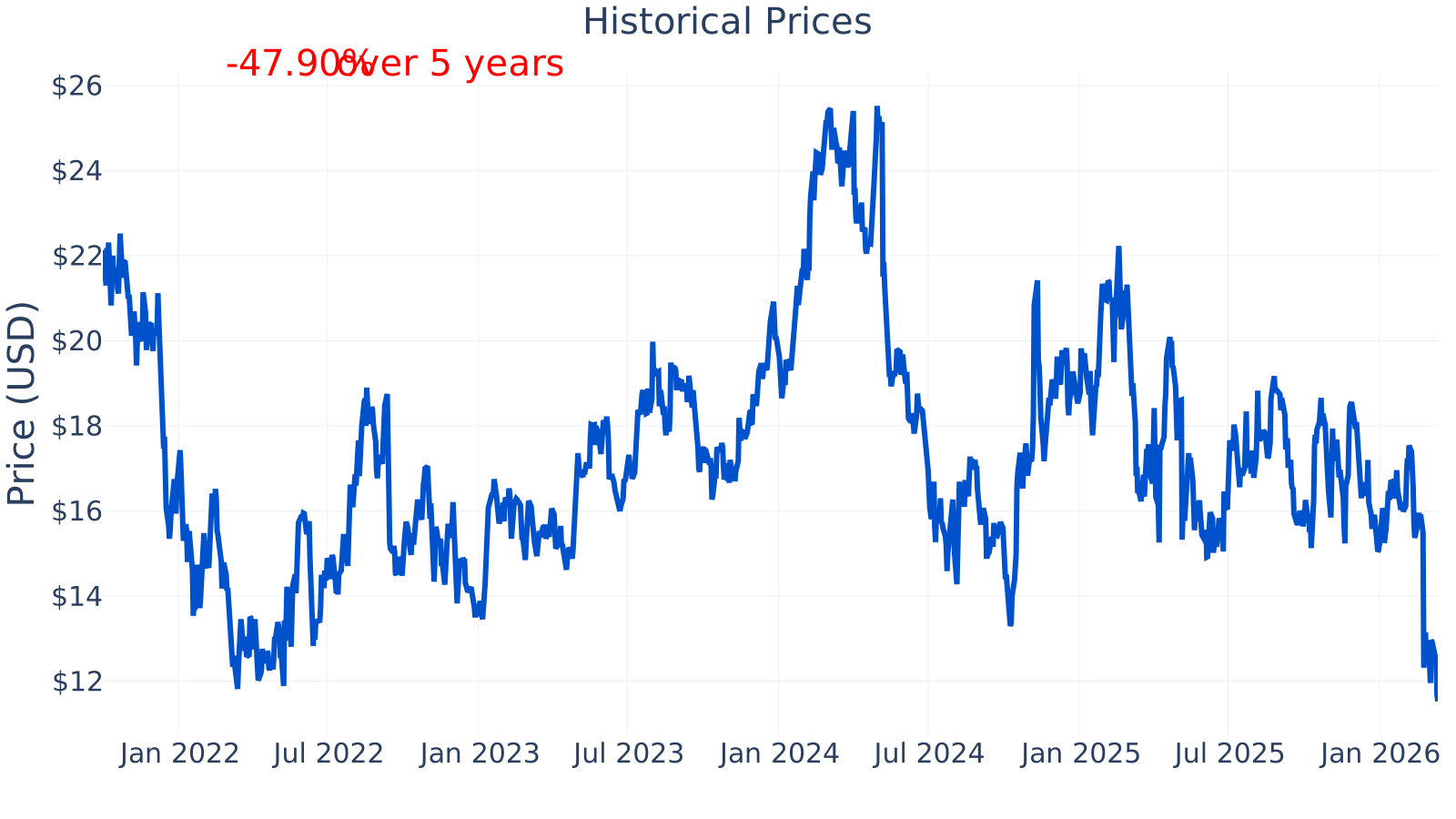
Overview
First Watch Restaurant Group Inc. is a U.S.-based restaurant company focused on daytime dining, with a menu centered on breakfast, brunch, and lunch. The concept is positioned around made-to-order meals and a “daytime-only” operating model (no dinner service), which can simplify operations compared with full-day restaurant formats.
The company’s business model is primarily tied to operating and franchising First Watch restaurants. In practice, that means most revenue comes from food-and-beverage sales at company-owned locations, with a smaller portion typically coming from franchise-related items (such as royalties and fees) where applicable. Public filings are the best place to confirm the exact split by period; when percentages are not disclosed in a simple breakdown, the main idea remains that restaurant sales are the dominant driver of revenue.
Main sources of revenue (typical structure for a restaurant operator like First Watch):
- Company-owned restaurant sales (food and beverage sold to guests; usually the largest share)
- Franchise-related revenue (royalties, franchise fees, and related items; typically smaller than restaurant sales)
- Other revenue (if any, as defined in filings for a given period)
The recent revenue scale shown below suggests a business that has expanded meaningfully over the last few years (from about $601 million in 2021 to about $1.22 billion in 2025). Over the same window, operating costs and overhead also remained substantial, which matters because restaurant companies often grow quickly in sales while profits can fluctuate with labor, food costs, occupancy costs, and new-restaurant opening expenses.
From 2021 to 2025, total revenue increased from about $601M to about $1.22B. Over that span, operating income remained positive, but net income did not rise in a straight line (for example, net income was approximately -$2.1M in 2021, about $6.9M in 2022, about $25.4M in 2023, about $18.9M in 2024, and about $19.4M in 2025). That pattern is consistent with a growing restaurant chain where unit expansion and cost pressures can create uneven bottom-line results.
Key Figures
| Metric | Value | Industry ⓘ |
|---|---|---|
| Date | Mar 16, 2026 | |
| Context | ||
| Sector | Consumer Cyclical | |
| Industry | Restaurants | |
| Market Cap ⓘ | $704.92M | |
| Beta ⓘ | 0.92 | |
| Fundamental | ||
| P/E Ratio ⓘ | 37.19 | 27.79 |
| Profit Margin ⓘ | 1.59% | 7.24% |
| Revenue Growth ⓘ | 20.20% | 7.35% |
| Debt to Equity ⓘ | 118.09% | 93.31% |
| PEG ⓘ | N/A | |
| Free Cash Flow ⓘ | -$30.99M | |
First Watch’s market capitalization is about $705M, and its beta of about 0.92 suggests the stock has historically moved somewhat similarly to the broader market (though beta can change over time). The company’s P/E ratio is ~37.2 versus an industry median of ~27.8, meaning the shares are priced at a higher multiple of earnings than the typical peer in the restaurant group used here.
Profitability and growth show a clear contrast: profit margin is ~1.6% versus an industry median of ~7.2%, while year-over-year revenue growth is ~20.2% versus an industry median of ~7.35%. Debt relative to equity is about 118% versus an industry median of ~93%. Finally, trailing twelve-month free cash flow is about -$31.0M, indicating cash outflows after operating cash flow and capital spending over that period (often influenced by expansion investments).
Growth (medium)
The restaurant industry is mature overall, but it still offers room for expansion for concepts that can add locations, maintain customer traffic, and manage costs. A daytime-focused brand can benefit from consumer demand for breakfast/brunch occasions, and it may also avoid some dinner-specific challenges (like late-night staffing and a different competitive set). At the same time, the category remains competitive and sensitive to household budgets.
A practical way to view First Watch’s growth profile is that the company has recently combined above-median revenue growth with thin margins. That often happens when a chain is actively adding restaurants and investing in infrastructure, training, and new-market entry. If execution is strong, scale can support longer-term margin improvement; if execution weakens, incremental restaurants may not produce enough profit to justify the investment.
Revenue growth has frequently been in the double digits in recent years, and the most recent reading is about 20% year-over-year. The trend shows variability (including periods above 30% and periods closer to mid-to-high single digits), which is common as the comparison base changes and as operating conditions shift.
Free cash flow moved from positive levels earlier in the timeline (for example, around $14M to $29M in 2021–2022) to roughly breakeven in 2024 and then to about -$25M by early 2025 and -$31M on a trailing twelve-month basis. For a growing restaurant chain, negative free cash flow can reflect heavy spending on new locations (capital expenditures). The key long-term question is whether those investments translate into durable restaurant-level profitability and enough cash generation later to fund growth without excessive balance sheet strain.
Risks (high)
Restaurant businesses carry several structural risks that can be hard to avoid: food and packaging inflation, wage pressure, employee turnover, lease and occupancy costs, and demand sensitivity when consumers cut discretionary spending. For a daytime concept, traffic can also be affected by local competition, shifting consumer routines (work-from-home patterns), and seasonality.
Profit margin is currently around 1.5%, well below the peer median near 6.9%–8.1% across much of the period shown. Margins improved into 2023, then weakened through 2024–2025 before ticking up again. This matters because thin margins can leave less room to absorb cost increases or sales slowdowns without impacting earnings.
Debt-to-equity is around 118%. The longer-term pattern shows leverage rising from roughly the mid-90% range in 2022–2023 to higher levels in 2024–2025, before dropping to about 118% at the most recent point shown (still above the earlier years and generally above the industry median for most of the period). Higher leverage can increase vulnerability to higher interest costs and reduces flexibility if operating results soften.
Competitive positioning is another key risk area. First Watch competes for breakfast and lunch occasions with a wide set of options, including national chains and local restaurants. Competitors can include large, well-capitalized brands in the broader family-dining and fast-casual universe, as well as independent breakfast-and-brunch operators that can be strong at the local level. First Watch’s potential advantages typically come from brand consistency, menu development, unit-level execution, and the ability to scale new restaurant openings across markets. However, it is not the only scaled player in daytime dining, and brand loyalty in restaurants can be hard-won and easily challenged by pricing, promotions, and new concepts.
Expansion itself can also be a risk. Opening many locations requires consistent site selection, construction management, hiring and training, and supply chain execution. If new restaurants underperform, the company can be left with fixed costs (leases and labor) that weigh on profitability.
Valuation
The current P/E ratio is about 37.2, above the industry median near 27.8. Historically, the company’s P/E has been volatile, ranging from very high levels in parts of 2022–2023 and again in parts of 2025, before coming down to the current range. For interpretation, a higher P/E often implies the market is assigning more value to expected future earnings growth or to the possibility that margins improve over time.
At the same time, valuation needs to be viewed alongside fundamentals that are currently mixed: revenue growth has been stronger than the industry median, but profit margins are meaningfully lower than peers and free cash flow is negative on a trailing basis. This combination typically places more weight on future execution (keeping sales momentum while improving unit economics and controlling costs) to support a higher earnings multiple over time.
Conclusion
First Watch is a growing daytime restaurant concept with revenue that has expanded substantially over the last several years and with recent year-over-year growth above the typical restaurant peer median. The main fundamental trade-off visible in the metrics is that this growth has come with thin profit margins and negative trailing free cash flow, alongside a leverage level that is not low for the sector.
In plain terms, the long-term story centers on whether the company can keep expanding while strengthening profitability and eventually generating consistent free cash flow. The current valuation level (P/E above the industry median) suggests that future improvement is an important part of how the market is viewing the business today.
Sources:
- U.S. SEC EDGAR — First Watch Restaurant Group, Inc. — Form 10-K (Annual Report)
- U.S. SEC EDGAR — First Watch Restaurant Group, Inc. — Form 10-Q (Quarterly Report)
- First Watch Restaurant Group, Inc. — Investor Relations materials and SEC filings repository
- Wikipedia — “First Watch (restaurant)” (basic company background)
This article is for informational purposes only and does not constitute financial advice. Some content is AI-generated. See Disclaimer


