Stock Analysis · First Solar Inc (FSLR)
Overview
First Solar, Inc. (FSLR) designs and manufactures solar panels and sells them primarily for large, utility-scale solar power plants. Unlike many solar brands that focus on rooftop systems, First Solar is best known for serving large energy developers and utilities with long-term supply agreements. The company also provides certain related services (for example, around project support and module recycling), but the core business is producing and selling solar modules.
In simple terms, First Solar earns money mainly by delivering solar panels to large projects. Its reported revenue is concentrated in its module segment, with additional contributions from related services and other items (the exact mix can vary by year based on deliveries and contract timing).
Main sources of revenue (typical structure):
- Solar modules sold to utility-scale customers (largest share; the company’s primary business)
- Services and other revenue (smaller share; varies by period)
One notable pattern over the last several years is how profitability changed: after weaker results in 2022, the company’s gross profit and net income expanded significantly in 2023–2025, alongside rising total revenue. This suggests improved pricing, product mix, execution, and/or policy-related benefits flowing through the income statement (the exact drivers are discussed in company filings).
Key Figures
| Metric | Value | Industry ⓘ |
|---|---|---|
| Date | Apr 27, 2026 | |
| Context | ||
| Sector | Technology | |
| Industry | Solar | |
| Market Cap ⓘ | $20.82B | |
| Beta ⓘ | 1.61 | |
| Fundamental | ||
| P/E Ratio ⓘ | 13.65 | 27.73 |
| Profit Margin ⓘ | 29.28% | 7.06% |
| Revenue Growth ⓘ | 11.10% | 11.10% |
| Debt to Equity ⓘ | 5.23% | 110.80% |
| PEG ⓘ | 0.49 | |
| Free Cash Flow ⓘ | $1.19B | |
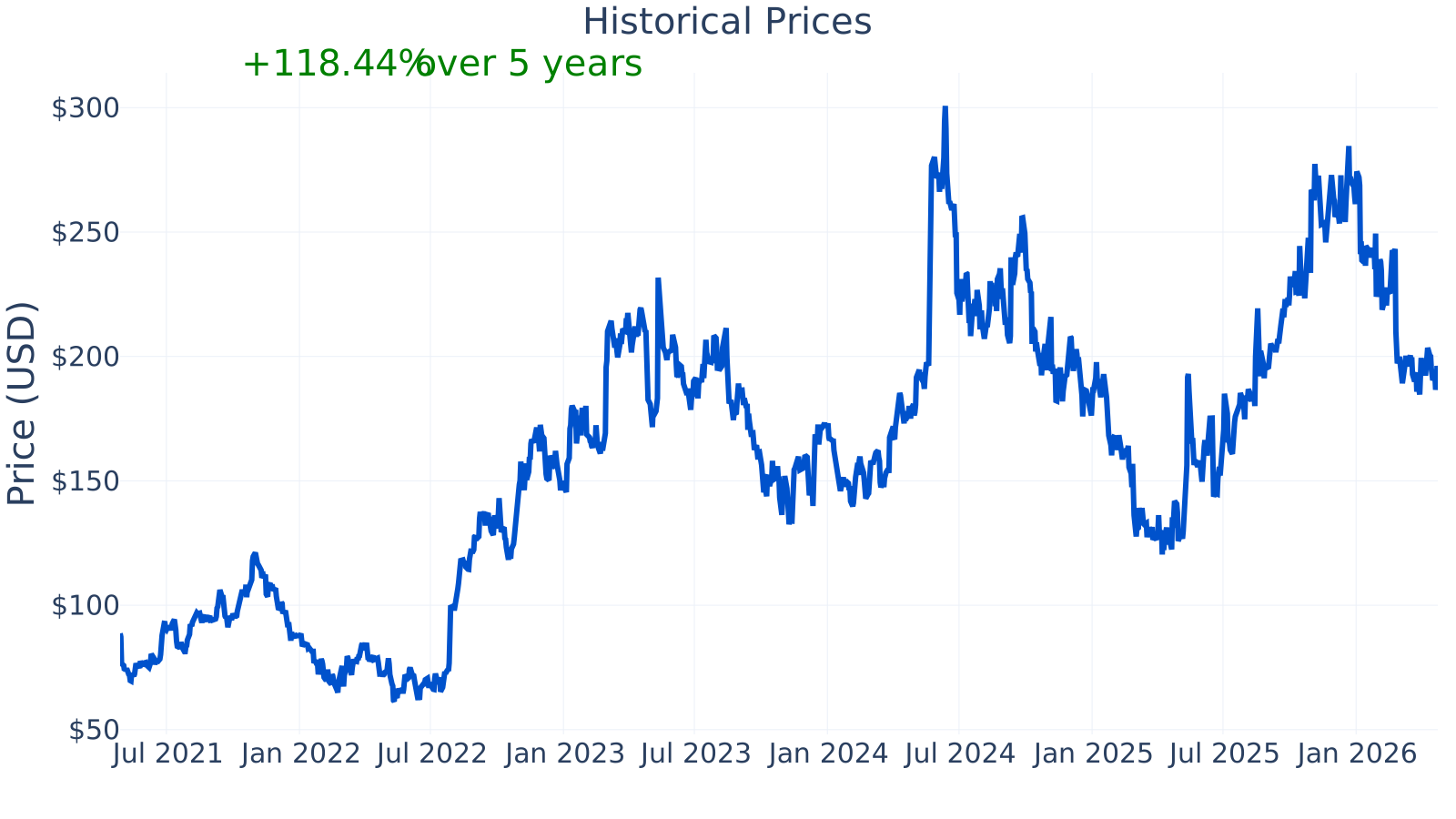
First Solar’s market capitalization is about $20.8B. The stock’s beta of ~1.61 indicates it has tended to move more than the broader market (higher volatility).
On profitability, the company shows a profit margin of ~29.3%, well above the industry median shown (~7.1%), reflecting a period of strong earnings relative to many peers. Growth is positive as well: revenue growth year over year is ~11.1%, roughly in line with the industry median displayed.
Balance-sheet leverage appears modest: debt-to-equity is ~5.2% versus an industry median above 110%, implying First Solar has used substantially less debt than many companies in the same peer set. Free cash flow (TTM) is shown at about $1.19B, and the P/E ratio is ~13.6 (below the industry median shown of ~27.7), meaning the market is currently valuing its earnings at a lower multiple than the median peer.
Growth (Medium)
First Solar operates in the solar energy industry, which is tied to long-term trends such as electrification, new power demand (including data centers and broader grid growth), and the continued build-out of renewable generation. Utility-scale solar in particular is often built in large, multi-year development pipelines, which can support long planning horizons for suppliers when project economics and financing conditions are favorable.
The company’s strategy centers on utility-scale manufacturing capacity, technology differentiation, and long-term contracting. For long-term growth, key practical drivers typically include: the pace of new solar project approvals and grid interconnections, the availability and cost of financing, and policy frameworks that encourage domestic manufacturing and clean-energy deployment (where applicable). Management commentary and risk disclosures in filings are important for understanding which of these factors is most significant in the current cycle.
Revenue growth has been positive most recently (about 11.1% year over year in the latest reading), but it has also been uneven historically, with some quarters showing declines and others showing sharp increases. For a manufacturer tied to project delivery schedules, this variability can happen when large customer deliveries shift between periods.
Free cash flow is an area to watch closely. The longer series shown includes multiple periods of negative trailing free cash flow (for example, as of March readings in 2022–2025), which can be consistent with heavy investment cycles (such as building or expanding factories) and working-capital swings. At the same time, the latest metrics table shows positive trailing free cash flow of about $1.19B, indicating that cash generation can improve meaningfully when deliveries, margins, and investment timing align.
Risks (High)
Solar manufacturing and utility-scale demand can be cyclical. Results may be influenced by changes in interest rates (which affect project financing), power-market conditions, supply chain constraints, and shifting trade and industrial policies. Customer concentration can also matter: if a smaller number of large developers represent a meaningful share of contracted deliveries, project delays or cancellations may impact near-term results.
Competition is another central risk. First Solar competes against other solar module manufacturers globally, including large, low-cost producers, and also competes indirectly with other generation technologies for utility investment dollars. Key competitive factors include module cost per watt, performance and degradation characteristics, bankability (customer confidence in long-term performance and warranties), the ability to deliver large volumes on schedule, and the economics created by a given country’s incentive and trade environment.
That said, the company does have potential competitive advantages that are often discussed in its filings: scale in utility-scale modules, established customer relationships, and product/technology positioning that differs from many commodity module offerings. Whether those advantages persist depends on execution, ongoing innovation, and maintaining cost and performance competitiveness as the industry evolves.
The balance sheet currently appears conservatively levered relative to the peer median: debt-to-equity is ~5.2% versus an industry median above 110%. Lower leverage can reduce financial risk during down cycles, but it does not eliminate operational and market risks (such as pricing pressure or demand slowdowns).
Profitability has improved sharply over time. After a weak period around 2022 (including a negative margin at one point), margins rose substantially through 2023–2025 and recently sit around 29%, far above the peer median shown. A key risk is that unusually high margins may not be permanent if competitive pricing intensifies, input costs change, or policy benefits evolve.
Valuation
On a price-to-earnings basis, First Solar’s current P/E of ~13.6 is below the industry median shown (~27.7). Historically on the chart, First Solar’s P/E has moved widely, including periods when earnings were low or volatile (which can cause the ratio to spike or become less meaningful). More recently, the P/E appears to have settled into a lower range than several earlier peaks.
Interpreting whether the current valuation is “expensive” or “cheap” depends heavily on durability of earnings and cash generation. The company is showing strong recent profit margins and comparatively low leverage, which can support valuation. At the same time, the business is exposed to cycles in utility-scale project timing and pricing, and free cash flow can swing during investment phases—factors that can justify more conservative multiples in some periods.
Conclusion
First Solar is a utility-scale solar manufacturer with financial characteristics that recently stand out within its peer group: high profit margins, relatively low debt usage, and a P/E ratio below the industry median shown. Its results over 2023–2025 reflect a meaningful step-up in revenue and profits compared with 2022, suggesting improved operating performance and/or a more supportive market and policy backdrop.
At the same time, the company operates in an industry where outcomes can change quickly due to project cycles, financing conditions, global competition, and policy shifts. For long-term ownership analysis, the most important items to monitor over time are: the stability of margins, consistency of cash generation through investment cycles, and evidence that contractual demand and manufacturing execution remain strong enough to withstand pricing pressure.
Sources:
- U.S. Securities and Exchange Commission (SEC EDGAR) — First Solar, Inc. filings (Form 10-K, 10-Q, 8-K)
- First Solar, Inc. Investor Relations — SEC filings and shareholder materials (as published by the company)
- Wikipedia — “First Solar” (basic company background)
This article is for informational purposes only and does not constitute financial advice. Some content is AI-generated. See Disclaimer


