Stock Analysis · First Solar Inc (FSLR)
Overview
First Solar, Inc. (FSLR) is a U.S.-based solar company that manufactures photovoltaic (PV) solar modules and sells them primarily to utility-scale solar project developers and operators. Unlike many solar brands that focus on rooftop panels, First Solar’s business is centered on large solar farms that sell electricity to utilities and large customers. The company also provides certain related services (such as logistics and performance-related support) tied to module sales, but the core activity is manufacturing and selling solar modules.
In its SEC filings, First Solar describes its operations primarily as a single business focused on PV solar modules, meaning revenue is not typically split into many separate consumer-style product lines. In practical terms, revenue is mainly driven by delivering modules under long-term supply agreements and recognized as those deliveries occur.
Main sources of revenue (simplified)
- Solar modules sold to utility-scale customers (the dominant source of revenue; First Solar generally reports as one main operating segment in filings)
- Other / related services (ancillary items associated with module sales; typically much smaller than module revenue)
From 2021 to 2024, the company’s revenue and profitability profile changed notably: revenue increased and profitability expanded sharply by 2023–2024, reflecting improved gross profit and operating income versus the weaker 2022 period.
Looking across the income flow over multiple years, total revenue rose from about $2.9B (2021) to $4.2B (2024). Over the same period, gross profit expanded substantially (from roughly $0.73B in 2021 to about $1.86B in 2024), and net income moved from a loss in 2022 to over $1.29B in 2024. This suggests the recent years benefited from stronger pricing and/or improved cost economics and production mix compared with 2022.
Key Figures
| Metric | Value | Industry ⓘ |
|---|---|---|
| Date | Feb 07, 2026 | |
| Context | ||
| Sector | Technology | |
| Industry | Solar | |
| Market Cap ⓘ | $23.47B | |
| Beta ⓘ | 1.63 | |
| Fundamental | ||
| P/E Ratio ⓘ | 16.77 | |
| Profit Margin ⓘ | 27.73% | 0.27% |
| Revenue Growth ⓘ | 79.70% | 33.90% |
| Debt to Equity ⓘ | 9.89% | 139.55% |
| PEG ⓘ | 0.36 | |
| Free Cash Flow ⓘ | $614.52M | |
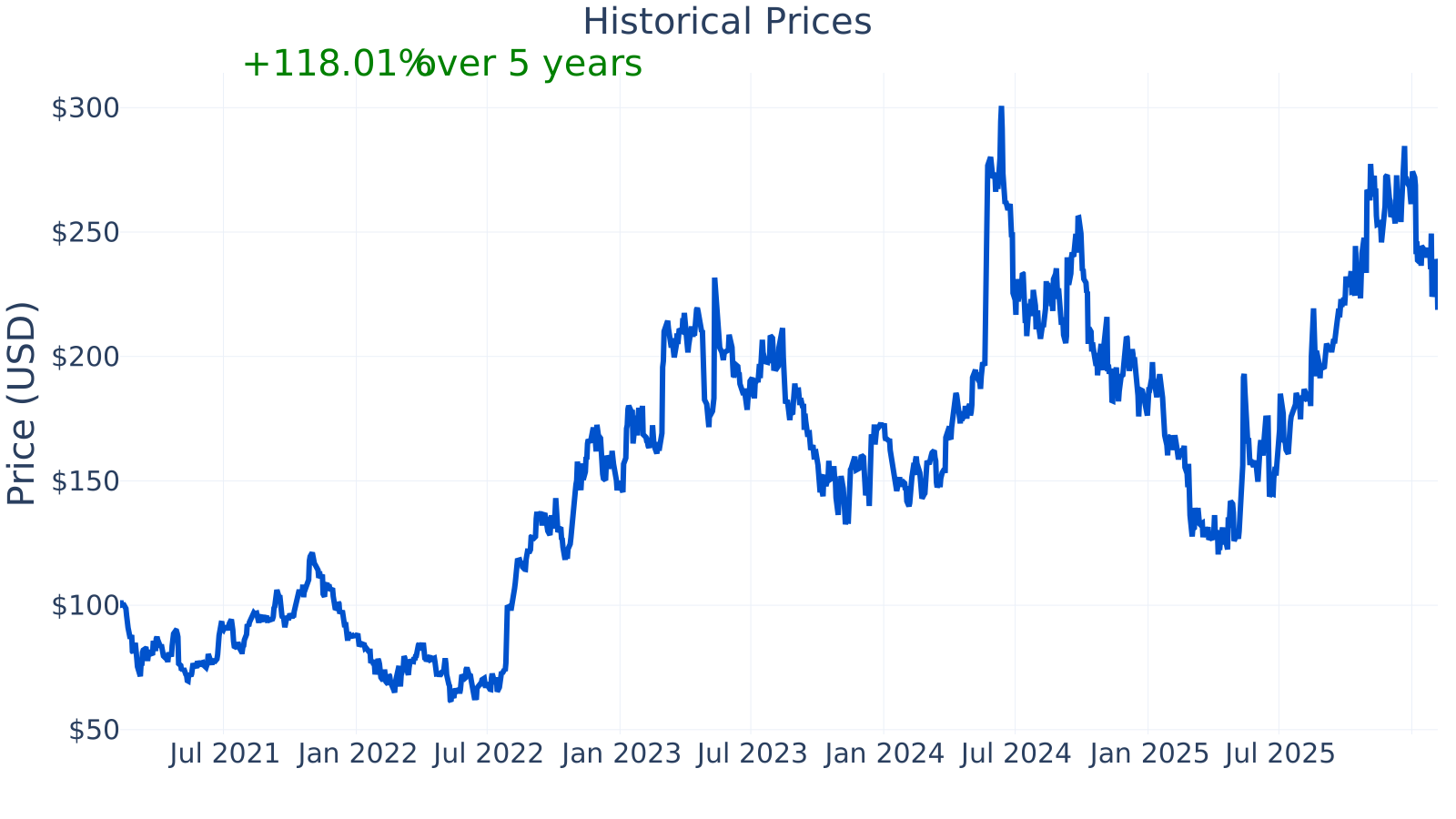
First Solar’s market capitalization is about $23.5B, placing it among the larger publicly traded solar-focused manufacturers. The stock’s beta of 1.63 indicates it has historically been more volatile than the broader market.
On profitability, the latest profit margin shown is about 27.7%, which is far above the industry median displayed (about 0.3%). Revenue growth year-over-year is shown at about 79.7%, also above the displayed industry median (about 33.9%), highlighting a period of strong top-line expansion. Leverage appears conservative with debt-to-equity near 9.9% versus a much higher industry median shown.
Growth (medium)
Solar power is part of a long-term global shift toward lower-carbon electricity generation, and utility-scale solar in particular is often built where it can deliver competitive electricity costs and be deployed relatively quickly. In that context, First Solar’s focus on large-scale projects aligns with a market segment that can add capacity in sizable increments.
Strategy-wise, First Solar emphasizes manufacturing at scale and selling into multi-year demand through contracted supply arrangements (as described in its filings). This can support planning and capacity utilization, but it also ties results to execution (building and ramping factories, meeting customer specifications, and delivering on time).
The year-over-year revenue growth trend is not smooth—there are periods of negative growth earlier in the series, followed by sustained positive growth through 2023–2024 and a very high recent reading (about 79.7%). This pattern is consistent with an industry where project timing, contract milestones, and product transitions can cause uneven quarterly and annual comparisons.
Free cash flow over the trailing twelve months is shown as +$615M in the latest metric snapshot, while the longer series includes several periods of negative trailing free cash flow (down to around -$976M at one point). For a manufacturer expanding capacity, this kind of swing can happen when cash is spent on new factories and equipment before the related revenue and margins are fully realized. For long-term evaluation, the key question is whether the business can consistently convert profits into cash after major build-outs normalize.
Risks (high)
This article is for informational purposes only and does not constitute financial advice. Some content is AI-generated. See Disclaimer