Stock Analysis · F5 Networks Inc (FFIV)
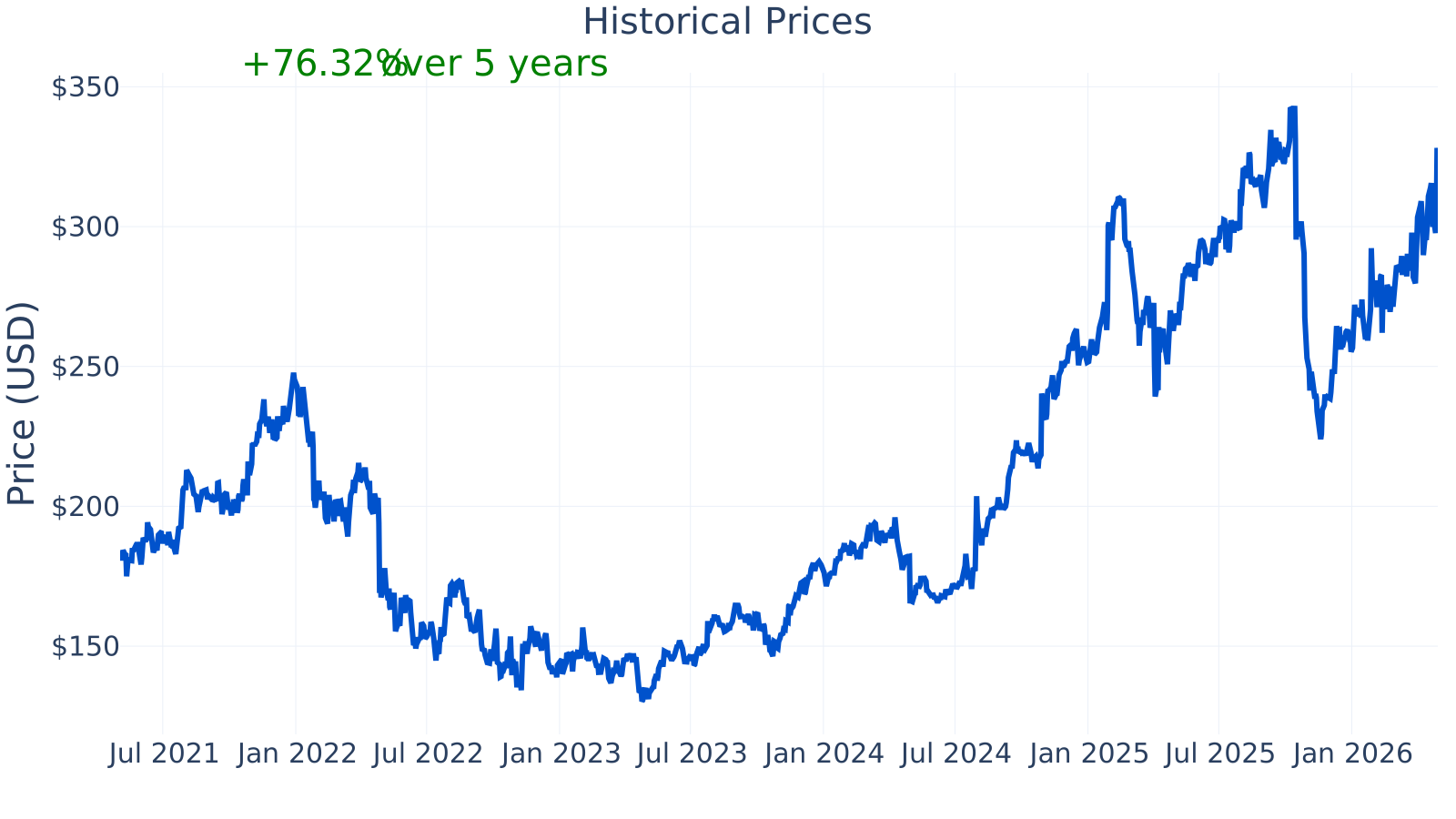
Overview
F5 Networks, Inc. (FFIV) is a technology company that helps organizations keep their applications (websites, mobile apps, internal business apps, and APIs) fast, available, and secure. In simple terms, when a company runs important software for customers or employees, F5’s products help that software handle heavy traffic, stay online during disruptions, and defend against cyberattacks.
F5 is best known for application delivery and security. This includes tools that route and balance traffic across servers (so no single system gets overloaded), improve performance, and protect applications from threats like malicious bots and attacks that try to overwhelm a site.
In its financial reporting, F5 groups revenue into two broad buckets:
- Software (including subscriptions and software-related support)
- Systems (physical and virtual appliances, plus related components)
Across these offerings, a meaningful part of customer spending is recurring in nature (for example, subscription licenses and ongoing support/maintenance), which can help smooth results compared with purely one-time hardware sales. For precise, up-to-date percentages by category, F5’s latest Form 10-K and quarterly filings provide the official breakdown.
Over the years shown, total revenue rises overall, while operating income and net income increase more noticeably in the most recent period—suggesting improved operating efficiency and profitability even without dramatic revenue expansion.
Key Figures
| Metric | Value | Industry ⓘ |
|---|---|---|
| Date | May 01, 2026 | |
| Context | ||
| Sector | Technology | |
| Industry | Software - Infrastructure | |
| Market Cap ⓘ | $18.38B | |
| Beta ⓘ | 0.93 | |
| Fundamental | ||
| P/E Ratio ⓘ | 26.57 | 29.35 |
| Profit Margin ⓘ | 22.46% | 6.83% |
| Revenue Growth ⓘ | 7.30% | 14.85% |
| Debt to Equity ⓘ | 6.21% | 24.49% |
| PEG ⓘ | 2.17 | |
| Free Cash Flow ⓘ | $962.66M | |
F5’s market capitalization is about $18.4B, placing it in the mid-cap range. The stock’s beta of 0.93 indicates price moves that have historically been close to the broader market (slightly less volatile than “beta = 1”). Profitability stands out: the latest profit margin is ~22.5% versus an industry median of ~6.8%, which points to stronger earnings power than many peers in the same broad category. Growth is more moderate: revenue growth is ~7.3% year over year versus an industry median of ~14.9%. Balance sheet leverage appears relatively conservative with debt-to-equity of ~6.2%, well below the industry median of ~24.5%. Over the last twelve months, free cash flow is about $963M, reflecting substantial cash generation.
Growth (Medium)
F5 operates in markets supported by long-term trends: more applications moving online, more digital traffic (including API traffic), more complexity from hybrid IT (mixing on-premise data centers with cloud), and persistent cybersecurity needs. These forces generally increase demand for tools that manage and protect application traffic.
Strategically, F5 has been positioning more of its business around software and subscriptions, which can better match how customers prefer to buy technology (ongoing licenses and services rather than periodic large hardware refreshes). That shift can also improve predictability if renewal rates stay healthy.
The year-over-year revenue growth pattern is uneven across the period shown—moving from low-to-mid single digit growth to occasional declines and then improving again into mid-to-high single digits (and some low double-digit quarters). This fits a company that is growing, but not in a straight line, and may be influenced by customer budgeting cycles and timing of renewals or large deployments.
Free cash flow increases meaningfully over the time shown (from roughly $564M to about $963M). For long-term business quality, this matters because free cash flow is the cash a company generates after paying operating costs and necessary capital spending—cash that can be used for reinvestment, acquisitions, debt reduction, or share repurchases (subject to management decisions and board authorization).
Potential catalysts (in a neutral, business sense) often include: broader adoption of subscription offerings, increased demand for application security as threats evolve, and continued optimization of costs while maintaining product development. However, the size and timing of these factors can vary widely by year.
Risks (Medium)
A key risk for F5 is competitive pressure in application delivery and security. Customers can choose among multiple approaches—hardware appliances, software, cloud-native tools, and services integrated into major cloud platforms. Competition can lead to pricing pressure, slower growth, or higher spending needs to keep products differentiated.
Another risk is product and platform transitions. As customers modernize applications (for example, adopting containers, microservices, and cloud-managed services), vendors must keep pace. If customers prefer “built-in” cloud provider tools or competing platforms, F5 may need continued product innovation to defend its position.
Revenue can also be sensitive to enterprise IT budgets. In cautious spending environments, customers may delay large projects, reduce expansions, or negotiate more aggressively on renewals.
Leverage trends appear favorable over time, declining from higher levels earlier in the series to about 6% most recently, below the industry median. Lower leverage can reduce financial risk, particularly during periods of slower demand or tighter credit conditions.
Profit margin expands substantially over the period shown, reaching the low-20% range and staying well above the industry median. Strong margins can be a competitive advantage when they reflect durable product value and disciplined cost structure—though margins can also compress if competition intensifies or if the company increases investment spending.
On competitive advantages, F5 benefits from an established presence in large enterprises and service providers, deep expertise in managing application traffic at scale, and a product portfolio spanning performance and security. It is widely recognized for its role in application delivery (historically associated with BIG-IP). Still, it competes in crowded categories with strong players.
Main competitors typically include large networking and security vendors and specialized application security/content delivery firms. Depending on the specific product area, this can include companies such as Cisco, Palo Alto Networks, Fortinet, Akamai, Cloudflare, and application delivery alternatives embedded in cloud ecosystems. Competitive positioning often depends on a customer’s architecture (on-prem vs. cloud), security requirements, and preference for integrated platforms versus best-of-breed solutions.
Valuation
One simple way to describe valuation is the price-to-earnings (P/E) ratio, which compares the stock price to the company’s earnings. This metric is best interpreted alongside profitability quality, growth rate, and business stability.
Most recently, F5’s P/E is around 22.9x (with an industry median near 29.4x at the same time point shown). Over the historical period displayed, F5’s P/E generally trends downward from the 40x range earlier in the series to the low-to-mid 20s more recently, with some variability. This indicates that the market’s valuation of each dollar of earnings has changed over time.
Putting the valuation metrics next to fundamentals: F5 shows strong profitability (profit margin well above peers) and substantial free cash flow generation, but revenue growth has been lower than the industry median. That combination often leads markets to value the company more like a mature, cash-generative software infrastructure business rather than a high-growth company. The PEG ratio shown (~2.17) is one signal that the valuation may rely on continued execution and sustained earnings power rather than rapid top-line expansion.
Conclusion
F5 Networks is a long-established infrastructure and security provider focused on keeping applications available, fast, and protected. The company shows clear strengths in profitability and cash generation, and it appears to be operating with relatively low financial leverage.
The main long-term questions are less about whether application traffic and security matter (they do) and more about how spending is allocated in a competitive landscape that includes major platform vendors and cloud-native alternatives. With revenue growth that has been uneven and often below the industry median, the long-term outlook depends on continued customer demand for F5’s approach, successful execution in subscriptions/software, and sustained differentiation in application security and delivery.
Sources:
- U.S. Securities and Exchange Commission (SEC) EDGAR — “F5 Networks, Inc. Filings (10-K, 10-Q, 8-K)”
- F5, Inc. Investor Relations — “SEC Filings”
- F5, Inc. Investor Relations — “Earnings Materials (Shareholder letters / prepared remarks, where provided by the company)”
- Wikipedia — “F5, Inc.”
This article is for informational purposes only and does not constitute financial advice. Some content is AI-generated. See Disclaimer


