Stock Analysis · Fastly Inc (FSLY)
Overview
Fastly Inc. is a technology company that helps businesses deliver digital content and online applications to end users quickly and reliably. In simple terms, it runs a network of servers around the world so websites, apps, videos, and software updates can load faster and handle traffic spikes better. Fastly also offers tools that sit closer to the “edge” of the internet (near users rather than in a distant centralized data center), which can improve performance and support real-time use cases.
Fastly’s business is commonly described as an edge cloud platform, which includes content delivery (CDN), security, and compute capabilities. Customers typically pay based on usage (for example, how much data is delivered) and/or for specific products and service levels, under commercial agreements described in company filings.
In its filings, Fastly reports revenue as a single line item rather than breaking it into detailed public percentages by product. As a practical way to understand what drives revenue, the main revenue “buckets” discussed in company materials are:
- Content delivery and edge delivery services (helping customers deliver websites, APIs, and media quickly)
- Security products (helping protect web applications and traffic at the edge)
- Edge compute and related platform services (running logic closer to users for speed and customization)
Over time, the company’s financial results show that revenue growth and cost control have been central themes, with ongoing investment in research and development and sales/marketing to expand product capabilities and customer adoption.
From 2021 to 2025, total revenue increased from about $354M to about $624M. Over the same period, gross profit also rose (about $187M to about $356M), while the company still reported net losses each year. Operating expenses stayed substantial, reflecting continued spending on product development and customer acquisition.
Key Figures
| Metric | Value | Industry ⓘ |
|---|---|---|
| Date | Feb 16, 2026 | |
| Context | ||
| Sector | Technology | |
| Industry | Software - Application | |
| Market Cap ⓘ | $2.73B | |
| Beta ⓘ | 1.08 | |
| Fundamental | ||
| P/E Ratio ⓘ | N/A | 27.48 |
| Profit Margin ⓘ | -19.50% | 7.66% |
| Revenue Growth ⓘ | 22.80% | 15.80% |
| Debt to Equity ⓘ | 11.50% | 24.71% |
| PEG ⓘ | N/A | |
| Free Cash Flow ⓘ | $61.04M | |
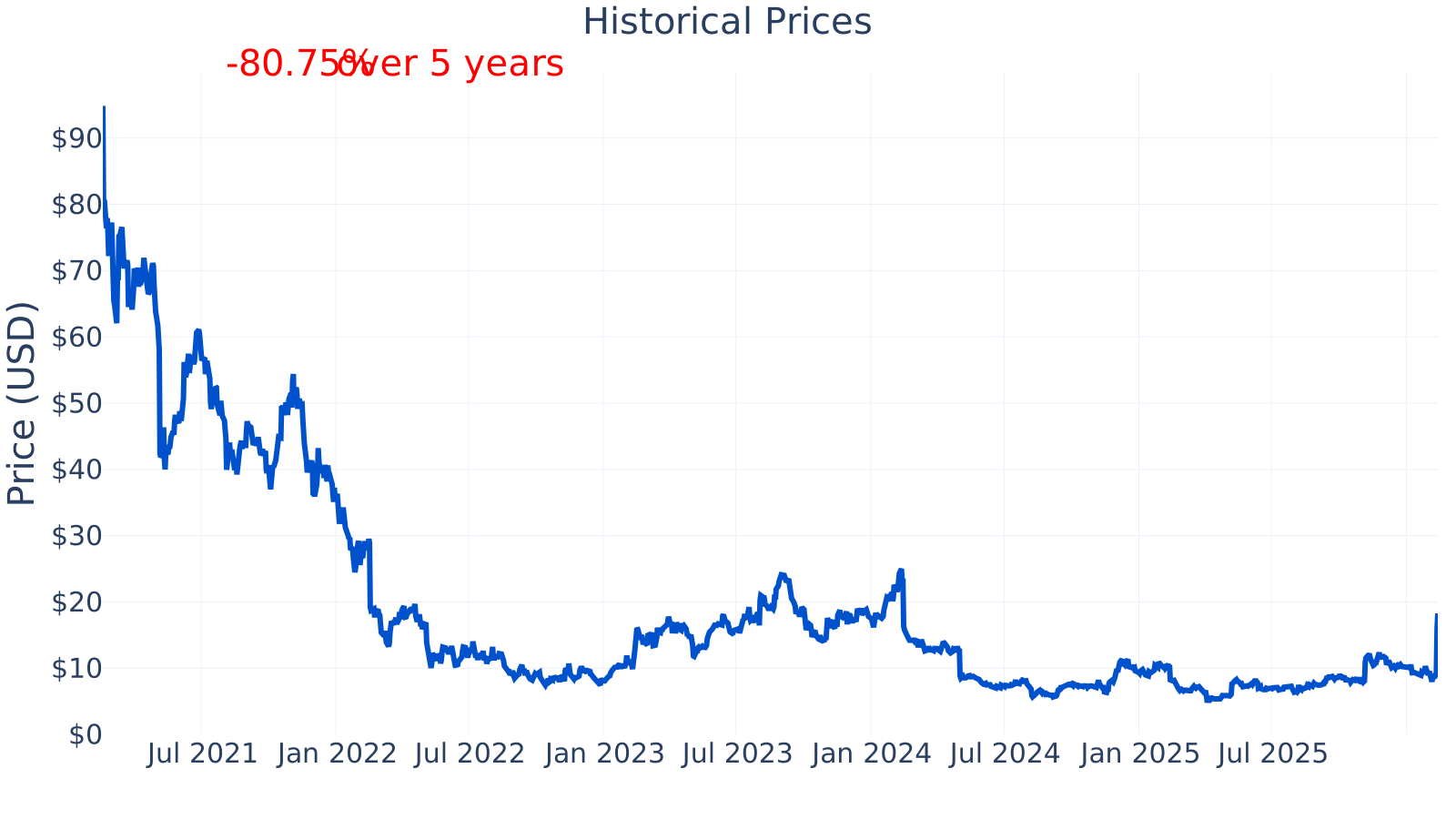
Fastly’s market capitalization is about $2.73B, placing it in the small-to-mid cap range. The stock’s beta (~1.08) suggests price moves broadly in line with the overall market, though the historical price series shows periods of very large swings. The company’s latest profit margin is about -19.5% versus an industry median near +7.7%, meaning profitability remains a key gap versus many peers. On the other hand, the latest year-over-year revenue growth is about +22.8%, above the industry median near +15.8%. Leverage appears modest on this snapshot (debt-to-equity ~11.5% versus industry median ~24.7%). Trailing twelve-month free cash flow is about +$61.0M, which can be an important signal for funding operations without relying only on external capital.
Growth (Medium)
Fastly operates in an area shaped by long-term trends: more software moving online, more video and rich content, more security threats, and rising expectations for fast and reliable digital experiences. As businesses push applications closer to users for speed and responsiveness, edge-oriented infrastructure and security services remain strategically relevant.
A key question for long-term business growth is whether Fastly can expand beyond core delivery into higher-value services (such as security and edge compute) while keeping its network efficient. The company’s continued research and development spending in its financial statements reflects an effort to improve the platform and broaden what customers can do at the edge.
Revenue growth has fluctuated over time. After stronger growth earlier in the period shown, it slowed into late 2024 (down to low single digits) and then re-accelerated in 2025, reaching about +22.8% by year-end. For a company in infrastructure software, this pattern can matter because it may influence how efficiently fixed network and operating costs can be absorbed as the business scales.
Free cash flow was negative for several years in the period shown (including a low near -$147M in 2023), improved significantly by 2024, and is shown as +$61M on a trailing twelve-month basis in the latest table. If sustained, positive free cash flow can reduce financing pressure and give more flexibility for continued investment, though it does not by itself mean the company is profitable on a net income basis.
Risks (High)
The main fundamental risk is that Fastly has remained unprofitable on net income across the years shown in the operating results, even as revenue grew. The path to durable profitability typically depends on maintaining competitive pricing, keeping network costs efficient, and controlling operating expenses while still investing enough to stay relevant in a fast-moving market.
Profit margins have improved meaningfully from very negative levels earlier in the period (around -60% range in 2021–2022) to about -19.5% by the end of 2025. Despite the improvement, the company is still below the industry median (about +8.4% at the end of the series), highlighting an ongoing execution gap versus many application software peers.
Competition is another major risk. The content delivery and edge services market includes much larger platforms and well-established specialists. Depending on the specific product area, competitors can include:
- Cloud platform providers offering integrated delivery, security, and edge features
- Large CDN and edge network specialists with broad global reach
- Security-focused providers that bundle web performance with protection
In markets where large providers can bundle services, pricing pressure and customer consolidation can be challenging for smaller players. Fastly’s competitive positioning often rests on performance, developer-focused tooling, and edge programmability described in its filings, but maintaining differentiation requires continuous investment.
Leverage appears to have declined substantially over the time shown—from roughly ~98–104% debt-to-equity in 2021 to about 11.5% at the end of 2025, which is also below the industry median (~25%). Lower leverage can reduce financial risk, but operating losses and the need to fund infrastructure still remain important considerations.
Additional risks described in typical company risk disclosures include customer concentration (large customers can materially affect results), traffic variability (usage-based revenue can fluctuate), cybersecurity and service reliability expectations, and rapid technology shifts that can change what customers demand from edge platforms.
Valuation
A traditional price-to-earnings (P/E) ratio is not meaningful here because the company has been reporting net losses, and the P/E chart shows 0 across the period (a common outcome when earnings are negative or the ratio is otherwise not interpretable). In contrast, the industry median P/E shown remains positive and elevated across much of the timeline, indicating many peers have positive earnings that can support P/E-based comparisons.
In situations like this, valuation discussions often shift toward other lenses (such as revenue multiples, gross profit, and free cash flow consistency). Based on the operating picture shown earlier—growing revenue, improving margins but still negative net income—the market price typically reflects expectations about future scaling and profitability improvement rather than current earnings power.
Conclusion
Fastly is an edge-focused internet infrastructure company whose results show a multi-year pattern of revenue growth alongside ongoing net losses, with notable improvement in profit margin over time. The business operates in a strategically important area as digital experiences, security needs, and real-time applications continue to expand, and the company’s recent re-acceleration in revenue growth and improvement in free cash flow stand out as operational developments to track.
At the same time, the company operates in highly competitive markets with large, well-resourced rivals, and the gap versus industry median profitability remains significant. For long-term evaluation, the most decision-relevant facts to monitor tend to be whether revenue growth can be sustained, whether margin improvement continues toward profitability, and whether positive free cash flow proves durable while the company invests to maintain differentiation.
Sources:
- U.S. Securities and Exchange Commission (SEC) EDGAR — Fastly Inc. filings (Form 10-K, Form 10-Q)
- Fastly Investor Relations — Annual Report / shareholder materials and press releases (as published by the company)
- Wikipedia — “Fastly” (general company background)
This article is for informational purposes only and does not constitute financial advice. Some content is AI-generated. See Disclaimer


