Stock Analysis · Fair Isaac Corporation (FICO)
Overview
Fair Isaac Corporation (FICO) is a software and analytics company best known for developing the FICO score, a credit score widely used by lenders to help assess consumer credit risk. Beyond the score itself, the company sells decisioning software that helps organizations (especially in financial services) automate and improve high-stakes decisions such as approving a loan, setting a credit limit, detecting fraud, and managing customer relationships.
FICO’s business is commonly described through two main segments in its filings:
- Scores: licensing the FICO score to lenders and other participants in the credit ecosystem, with usage-based revenue tied to credit activity.
- Software: subscriptions and licenses for analytics and decision management platforms (including cloud-delivered offerings), typically under longer-term customer relationships.
These two streams create a mix of (1) credit-activity-linked revenue (Scores) and (2) more recurring, contract-driven revenue (Software). In recent years, the company has emphasized expanding its software offerings and increasing the share of revenue that is recurring or subscription-like, while the Scores business remains a major contributor due to the FICO score’s embedded role in U.S. consumer lending.
Over the periods shown, total revenue and operating income rise meaningfully, and net income increases as well. Operating expenses grow, but revenue growth is strong enough that operating income expands in absolute dollars (from roughly $513M in 2021 to about $936M in 2025 for the same fiscal quarter shown), indicating operating leverage.
Key Figures
| Metric | Value | Industry ⓘ |
|---|---|---|
| Date | May 01, 2026 | |
| Context | ||
| Sector | Technology | |
| Industry | Software - Application | |
| Market Cap ⓘ | $23.77B | |
| Beta ⓘ | 1.38 | |
| Fundamental | ||
| P/E Ratio ⓘ | 32.47 | 25.81 |
| Profit Margin ⓘ | 33.68% | 7.87% |
| Revenue Growth ⓘ | 38.70% | 16.85% |
| Debt to Equity ⓘ | -173.99% | 25.08% |
| PEG ⓘ | 0.95 | |
| Free Cash Flow ⓘ | $892.68M | |
FICO’s market capitalization is about $23.8B. The stock’s beta of ~1.38 indicates it has tended to move more than the broader market (higher volatility). Profitability stands out: the net profit margin is ~33.7%, far above the industry median of ~7.9%. Recent year-over-year revenue growth is ~38.7%, also above the industry median of ~16.9%. Free cash flow over the last twelve months is about $893M, which can support reinvestment, debt service, and shareholder returns. The debt-to-equity ratio is negative, which usually reflects negative book equity rather than “no debt,” and is often seen in companies that have used significant share repurchases or have accounting dynamics that reduce equity; it makes simple leverage comparisons to peers less straightforward.
Growth (Medium)
FICO operates in areas with durable demand drivers: consumer and commercial credit, risk management, fraud prevention, and automation of decisions using analytics. These needs tend to persist across economic cycles, although activity levels (like loan originations and refinancing) can rise and fall with interest rates and the economy.
A key long-term growth theme is the continued digitization of financial services and the push for faster, more consistent risk decisions. FICO’s strategy of expanding software subscriptions and cloud-delivered capabilities is aligned with this broader shift toward recurring software revenue, while the Scores business benefits from being deeply embedded in lending workflows.
The revenue growth trend is mostly positive over time, with a notable acceleration in the most recent period shown (to roughly 38.7% year over year). That type of jump can reflect a combination of pricing, volume, and mix effects; it is important contextually because some parts of FICO’s revenue base are tied to credit-market activity while others are more contract-based.
Free cash flow increases from about $433M (2022) to about $893M (2026) on the timeline shown. Rising free cash flow can matter for a software and analytics firm because it provides flexibility to fund product development, invest in go-to-market efforts, and withstand periods when credit-market activity is weaker.
Risks (Medium)
FICO’s results can be influenced by credit cycles. When lending activity slows (for example, fewer mortgages or auto loans), usage-based score revenue can face pressure. In addition, customers in financial services may delay software purchases or renewals during uncertain economic periods, even if the underlying need for risk tools remains.
Another risk category is competitive and structural change. In scoring, the FICO score has historically held a strong position due to broad lender adoption and integration into established processes. However, credit scoring and underwriting models can evolve, and alternative data or new scoring approaches could gain traction in certain segments. In software, FICO competes in decisioning, analytics, and fraud with a range of large and specialized vendors, and customers can be price-sensitive or pursue internal solutions.
Competitive positioning tends to look different by segment:
- Scores: FICO is strongly associated with “the” standard credit score used in many U.S. lending decisions, which creates brand recognition and switching friction, but the ecosystem includes other scoring models and industry initiatives.
- Software: competition is broader, including large enterprise software providers and specialized analytics firms offering decisioning platforms, fraud tools, and risk analytics.
The debt-to-equity ratio is shown as negative across the timeline. This typically indicates negative shareholders’ equity rather than a traditional “low leverage” profile. For readers, the practical takeaway is that balance-sheet analysis should lean more on cash flow generation and debt servicing capacity than on equity-based leverage ratios alone, and comparisons to industry medians (which are positive) can be misleading.
Net profit margin trends upward to about 33.7% most recently, consistently well above the industry median (around 8.2% at the latest point shown). High margins can signal pricing power, operating leverage, and differentiated products, but they can also attract competition and increase sensitivity to any change in pricing, regulation, or customer behavior.
Valuation
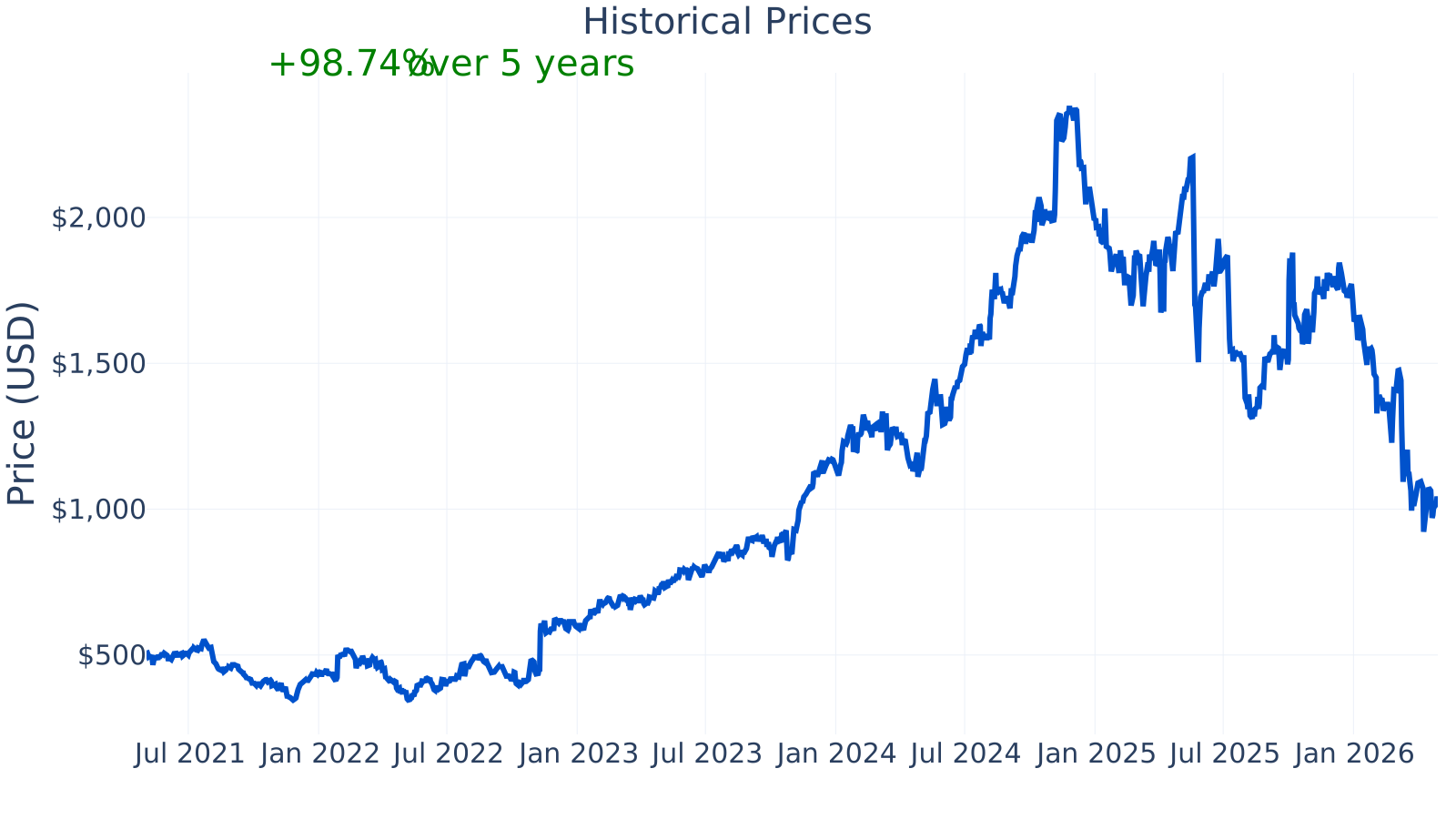
On an earnings multiple basis, the latest P/E is about 32.5 versus an industry median around 25.8, indicating the market is valuing FICO at a premium to typical application software peers in this comparison set. Historically in the period shown, FICO’s P/E has moved widely (roughly from the mid-20s at lower points to much higher levels at peaks), reflecting changing expectations for growth and profitability as well as share price volatility.
Whether that premium is “justified” depends on how durable the company’s high profitability and growth are. The business shows two supportive fundamentals in the metrics displayed: above-median revenue growth and far above-median profit margins. At the same time, a premium multiple can leave less room for disappointment if growth normalizes, if credit-market activity weakens, or if competitive and regulatory conditions change.
Conclusion
FICO is a specialized software and analytics company with a globally recognized credit scoring franchise and an enterprise software business focused on decisioning and risk. The figures shown highlight a combination of strong profitability, recently strong revenue growth, and rising free cash flow, which are important characteristics for understanding long-term business durability.
The main offsets are that parts of the business are exposed to credit cycles, the competitive landscape in analytics and decisioning software is broad, and some balance-sheet ratios (like debt-to-equity) are less straightforward because equity is negative. Valuation metrics indicate the stock has traded at a premium earnings multiple versus the industry median in the comparison provided, meaning expectations embedded in the price may already assume continued strong execution.
Sources:
- U.S. SEC — EDGAR Database (Fair Isaac Corporation filings, including Form 10-K and 10-Q)
- Fair Isaac Corporation — Investor Relations materials (SEC filings and shareholder information)
- Wikipedia — “Fair Isaac” (basic company background and history)
This article is for informational purposes only and does not constitute financial advice. Some content is AI-generated. See Disclaimer


