Stock Analysis · Meta Platforms Inc (META)
Overview
Meta Platforms Inc. is a global technology company best known for building social and communication apps used by billions of people. Its products are organized around a “Family of Apps” (such as Facebook, Instagram, Messenger, and WhatsApp) and a separate group of activities focused on immersive computing (often referred to as augmented/virtual reality and related hardware and software). In practical terms, Meta helps people connect and share content, and it helps businesses reach audiences through targeted advertising tools.
Meta’s business model is mostly supported by advertising. Businesses pay to show ads across Meta’s apps, typically priced based on impressions (how many times an ad is shown) and/or actions (like clicks). A smaller part of the business comes from consumer hardware and related software (for example, devices and content tied to its immersive computing efforts).
Main sources of revenue (largest to lowest):
- Advertising (vast majority of revenue)
- Reality Labs (hardware, software, and related sales; smaller share)
In recent years, Meta expanded revenue while also increasing large, long-horizon investments in areas like artificial intelligence and immersive computing. This mix matters for long-term ownership because it can support new products and monetization over time, but it also raises the level of spending and uncertainty compared with a simpler “ads-only” business.
The company’s scale is visible in the income-flow overview: total revenue rose from about $117.9B (2021) to about $201.0B (2025), while net income moved from about $39.4B (2021) to about $60.5B (2025). Over the same period, research and development spending increased meaningfully (about $24.7B in 2021 to about $57.4B in 2025), highlighting a strategy that relies heavily on ongoing product and infrastructure investment.
Key Figures
| Metric | Value | Industry ⓘ |
|---|---|---|
| Date | May 04, 2026 | |
| Context | ||
| Sector | Communication Services | |
| Industry | Internet Content & Information | |
| Market Cap ⓘ | $1.55T | |
| Beta ⓘ | 1.31 | |
| Fundamental | ||
| P/E Ratio ⓘ | 22.12 | 15.98 |
| Profit Margin ⓘ | 32.84% | 9.94% |
| Revenue Growth ⓘ | 33.10% | 6.40% |
| Debt to Equity ⓘ | 35.61% | 5.95% |
| PEG ⓘ | 0.93 | |
| Free Cash Flow ⓘ | $48.25B | |
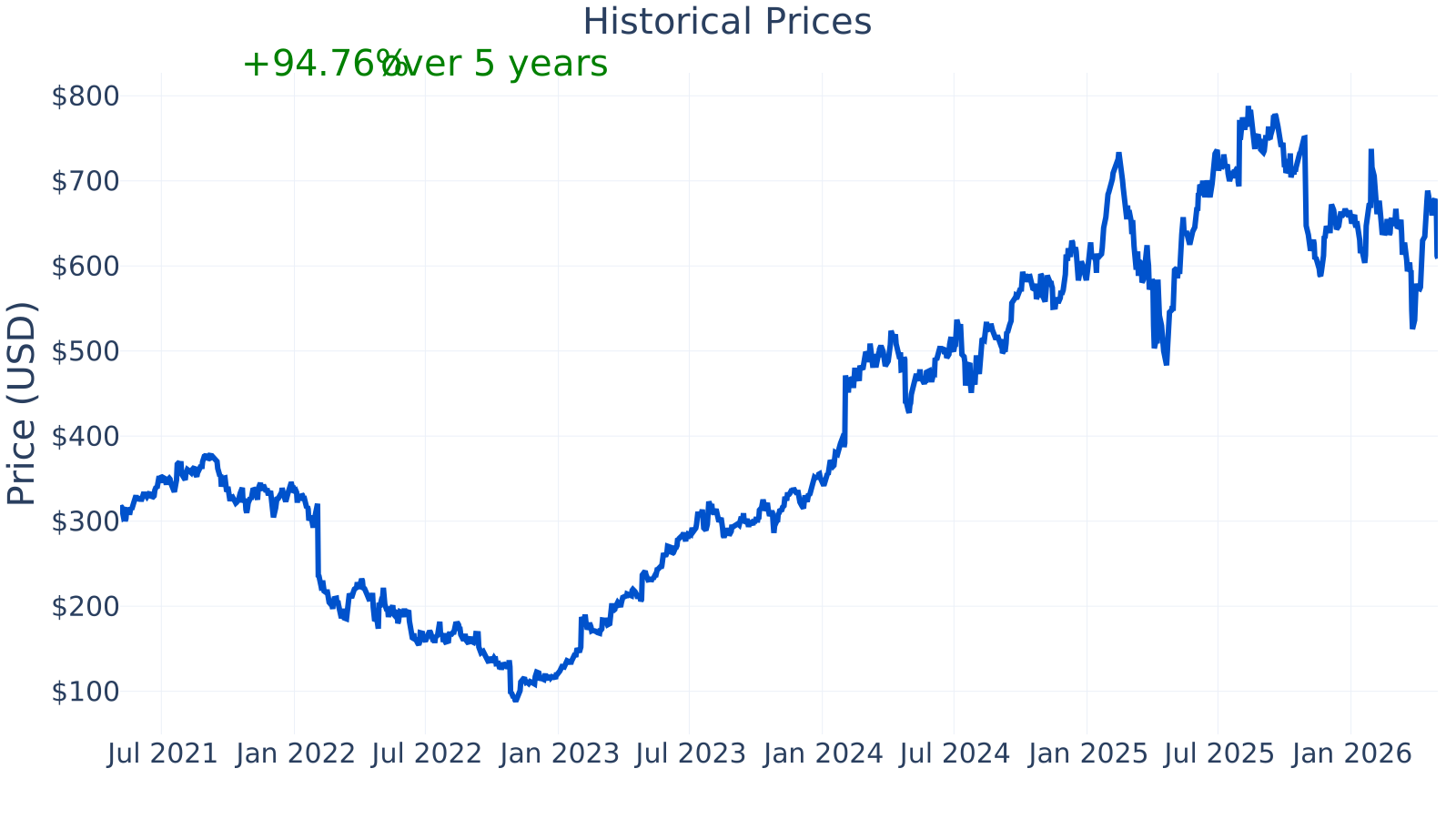
Meta’s market capitalization is about $1.55T, placing it among the largest public companies. The stock’s beta of ~1.31 indicates it has historically been more volatile than the overall market. On profitability, the latest profit margin is ~32.84%, substantially higher than the industry median shown (~9.94%), suggesting strong operating efficiency relative to many peers in the same broad classification. Recent growth is also notable: revenue growth year-over-year is ~33.10% versus an industry median of ~6.40%. Leverage is higher than the listed industry median: debt-to-equity is ~35.61% compared with ~5.95%. The latest P/E ratio is ~22.12 versus an industry median of ~15.98. Free cash flow over the trailing twelve months is about $48.25B, reflecting significant cash generation after operating costs and capital spending.
Growth (Medium)
Meta operates in large and still-evolving markets: digital advertising, online video, creator-driven content, and business messaging. Over long horizons, advertising budgets tend to follow consumer attention, and Meta’s apps remain major destinations for time spent and content discovery. This creates an ongoing opportunity to improve ad performance (better targeting and measurement) and ad formats (short-form video, shopping, click-to-message), which can support revenue even if user growth slows.
Meta’s strategy for future growth has several building blocks. One is improving monetization in areas that have historically been under-monetized, such as messaging, while continuing to refine ad tools that help marketers measure results. Another is heavy investment in AI for content ranking and advertising optimization, which can lift engagement and ad effectiveness. A third is the longer-term effort in immersive computing, which is uncertain in timing but could open new product categories if adoption expands.
Year-over-year revenue growth dipped into negative territory in parts of 2022, then re-accelerated through 2023–2026, reaching roughly 33% most recently. That pattern is consistent with a business that can be cyclical with ad markets, but also capable of re-accelerating when engagement, pricing, and ad performance improve.
Free cash flow shows a sharp drop from about $39.78B (TTM, 2022-03-31) to about $17.57B (TTM, 2023-03-31), followed by a strong recovery to roughly $49.54B (TTM, 2024-03-31) and around $48.25B most recently. For long-term owners, this matters because strong cash generation can support continued investment, resilience in downturns, and shareholder returns (subject to management decisions and board authorization).
Risks (High)
Meta faces several structural risks. A major one is regulation and legal scrutiny related to privacy, competition, and content governance. Changes in platform rules (including app-store policies and operating system privacy features) can affect ad targeting and measurement, potentially lowering ad prices or reducing advertiser demand. There is also reputation and brand risk tied to misinformation, harmful content, and user trust—issues that can lead to higher compliance costs, product changes, or advertiser caution.
Competition is intense and multi-layered. Meta competes for user time and advertising budgets with other large digital platforms, including Alphabet (Google/YouTube), TikTok, Snap, and X, while also competing indirectly with Apple and Amazon in parts of the advertising ecosystem. Meta’s competitive strengths include massive global scale, deep advertiser relationships, broad reach across multiple apps, and sophisticated ad delivery systems. However, switching costs for users can be low (people can adopt new apps quickly), and ad budgets can shift fast toward whichever platforms show the best performance.
Another key risk is execution risk from large R&D spending. Meta invests heavily in infrastructure and long-term bets. If these investments do not produce products that users adopt or advertisers can monetize, profitability could be pressured. The company also operates globally, so currency movements and differing local rules can affect reported results.
Meta’s debt-to-equity increased over time, reaching about 35.61% most recently, versus an industry median shown near 10.97% for the latest point. This does not automatically signal financial stress, but it does indicate Meta is using more leverage than many peers in the same category, which can reduce flexibility if operating conditions worsen.
Profitability declined during 2022–2023 (bottoming near the high teens in this series) and then rebounded strongly, reaching above 30% again and ending around 32.84%. This rebound suggests improved efficiency and/or better revenue monetization, but margins can still swing with ad cycles, investment intensity, and regulatory/compliance costs.
Valuation
Valuation is commonly discussed using the price-to-earnings (P/E) ratio, which compares the stock price to earnings. Meta’s latest P/E is about 22.12, above the industry median shown of about 15.98. Historically in this series, Meta’s P/E dropped to single digits in late 2022 and later moved back into the 20s and 30s, reflecting both changing market sentiment and changes in the company’s earnings level.
Interpreting whether the price is “expensive” depends on context rather than a single number. The current multiple sits alongside (1) high profit margins relative to the displayed industry median, (2) strong recent year-over-year revenue growth, and (3) substantial free cash flow generation. At the same time, Meta’s risk profile includes heavy ongoing investment, competitive pressure for attention and ad budgets, and meaningful regulatory uncertainty. These factors can justify a higher or lower valuation at different times, depending on how durable earnings and growth appear.
Conclusion
Meta is a large-scale digital advertising company with additional long-term product bets. The core business has historically produced strong profitability and significant free cash flow, and recent figures show a rebound in margins and an acceleration in year-over-year revenue growth. The company’s strategy emphasizes continued investment in AI-driven improvements and new platforms, which can support future monetization but also introduces uncertainty around spending levels and payoff timing.
The main long-term considerations are the durability of Meta’s user engagement and ad effectiveness, how successfully it navigates regulation and privacy constraints, and whether its large investment programs translate into sustainable products and revenue streams. From a valuation standpoint, Meta trades at a P/E above the listed industry median while also showing stronger profitability and growth than that median—an important trade-off to weigh when evaluating the stock strictly on fundamentals.
Sources:
- Meta Platforms, Inc. — Form 10-K (Annual Report) (Business, Risk Factors, and Financial Statements)
- SEC EDGAR — Meta Platforms, Inc. filings (10-K, 10-Q, 8-K)
- Meta Investor Relations — Earnings releases and shareholder materials
- Meta Investor Relations — Earnings call transcripts (company-hosted)
- Wikipedia — “Meta Platforms” (basic company background)
This article is for informational purposes only and does not constitute financial advice. Some content is AI-generated. See Disclaimer