Stock Analysis · Meta Platforms Inc (META)
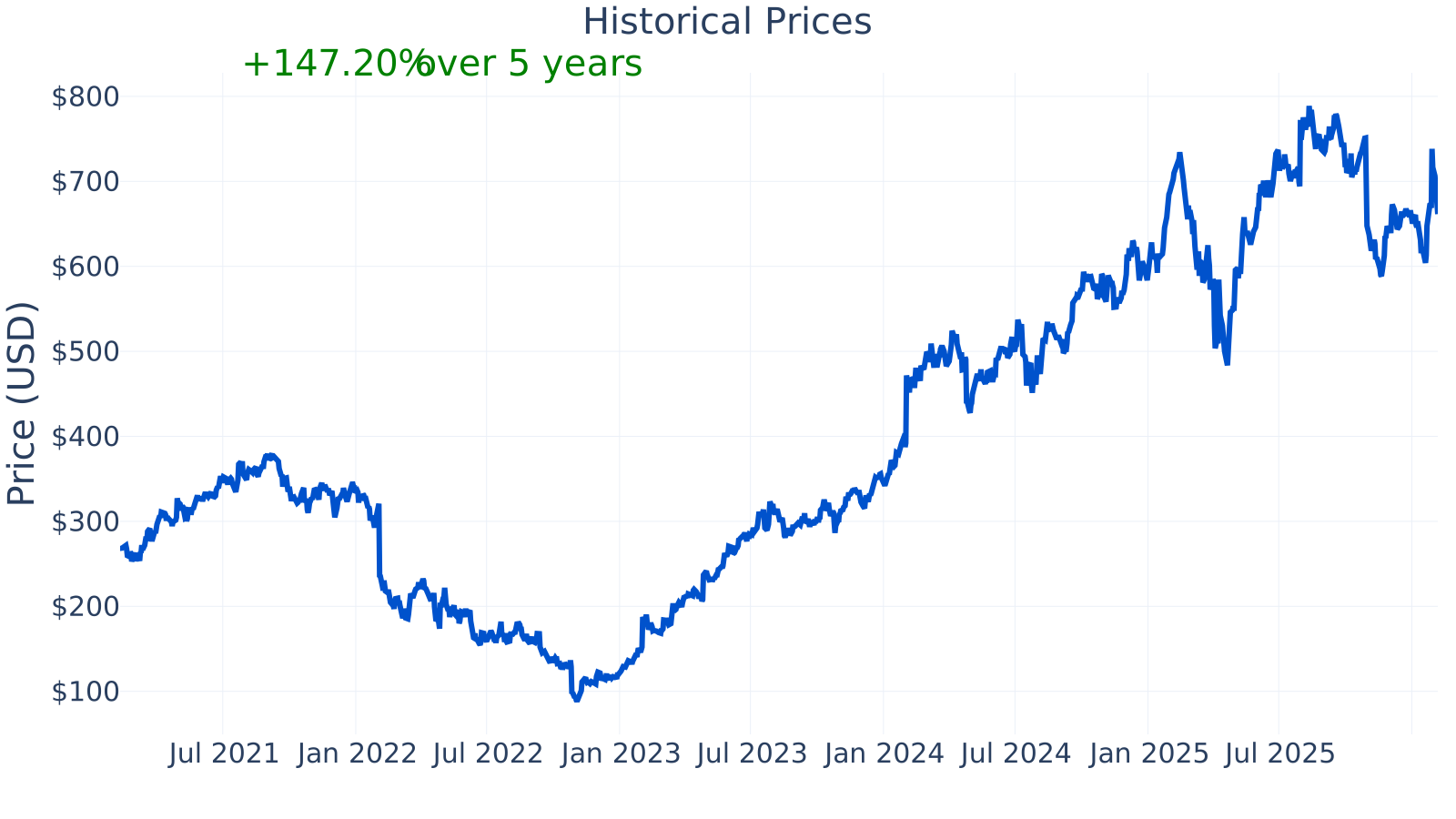
Overview
Meta Platforms Inc. is a global technology company best known for operating large social and communication apps and for selling digital advertising across them. Its main products include Facebook, Instagram, Messenger, and WhatsApp. The company also develops consumer hardware and software (such as virtual/augmented reality products) and invests heavily in long-term computing platforms and artificial intelligence that can improve content recommendations, advertising performance, and user experiences.
Meta’s business is organized around two main segments in its public reporting: (1) its core “Family of Apps” (Facebook, Instagram, Messenger, WhatsApp and related services), and (2) “Reality Labs,” which focuses on AR/VR and related technologies. In practical terms, Meta’s results are still overwhelmingly driven by advertising shown to users across its apps, while Reality Labs is positioned as a longer-term effort and has historically generated much smaller revenue relative to the core segment.
Main sources of revenue (largest to smallest, based on Meta’s reporting and typical mix):
- Advertising (the clear majority of revenue; driven by ads shown across Facebook and Instagram in particular)
- Other revenue (includes consumer hardware and other items; smaller compared with advertising)
The company’s income profile over recent years shows how results can shift with expense levels (especially research and development) and efficiency efforts. Revenue and profits declined in 2022, then recovered strongly afterward, alongside a rebound in revenue growth and significantly higher profitability.
From 2022 to 2025, revenue increased notably (about $116.6B to about $201.0B), while operating income rose even faster (about $28.9B to about $85.9B). Over the same period, research and development spending also increased meaningfully (about $35.3B to about $57.4B), highlighting continued investment even as operating profitability improved.
Key Figures
| Metric | Value | Industry ⓘ |
|---|---|---|
| Date | Feb 08, 2026 | |
| Context | ||
| Sector | Communication Services | |
| Industry | Internet Content & Information | |
| Market Cap ⓘ | $1.67T | |
| Beta ⓘ | 1.28 | |
| Fundamental | ||
| P/E Ratio ⓘ | 28.17 | 14.12 |
| Profit Margin ⓘ | 30.08% | 10.23% |
| Revenue Growth ⓘ | 23.80% | 7.10% |
| Debt to Equity ⓘ | 38.62% | 10.16% |
| PEG ⓘ | 1.19 | |
| Free Cash Flow ⓘ | $46.11B | |
Meta’s market capitalization is about $1.67T, reflecting its position as one of the largest companies in its sector. The stock’s beta of 1.28 indicates it has tended to move more than the broader market. Profitability stands out: a ~30.1% profit margin versus an industry median of ~10.2%. Recent top-line momentum has also been strong with ~23.8% year-over-year revenue growth versus an industry median of ~7.1%. Leverage is higher than the industry median, with debt-to-equity of ~38.6% compared with ~10.2% for the industry median. The company also generated substantial cash, with free cash flow (TTM) of about $46.1B. The P/E ratio of ~28.2 is above the industry median (~14.1), while a PEG ratio of ~1.19 suggests the valuation is not only about today’s earnings but also about expected growth.
Growth (Medium)
Meta operates in digital advertising and social media—industries that have historically benefited from long-term shifts of marketing budgets toward online channels and performance-based advertising. Within that environment, Meta’s growth strategy is closely tied to improving ad effectiveness (helping advertisers measure outcomes and reach the right audiences) and keeping user engagement high across its apps, especially as usage continues to evolve toward short-form video and messaging.
One potential catalyst for growth is Meta’s continued use of AI systems to improve recommendations and ad targeting within the constraints of privacy and platform changes. Better ad performance can support pricing and demand, while better content ranking can support engagement. Another catalyst is the scale of its app ecosystem: product improvements can be rolled out across billions of users, and advertiser tools can benefit from large amounts of conversion and performance feedback.
Revenue growth has shown a clear cycle: very high growth in 2021, a slowdown and contraction in parts of 2022, and then a sustained re-acceleration from 2023 through 2025. The most recent year-over-year revenue growth shown is ~23.8%, which is well above the industry median in the table.
Free cash flow has also been sizable over time, though it has fluctuated. It was about $24.2B (2021), rose to about $39.8B (2022), fell to about $17.6B (2023), and then increased sharply to about $49.5B (2024) and about $52.3B (2025). This matters because strong cash generation can support large infrastructure spending (data centers and AI capacity), research efforts, and financial flexibility without relying as heavily on external funding.
Risks (High)
This article is for informational purposes only and does not constitute financial advice. Some content is AI-generated. See Disclaimer


