Stock Analysis · Figs Inc (FIGS)
Overview
Figs, Inc. (FIGS) is an apparel company focused on healthcare professionals. Its best-known products are scrubs, along with related workwear and accessories designed for medical and other clinical settings. The company’s positioning is built around branded, fit- and function-focused products, with a strong emphasis on direct relationships with customers through its own digital channels.
Figs’ revenue is primarily generated through selling its products directly to consumers (for example, through its website and mobile app). Based on the company’s business description in its SEC filings, the main revenue streams are typically:
- Scrubs (core apparel) — the largest contributor
- Other apparel / outerwear — smaller than scrubs
- Accessories (such as bags, socks, and related items) — generally the smallest category
The company’s filings should be consulted for the most current category breakdown, as percentages by product line are not always disclosed in a consistent way across periods.
Business snapshot from recent annual results: total revenue increased from about $419.6M (2021) to $555.6M (2024). Over the same period, profitability tightened materially: net income moved from about -$9.6M (2021) to about $2.7M (2024), with operating income also compressing by 2024.
Across 2021–2024, revenue rose steadily (about $419.6M to $555.6M), while operating income fell from roughly $10.1M (2021) to about $2.3M (2024). A key swing factor is that operating expenses grew over time (about $290.2M in 2021 to about $373.4M in 2024), which reduced operating profit despite higher gross profit.
Key Figures
| Metric | Value | Industry ⓘ |
|---|---|---|
| Date | Feb 08, 2026 | |
| Context | ||
| Sector | Consumer Cyclical | |
| Industry | Apparel Manufacturing | |
| Market Cap ⓘ | $1.77B | |
| Beta ⓘ | 1.30 | |
| Fundamental | ||
| P/E Ratio ⓘ | 97.64 | 22.80 |
| Profit Margin ⓘ | 3.03% | 4.94% |
| Revenue Growth ⓘ | 8.20% | 1.60% |
| Debt to Equity ⓘ | 13.09% | 109.04% |
| PEG ⓘ | N/A | |
| Free Cash Flow ⓘ | $21.99M | |
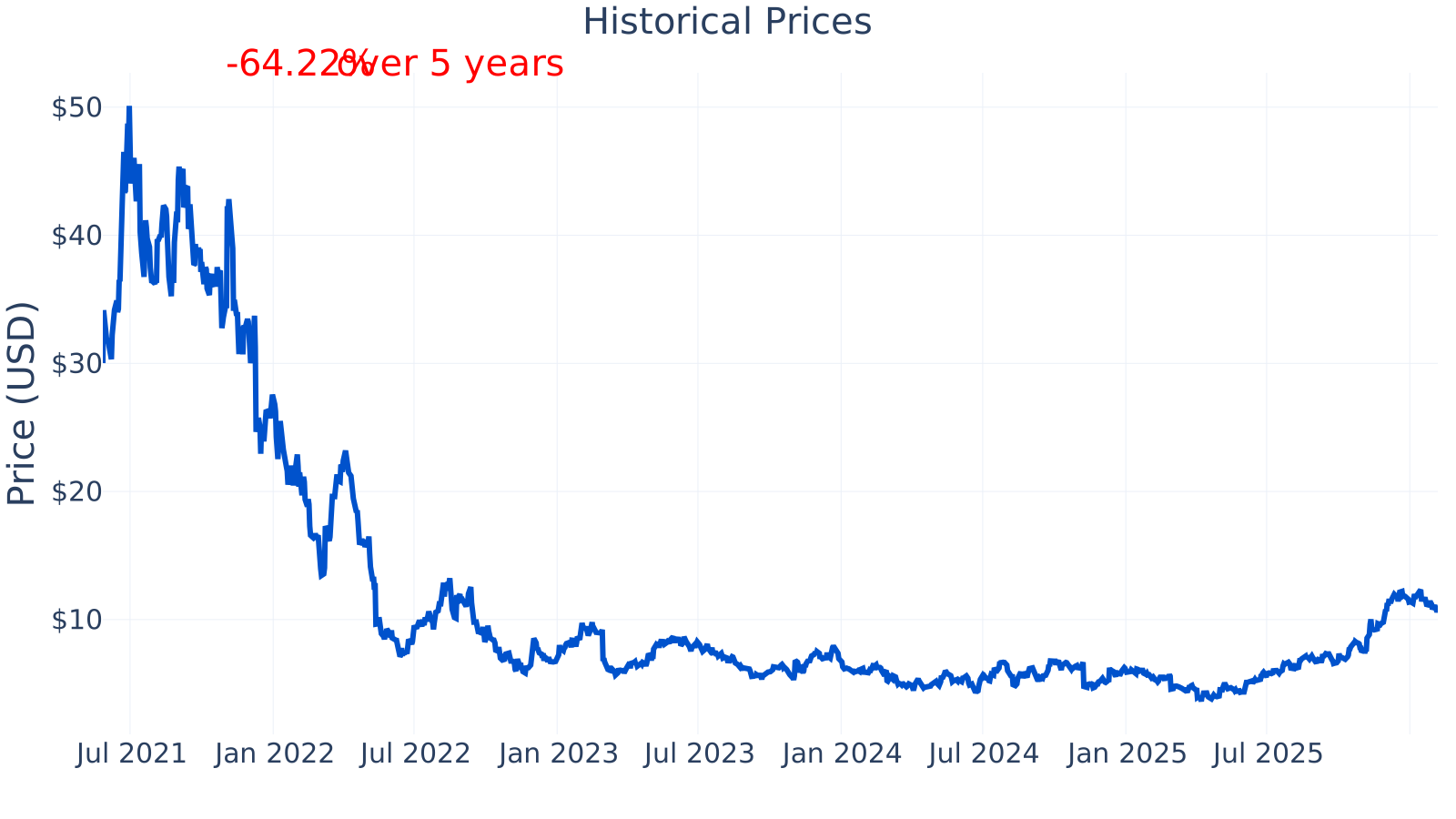
Figs’ market capitalization is about $1.77B. The stock’s beta (~1.30) suggests it has tended to move more than the broader market. Recent valuation and operating metrics show a mix of faster growth than the industry median but lower profitability: P/E ~97.6 vs an industry median ~22.8, profit margin ~3.0% vs industry median ~4.9%, and YoY revenue growth ~8.2% vs industry median ~1.6%. Leverage appears relatively conservative with debt-to-equity ~13% versus an industry median ~109%. Trailing twelve-month free cash flow is about $22.0M.
Growth (Medium)
Figs operates in a large, established end market—workwear for healthcare professionals—where demand is tied to employment levels in healthcare, replacement cycles for uniforms, and customer preferences. This is not typically a “hypergrowth” category, so longer-term expansion often depends on capturing share through brand strength, product innovation, and expanding into adjacent categories (for example, non-scrub apparel items or new customer segments within healthcare and related professions).
The company’s strategy—building a recognizable brand and selling predominantly through its own channels—can support growth by improving customer retention and enabling new product launches without relying entirely on wholesale partners. This approach can also help the company learn from customer behavior more quickly (for example, what fits, colors, or styles are popular), though it also means the company bears more responsibility for driving traffic and demand through marketing.
Year-over-year revenue growth decelerated significantly from the very high levels seen in 2021–2022 (for example, ~42.7% in late 2021 and ~20%–25% in parts of 2022) to low single digits around 2023–2024, then improved again into 2025 (reaching roughly 8.2% in the most recent point shown). This pattern is consistent with an early surge followed by normalization, with a more recent re-acceleration that would need to persist to materially change the longer-run growth profile.
Free cash flow has been volatile over the last several years: positive in 2021–2022, negative around early 2023 (about -$35.9M at one point), then strongly positive in 2024 (peaking around $99.3M) before moderating to about $60.9M in early 2025 and roughly $22.0M most recently. For a consumer brand, sustained free cash flow matters because it can fund inventory needs, marketing, and product development without requiring significant external financing.
Potential catalysts for future growth (in a descriptive, non-predictive sense) typically include: successful new product category expansion, improved repeat purchasing, and more efficient customer acquisition spending. As with many consumer brands, the main question is whether the brand can drive durable demand while maintaining healthy margins.
Risks (High)
Figs’ risks resemble those of many branded consumer apparel companies, with a few that are especially important for a digitally led model. Demand can be influenced by brand momentum, fashion cycles (even in uniforms, preferences change), and the cost of acquiring customers through digital advertising. If marketing becomes less efficient, it can pressure operating profit even if revenue grows.
Competition is a central risk. The healthcare workwear category includes both specialist scrub brands and broad apparel retailers. Competitors can include established scrub-focused brands and uniform suppliers, as well as large athletic/apparel brands and retailers that may offer scrub lines or workwear. In this landscape, Figs’ main competitive advantages are typically described as brand recognition within its niche, product design/fit, and a direct-to-consumer relationship. However, durable “moats” in apparel can be difficult to sustain if competitors replicate styles and use pricing promotions or broader distribution.
Another key risk is profitability. Even with rising revenue over the last several years, net income has narrowed sharply by 2024, which indicates that cost structure (including overhead, marketing, and other operating expenses) can materially influence results.
Leverage appears relatively low: the most recent debt-to-equity is about 13%, well below the industry median (about 109%). Historically, it has remained in a low range (roughly mid-single digits to mid-teens as shown). Lower leverage can reduce financial strain during weaker demand periods, though it does not eliminate operating risks such as margin compression or inventory challenges.
Profit margin has fluctuated meaningfully. After negative margins in late 2021/early 2022, margins turned positive and reached mid-single digits in 2022, then trended lower through 2024 before improving again to about 3.0% most recently. This remains below the industry median (about 5.7% at the latest point shown), highlighting that the company’s recent profitability has been thinner than peers even while growth has been comparatively higher.
Valuation
On an earnings basis, the stock has recently traded at a substantially higher P/E than the industry median. The latest P/E shown is about 97.6, compared with an industry median around 22.8. Historically, the company’s P/E (when meaningful/positive) has also tended to sit well above the industry median, with notable swings over time. A higher P/E can be consistent with expectations of stronger future growth, higher future margins, or both, but it also means the valuation can be more sensitive to disappointment if growth slows or profitability weakens.
Because current profit margins are relatively slim (about 3%) and have been volatile, valuation discussion often hinges on whether margins can expand and free cash flow can remain consistently positive. In that context, the combination of a high P/E and lower-than-industry profitability indicates that a large part of the market’s pricing is tied to expectations of improvement rather than current earnings power.
Conclusion
Figs is a niche, brand-led apparel company serving healthcare professionals, with revenue that has grown over the last several years and a balance sheet that appears conservatively leveraged relative to peers. At the same time, operating profitability has compressed by 2024, profit margins have been volatile, and free cash flow has varied widely across periods.
For a long-term, fundamentals-focused view, the central points to track are: whether revenue growth can remain consistently above industry norms, whether operating expenses can be managed in a way that supports durable margin expansion, and whether free cash flow stabilizes at healthy levels. Against that operating backdrop, the stock’s relatively high P/E versus industry levels suggests the market price is more dependent on future execution than on current profitability.
Sources:
- SEC EDGAR — Figs, Inc. Form 10-K (Annual Report): “Business” and “Management’s Discussion and Analysis of Financial Condition and Results of Operations”
- SEC EDGAR — Figs, Inc. Form 10-Q (Quarterly Report): “Management’s Discussion and Analysis of Financial Condition and Results of Operations”
- Figs, Inc. Investor Relations — SEC filings and shareholder materials (company-hosted)
- Wikipedia — “Figs (company)” (basic company background)
This article is for informational purposes only and does not constitute financial advice. Some content is AI-generated. See Disclaimer