Stock Analysis · Flywire Corp (FLYW)
Overview
Flywire Corp is a payments technology company that helps organizations accept and manage large, complex payments—often across borders and in multiple currencies. Instead of acting like a typical consumer payment app, Flywire focuses on “vertical” (industry-specific) workflows where payers and receivers need more than a card swipe: invoicing details, compliance checks, reconciliation, refunds, and clear tracking for both sides of the transaction.
Its platform is commonly used in areas such as education (for example, tuition and student-related payments), healthcare (patient payments), and business-to-business (B2B) use cases. The value proposition is mainly about reducing friction in payment collection, improving payment certainty, and simplifying back-office work (matching payments to the right student account, patient bill, or invoice).
Flywire’s revenue is typically generated from payment-related fees (a take rate on the payment volume it processes) and, depending on the customer and use case, software/platform-related fees tied to its embedded workflow tools. The company reports revenue by business line (rather than as a simple “product A vs product B” split). A clear percentage breakdown by revenue source is not provided in the information included here; in company filings, investors typically review revenue concentration and segment discussions for context around which verticals are the largest drivers.
From 2021 to 2025, total revenue increased from about $201 million to about $623 million, indicating meaningful scale-up over time. Over the same span, the company’s expense mix shows ongoing investment in operating costs (including sales/marketing and R&D) while progressing from operating losses (2021–2023) to positive operating income in 2024. (One 2025 operating/interest line item appears unusually large relative to revenue and is treated cautiously here; investors typically confirm such outliers directly in the audited filing and footnotes.)
Key Figures
| Metric | Value | Industry ⓘ |
|---|---|---|
| Date | Mar 02, 2026 | |
| Context | ||
| Sector | Technology | |
| Industry | Software - Infrastructure | |
| Market Cap ⓘ | $1.51B | |
| Beta ⓘ | 1.28 | |
| Fundamental | ||
| P/E Ratio ⓘ | N/A | 24.58 |
| Profit Margin ⓘ | 2.17% | 6.79% |
| Revenue Growth ⓘ | 34.00% | 16.35% |
| Debt to Equity ⓘ | 1.81% | 26.59% |
| PEG ⓘ | N/A | |
| Free Cash Flow ⓘ | $95.43M | |
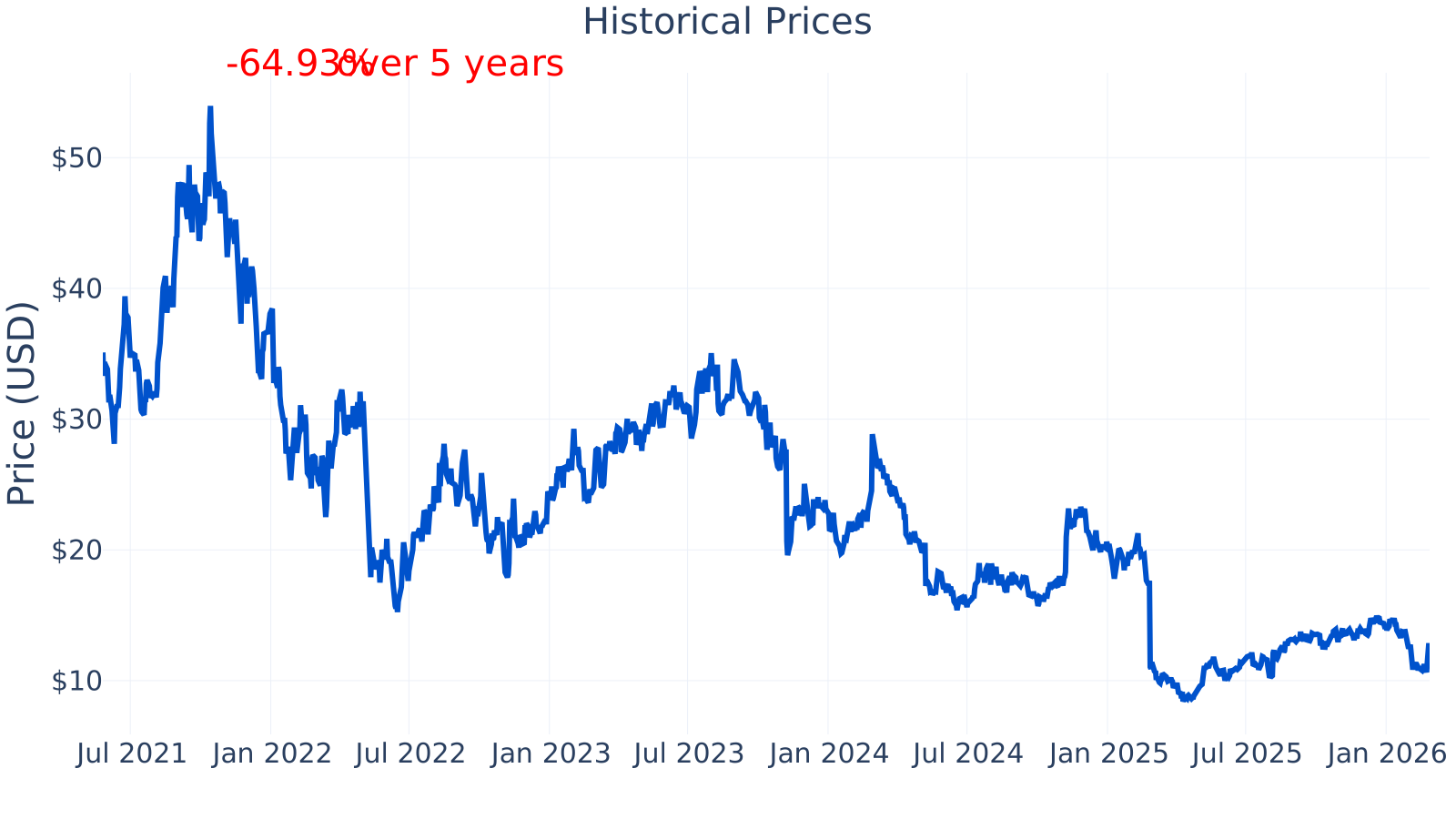
Flywire’s market capitalization is about $1.51 billion, and the stock’s beta of ~1.28 suggests it has tended to move more than the overall market. The company’s latest profit margin is ~2.17% versus an industry median around 6.79%, which indicates profitability has improved but still trails many peers in the same broad industry group. On growth, the most recent year-over-year revenue growth is ~34%, above the industry median (~16.35%). Balance-sheet leverage looks low, with debt-to-equity around ~1.81% versus an industry median near 26.59%. Trailing twelve-month free cash flow is about $95.4 million, which can be an important signal of operating cash generation.
Growth (Medium)
Flywire operates in a part of the payments and financial software ecosystem that benefits from long-term digitization trends: organizations are increasingly moving away from checks, manual bank transfers, and fragmented payment portals toward integrated payment experiences embedded directly into industry-specific systems. Cross-border education payments and healthcare billing workflows can be particularly complicated, which tends to favor specialized platforms built around compliance, reconciliation, and payer support rather than generic payment processing alone.
Revenue growth has remained positive over the period shown, with growth rates that were very high earlier (often above 40% in 2021–2023 quarters) and then generally moderating into the teens to 30% range in 2024–2025. The latest value shown (~34%) is higher than the industry median shown (~16%). This pattern can be consistent with a business transitioning from an early rapid expansion phase to scaling at a larger base.
A key part of Flywire’s strategy is vertical specialization—winning institutions (universities, healthcare providers, or B2B platforms) and embedding into their workflows. If that integration becomes sticky, it can support retention and expansion through additional use cases within the same customer (for example, adding more payment types, geographies, or related workflow tools).
Free cash flow (trailing twelve months) has improved over time in the period shown, moving from modestly positive to negative in 2023, then back to positive and higher levels in 2024–2025 (about $48.6 million at 2025-03-31, and about $95.4 million in the latest metrics). Sustained free cash flow can give a company more flexibility to invest in product development, sales capacity, and potential acquisitions without relying as heavily on external financing.
Risks (High)
Flywire’s main risks typically center on competition, execution, and the operating environment for the verticals it serves. Payments is a crowded field, and larger payment processors and fintech platforms can compete aggressively on pricing and features. Even if Flywire differentiates through vertical workflows, customers may still evaluate alternatives, negotiate fees, or use multiple providers.
Financial leverage appears low relative to the industry median across most of the period displayed, with the latest debt-to-equity around 1.81% versus an industry median near 15.78% at the same time point. Low leverage can reduce financial risk in downturns, but it does not remove operating risks such as slower customer growth, pricing pressure, or higher costs to acquire and support enterprise clients.
Profitability has been uneven. The profit margin was negative for much of 2021–2024, briefly turned positive in some recent quarters, and the latest value shown is about 2.17%, below the industry median (about 6.71%). This suggests the business has made progress toward profitability, but margins may still be sensitive to operating expense levels, product investment, and customer acquisition costs.
Flywire’s competitive positioning is often framed around industry-specific payment experiences (education, healthcare, and complex B2B flows) and cross-border capabilities. Competitive advantages may include workflow integration, compliance and reconciliation tooling, and relationships with institutions and software platforms in its target verticals. However, leadership is difficult to define without a single standardized market-share measure because “vertical payments” overlaps with broader payment processing and software categories.
Main competitor sets can include:
- Large payment processors and platforms that can serve enterprises (for example, firms offering payment acceptance, payout tools, and treasury features).
- Vertical software providers that embed payments directly into their own platforms (for example, education administration or healthcare billing software vendors with integrated payment options).
- Bank and cross-border payment networks for international transfers, which can compete depending on price, speed, and user experience.
Because pricing and switching decisions can be influenced by implementation complexity, compliance requirements, and customer service quality, Flywire’s long-term results may depend heavily on execution: maintaining platform reliability, expanding integrations, and keeping the value proposition clear enough to defend take rates.
Valuation
The P/E ratio chart shows limited meaningful data for several periods (displayed as 0), which commonly happens when earnings are negative or near zero. When the P/E does appear, it is very high at times (for example, above 100 in late 2024 and above 200–300 in parts of 2025), while the industry median shown is around the high-20s to low-30s. This pattern often indicates that earnings are still relatively small compared with the stock price, so the P/E can swing dramatically with small profit changes.
In this context, valuation discussions often rely more on a blend of indicators rather than a single metric: revenue growth trajectory (still relatively high vs. the industry median), progress toward durable profitability (still modest margins vs. peers), and cash generation (positive free cash flow recently). The mix of strong growth and still-developing profitability can lead to valuation sensitivity if growth slows, margins compress, or costs rise faster than revenue.
Conclusion
Flywire is a payments technology company focused on complex, vertical-specific payment workflows, with multi-year revenue expansion and recent signs of improved profitability and cash generation. The business appears positioned within long-term digitization trends in payments and back-office automation, and its vertical integration approach can support stickier customer relationships when implemented successfully.
At the same time, the company operates in a highly competitive environment, and profitability metrics remain lower than the industry median despite recent improvement. Valuation signals such as an intermittently very high P/E (when measurable) suggest results may be sensitive to changes in earnings and investor expectations. Overall, the long-term picture depends on Flywire’s ability to sustain above-industry growth while steadily improving margins and defending its role within the verticals it serves.
Sources:
- SEC EDGAR — Flywire Corp filings (Form 10-K, Form 10-Q)
- Flywire Investor Relations — SEC filings and shareholder materials (company-hosted)
- Wikipedia — “Flywire” (basic company background)
This article is for informational purposes only and does not constitute financial advice. Some content is AI-generated. See Disclaimer