Stock Analysis · Flywire Corp (FLYW)
Overview
Flywire Corp is a software-enabled payments company that helps organizations accept and manage complex, high-value payments, especially when money needs to move across borders, currencies, and payment methods. Instead of acting like a simple “pay now” button, Flywire focuses on use cases where the payer needs guidance (for example, an international student paying tuition) and where the receiving organization needs reconciliation, compliance checks, and integration into back-office systems.
Flywire typically earns revenue by charging fees connected to payment processing and foreign exchange (when currency conversion is involved). The company operates a payments platform and provides related software workflows to reduce manual work for its clients (such as matching incoming payments to the right student, patient, or customer account).
Based on how the company describes its business in its SEC filings, revenue is generally tied to payment activity and volume across its main verticals. These verticals commonly include education, travel, and healthcare, with additional activity in other “B2B” use cases. Public filings can vary in how much exact percentage breakdown is disclosed from period to period, so the mix is best read as a “largest-to-smallest by strategic focus” rather than a fixed split.
- Education-related payments (tuition and fees, often cross-border)
- Travel payments (tour operators, travel companies, and related suppliers)
- Healthcare payments (patient and insurance-related payment flows in certain markets)
- Other / B2B payments (additional industries and payment use cases)
Flywire’s model tends to benefit when its clients grow, when more payments move onto its platform, and when the company expands within existing customers (more campuses, more hospitals, more geographies, or more payment types).
The income flow over recent years shows revenue rising substantially from 2021 to 2024, while operating expenses also increased. By 2024, the company reached slightly positive operating income and net income, suggesting that scale and cost discipline can materially affect results even if profitability remains relatively thin.
Key Figures
| Metric | Value | Industry ⓘ |
|---|---|---|
| Date | Feb 08, 2026 | |
| Context | ||
| Sector | Technology | |
| Industry | Software - Infrastructure | |
| Market Cap ⓘ | $1.38B | |
| Beta ⓘ | 1.28 | |
| Fundamental | ||
| P/E Ratio ⓘ | N/A | 25.67 |
| Profit Margin ⓘ | -0.42% | 6.91% |
| Revenue Growth ⓘ | 27.60% | 15.20% |
| Debt to Equity ⓘ | 1.81% | 19.82% |
| PEG ⓘ | N/A | |
| Free Cash Flow ⓘ | $48.64M | |
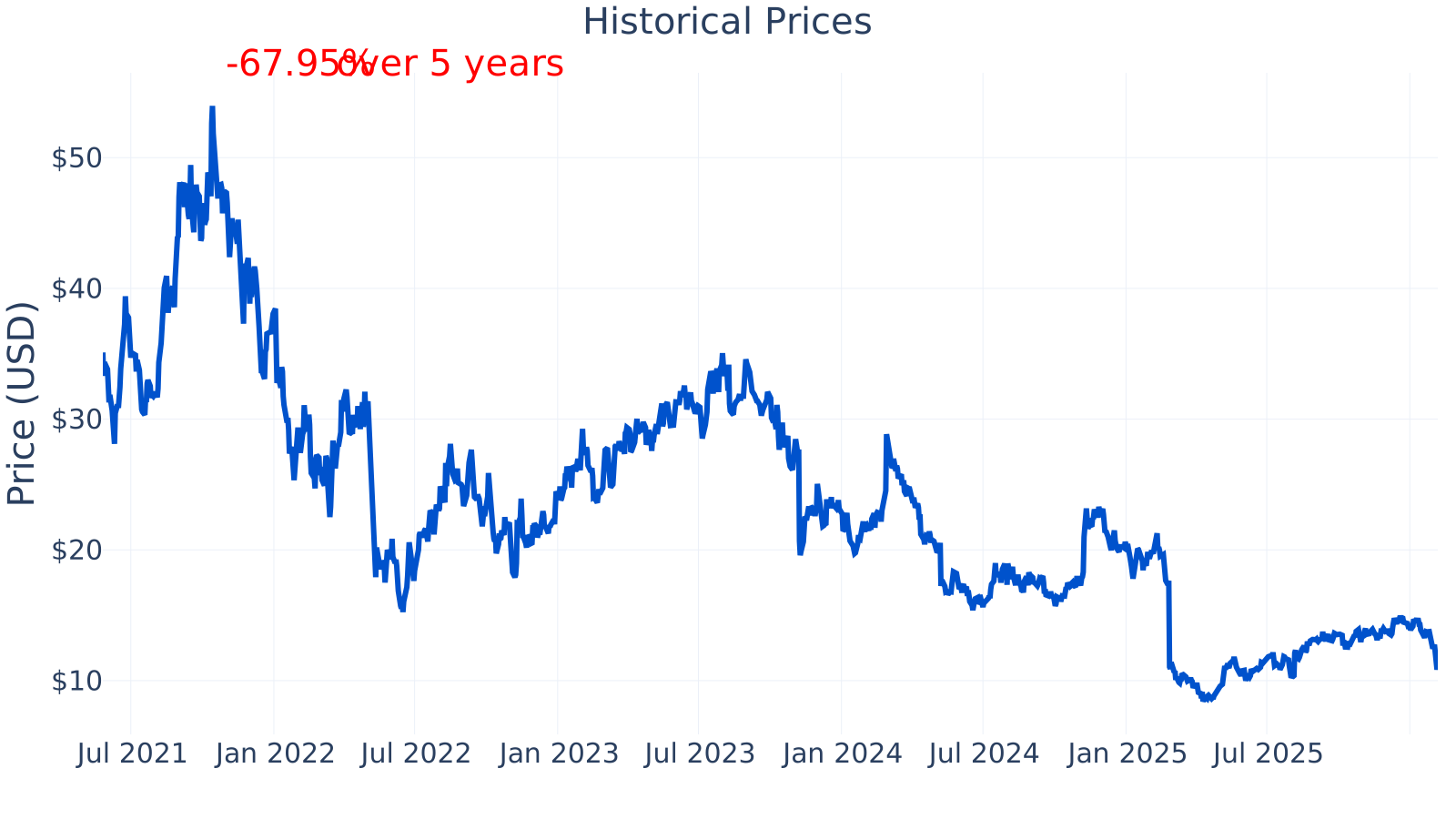
Flywire’s market capitalization is about $1.38B, placing it in the small- to mid-cap range. The stock’s beta of ~1.28 indicates it has historically moved more than the overall market on average. Recent profitability is close to break-even, with a profit margin of about -0.42% versus an industry median near 6.9%. Growth has been stronger than the industry median, with year-over-year revenue growth of ~27.6% compared with an industry median around 15.2%. Balance-sheet leverage appears low, with debt-to-equity around 1.8% versus an industry median near 19.8%. Free cash flow over the trailing twelve months is about $48.6M, showing cash generation even while accounting profitability is near zero.
Growth (medium)
Flywire operates in digital payments and vertical-specific payment workflows—areas that have long-term tailwinds as more transactions move from manual, bank-based processes to software-driven platforms. Its niche is not “payments for everything,” but “payments where things are complicated”: cross-border payers, multiple currencies, many local payment methods, and a need for reconciliation and compliance. In these situations, organizations often prefer an end-to-end platform rather than stitching together separate providers.
Strategically, Flywire’s approach is centered on (1) going deep in specific industries (like education and healthcare), (2) expanding within existing customers, and (3) adding new geographies and payment methods. If executed well, this can support durable growth because integrations and workflows can create switching friction: once the platform is embedded into enrollment, billing, or booking processes, changing providers can become disruptive.
Revenue growth has remained positive but has moderated from very high levels earlier (often above 40% in 2021–2023 quarters) to the high-teens to high-20% range more recently, including about 27.6% in the latest period shown. This pattern is consistent with a business that has scaled from a smaller base and is transitioning toward more “normalized” growth rates.
Free cash flow has been positive in recent periods and is about $48.6M on a trailing twelve-month basis. The timeline shown includes a dip into slightly negative territory in 2023, followed by a rebound in 2024 and continued positive levels into 2025. For a company near break-even profitability, consistent free cash flow can be an important signal of operating efficiency and working-capital dynamics.
Potential catalysts that can influence long-term growth (in either direction) typically include: expanding adoption within large education or healthcare customers, new payment corridors and local payment method additions, and deeper product integration that makes the platform more central to customer operations. As a payments business, overall payment volumes in its end markets also matter; if customers see lower activity (for example, fewer international enrollments or weaker travel demand), Flywire’s growth can slow.
Risks (high)
This article is for informational purposes only and does not constitute financial advice. Some content is AI-generated. See Disclaimer