Stock Analysis · Expedia Group Inc (EXPE)
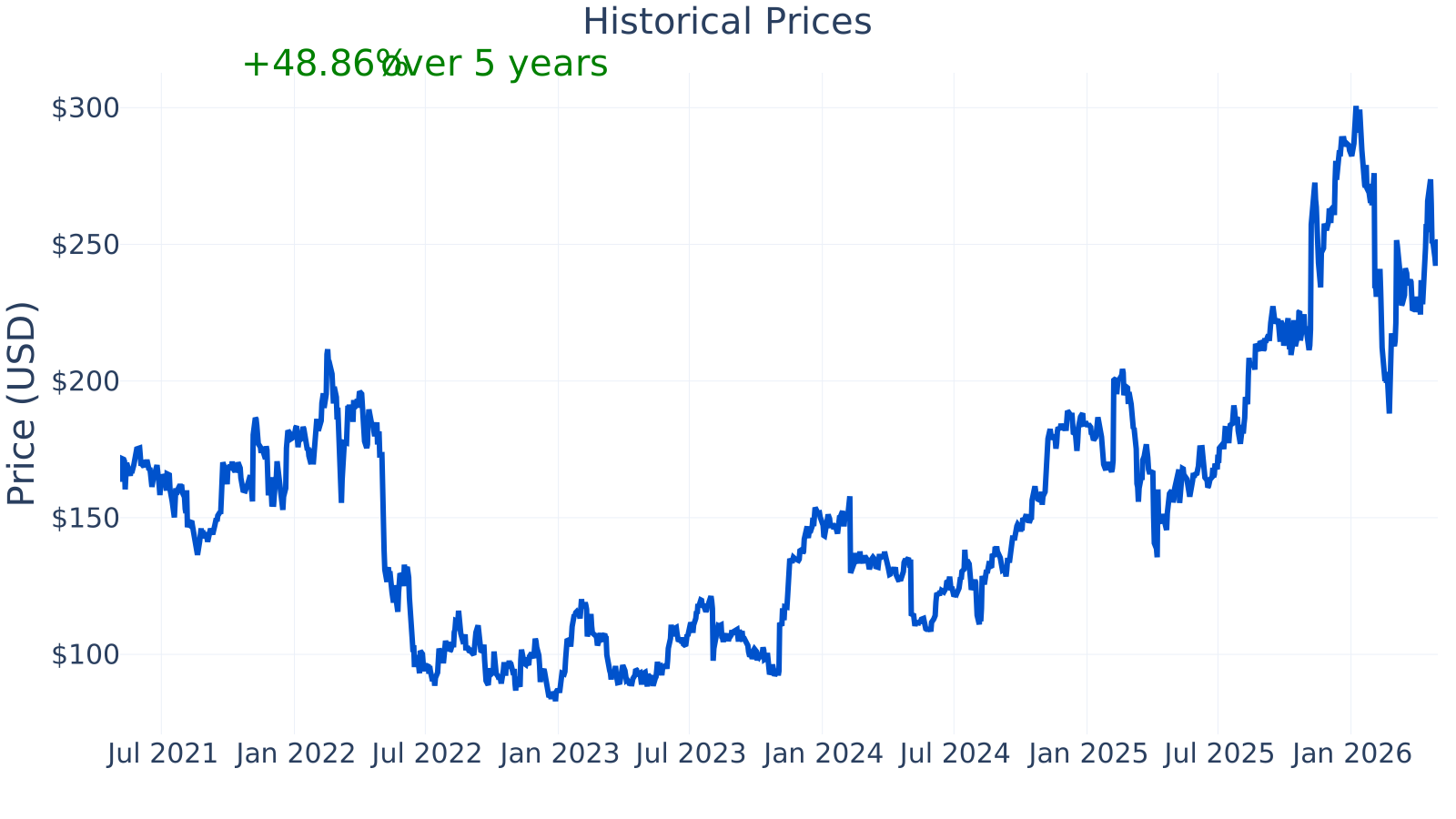
Overview
Expedia Group Inc operates online travel brands that help people search, compare, and book trips. Through its websites and apps, customers can book lodging (such as hotels and vacation rentals), airline tickets, car rentals, cruises, and activities. Expedia Group also provides technology and distribution tools to travel suppliers (for example, hotels) and to partners that embed Expedia’s travel inventory into their own websites.
In plain terms, Expedia mainly earns money by taking a commission or fee when a traveler books through its platforms, plus advertising and partner-related revenue. The business is typically described in two parts in company reporting: a consumer-facing travel marketplace and a business-to-business travel platform for partners.
Across Expedia’s travel marketplace, the main revenue streams generally include:
- Lodging (hotels and alternative accommodations) — typically the largest driver of revenue in online travel agencies because it often carries higher commissions than other travel products.
- Air (airline tickets) — usually lower margin than lodging, but helps attract customers and enables “bundled” trips.
- Advertising and media — travel suppliers can pay for visibility and placement.
- Other travel products — car rentals, activities, cruises, travel insurance, and related services.
- Partner / B2B travel technology — revenue tied to providing travel booking capabilities to other businesses.
Expedia’s scale comes from well-known brands (including Expedia, Hotels.com, and Vrbo) and from its global supply relationships with hotels and other travel providers.
Over the last several years, the company’s total revenue has risen from about $8.6B (2021) to about $14.7B (2025). Operating income expanded from about $262M (2021) to about $2.0B (2025), and net income increased from roughly $12M (2021) to about $1.3B (2025). Research and development spending has stayed substantial (around $1.1B–$1.4B per year), reflecting ongoing investment in product, technology, and platform capabilities.
Key Figures
| Metric | Value | Industry ⓘ |
|---|---|---|
| Date | May 04, 2026 | |
| Context | ||
| Sector | Consumer Cyclical | |
| Industry | Travel Services | |
| Market Cap ⓘ | $30.23B | |
| Beta ⓘ | 1.33 | |
| Fundamental | ||
| P/E Ratio ⓘ | 25.65 | 24.01 |
| Profit Margin ⓘ | 8.78% | 8.78% |
| Revenue Growth ⓘ | 11.40% | 12.00% |
| Debt to Equity ⓘ | 519.39% | 93.66% |
| PEG ⓘ | 0.89 | |
| Free Cash Flow ⓘ | $3.69B | |
Expedia Group’s market capitalization is about $30.2B. The stock’s beta of ~1.33 indicates it has historically moved more than the overall market, which can matter for long-term holders who prefer lower volatility.
Profitability is currently in line with the industry median, with a profit margin of ~8.78%. Growth is also close to peers: year-over-year revenue growth is ~11.4% versus an industry median near 12%.
The most notable outlier in the snapshot is leverage: debt-to-equity is ~519% compared with an industry median near 94%. Free cash flow over the last twelve months shown is about $3.695B, which highlights meaningful cash generation, but the balance sheet structure still deserves attention because leverage can amplify outcomes in both good and difficult travel environments.
Growth (Medium)
Online travel is tied to long-term demand for leisure and business travel, and the broader shift toward digital booking has been a multi-year tailwind for the industry. Within that landscape, Expedia’s growth prospects depend on maintaining strong traveler demand, improving conversion (turning searches into bookings), and increasing repeat usage through loyalty and a smoother cross-brand experience.
A practical way to think about Expedia’s strategy is that it aims to strengthen its marketplace by improving the traveler experience (apps, personalization, customer service) while also expanding partner distribution (B2B) so that Expedia’s inventory and booking tools are used beyond Expedia-branded sites. If executed well, this can broaden demand sources and reduce reliance on any single channel.
Revenue growth has normalized from very high post-pandemic comparisons to more typical rates. Recent quarters shown trend mostly in the mid-single digits to low double digits, ending around 11.4% most recently. That pattern is consistent with a large, established company operating in a mature but still expanding digital travel market.
Free cash flow has been positive across the periods shown, ranging from roughly $1.62B (2024) to $3.91B (2022), and about $2.95B (2025). For a platform business, sustained free cash flow can support investments in technology and marketing, as well as balance sheet management, but it can still fluctuate with travel demand and spending decisions.
Potential catalysts are typically operational rather than one-time events: better app engagement and loyalty penetration, improved efficiency in marketing spend, stronger supply relationships (especially lodging), and expansion of partner/technology revenue streams.
Risks (High)
Expedia operates in a highly competitive and cyclical market. Demand for travel can fall during recessions or periods of uncertainty, and online travel companies often face pressure to spend more on marketing when competition increases. In addition, lodging supply partners (hotels and property managers) can push to drive more direct bookings, which may limit the pricing power of online agencies.
Competition is a central risk. Expedia competes with other large online travel agencies and metasearch platforms, including Booking Holdings (Booking.com and related brands), Trip.com Group, and metasearch players such as Google Travel. It also competes with direct channels (hotel and airline websites) and with alternative accommodation platforms. Expedia has strong brand awareness and global scale, but it is not the only scaled player, and some rivals are leaders in certain geographies or categories.
Expedia’s competitive advantages are mainly scale and breadth (large supply network and many travel products), brand portfolio, and the ability to match travelers with inventory efficiently. These advantages can support long-term relevance, but they do not eliminate the need for ongoing investment because switching costs for travelers can be low.
Leverage stands out versus peers. The most recent debt-to-equity value shown is about 519%, while the industry median is around 143%. The chart also shows that Expedia’s leverage has been elevated for several years and spiked above 700% at points. High leverage can reduce flexibility in downturns, increase sensitivity to interest rates, and make consistent execution more important.
Profit margins improved significantly from negative territory in 2021 to consistently positive levels in later periods, recently around 8.78% (similar to the industry median). While that reflects a healthier operating environment and improved profitability, margins in travel can still swing with marketing intensity, mix shifts (for example, more air vs. lodging), and travel demand patterns.
Valuation
Expedia’s current price-to-earnings (P/E) ratio is about 25.65, slightly above the industry median near 24.01. Over the period shown, Expedia’s P/E has generally moved within a range that reflects changing profitability and market expectations, with several readings in the high teens to mid-20s more recently.
Interpreting this in a simple way: the market is valuing Expedia as a profitable, established online travel platform with ongoing growth, but not pricing it as an extreme high-growth company. Whether that valuation level is “high” or “low” depends on how durable one expects travel demand, margins, and cash generation to be, and how one weighs the company’s higher leverage relative to peers.
Conclusion
Expedia Group is a large online travel platform with recognizable brands and a business model primarily driven by commissions and fees on travel bookings, complemented by advertising and partner-related revenue. The company has shown meaningful improvement in profitability since the pandemic period and has generated substantial free cash flow in the periods shown, alongside continued investment in technology.
At the same time, the business operates in a competitive, promotion- and marketing-intensive market where customer switching can be easy and travel demand can fluctuate with the economy. Among the most important fundamentals to monitor is Expedia’s balance sheet leverage, which is notably higher than the industry median and can increase sensitivity to weaker travel cycles or tighter financial conditions.
From a valuation perspective, the P/E ratio sits close to the industry median, which is broadly consistent with a mature platform business that still has room to grow but faces meaningful competition and cyclical exposure. The long-term narrative therefore depends less on a single product cycle and more on execution: sustaining demand, managing marketing efficiency, expanding higher-value areas, and maintaining resilience given the company’s leverage profile.
Sources:
- SEC EDGAR — Expedia Group Inc Forms 10-K and 10-Q (consolidated financial statements and business description)
- Expedia Group Investor Relations — Annual Reports / Shareholder Materials and earnings materials (company-hosted)
- Wikipedia — “Expedia Group” (general company background)
This article is for informational purposes only and does not constitute financial advice. Some content is AI-generated. See Disclaimer


