Stock Analysis · Expedia Group Inc (EXPE)
Overview
Expedia Group Inc. is an online travel company. It operates websites and apps that help people plan and book trips, including lodging (such as hotels and vacation rentals), flights, car rentals, cruises, and activities. It also provides tools and services for travel suppliers (like hotels and other partners) to list, manage, and market their travel offerings.
Expedia generally earns money by taking a commission or “take rate” when a booking happens on its platforms, and by selling advertising and other partner services. The business is often described as a marketplace: travelers bring demand, and travel suppliers provide inventory.
In its SEC filings, Expedia reports results primarily through two segments: B2C (direct-to-traveler brands) and B2B (partner travel technology and distribution). Across these segments, the main revenue streams typically include:
- Lodging revenue (commissions/agency fees and merchant margin on hotel and short-term rental bookings)
- Air revenue (fees from airline ticket bookings)
- Advertising and media (travel advertising and sponsored placements)
- Other revenue (car rental, activities, insurance, and other travel-related services)
Because revenue mix can shift by year and reporting category, the most reliable percentages are those disclosed in the company’s latest annual report (10-K). This article keeps the breakdown at a practical level and focuses on the business model and the drivers behind results.
Over recent years, total revenue has increased meaningfully (from about $8.6B in 2021 to about $13.7B in 2024), while operating income also improved (from about $0.26B to about $1.79B). Interest expense appears relatively steady in the same period (roughly mid-$200M range recently), which highlights why profitability and cash generation matter for a company that carries material leverage.
Key Figures
| Metric | Value | Industry ⓘ |
|---|---|---|
| Date | Feb 07, 2026 | |
| Context | ||
| Sector | Consumer Cyclical | |
| Industry | Travel Services | |
| Market Cap ⓘ | $29.30B | |
| Beta ⓘ | 1.38 | |
| Fundamental | ||
| P/E Ratio ⓘ | 22.84 | 21.78 |
| Profit Margin ⓘ | 9.66% | 10.37% |
| Revenue Growth ⓘ | 8.70% | 10.60% |
| Debt to Equity ⓘ | 484.52% | 96.47% |
| PEG ⓘ | 0.65 | |
| Free Cash Flow ⓘ | $3.58B | |
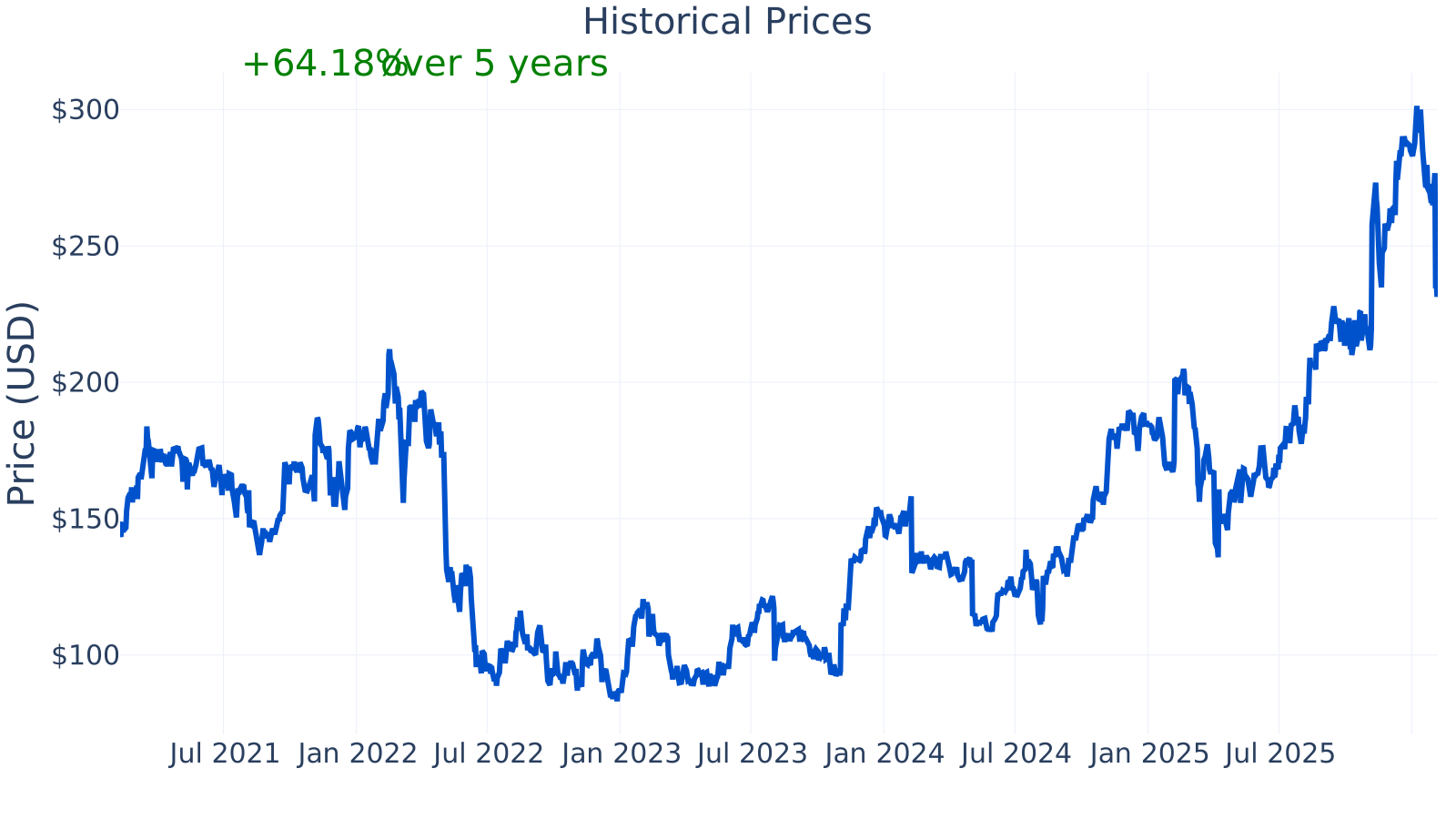
Expedia’s market capitalization is about $29.3B, and its beta of ~1.38 suggests the stock has tended to move more than the broader market. The latest P/E ratio is ~22.8, close to the industry median (~21.8). Profit margin is about 9.66% (slightly below the industry median of ~10.37%), and the most recent year-over-year revenue growth shown is about 8.7% (below the industry median of ~10.6%). A notable metric is debt-to-equity of ~485%, far above the industry median (~96%), indicating a more leveraged balance sheet. Trailing twelve-month free cash flow is about $3.58B.
Growth (medium)
Online travel is a large, well-established global category, and demand tends to track long-term trends such as rising travel participation, expanding lodging supply (including alternative accommodations), and ongoing digital booking adoption. At the same time, travel demand is cyclical: it typically weakens when consumers and businesses cut discretionary spending.
Expedia’s strategy, as described in its filings, has centered on building a more integrated “platform” across its brands and partner network. In simple terms, the goal is to make it easier for travelers to shop and book across devices, and easier for travel partners to distribute inventory efficiently—while using data and technology to improve conversion, personalization, and loyalty.
The revenue growth pattern shown is strong in the post-pandemic rebound period (with very high year-over-year increases in 2021 as travel recovered), then normalizes to mid-single to high-single digits more recently (around 3%–10% in the latest quarters shown). This is consistent with a mature industry where growth often comes from share gains, improved monetization, and operational execution rather than purely from market expansion.
Free cash flow turns from negative in early 2021 (about -$1.56B) to strongly positive thereafter, reaching about $3.91B in 2022 and about $2.95B in 2025 (as of the period shown), with some volatility in between. For long-term owners, sustained cash generation can matter because it helps fund product investment, balance sheet flexibility, and potential shareholder returns, although the uses of cash depend on management decisions and market conditions.
Potential catalysts that can influence results over time tend to be company-specific execution items rather than one-time events: improving the traveler experience (which can raise conversion), expanding partner distribution in B2B, increasing repeat usage through loyalty, and growing higher-margin advertising/media offerings. The pace of adoption of AI-driven search and customer service tools may also shape how efficiently travel platforms acquire customers and serve them, though outcomes across the industry remain uncertain.
Risks (high)
This article is for informational purposes only and does not constitute financial advice. Some content is AI-generated. See Disclaimer