Stock Analysis · ExlService Holdings Inc (EXLS)
Overview
ExlService Holdings Inc (EXLS) is a business services and technology company that helps other organizations run important “back-office” and customer-facing work more efficiently. In simple terms, it combines people, process design, and software to handle tasks such as analytics, operations support, and digital improvements. The company is commonly associated with work like business process management (outsourced operations) and data-driven services, with a strong emphasis on analytics and automation.
EXL primarily earns revenue by delivering ongoing services to enterprise clients. Its activities are typically organized around providing (1) digital operations support and process outsourcing and (2) analytics and data-led services, often supported by technology tools. While the company discloses revenue by service lines and verticals in its annual report, the exact percentage split is not included here because it is not provided in the available materials in this article draft.
Revenue drivers (high-level)
- Ongoing service contracts for operating and improving business processes (often multi-year arrangements)
- Analytics and data-driven services (e.g., modeling, insights, and decision support)
- Technology-enabled transformation work (automation and digital workflow improvements)
The financial profile shown below indicates a services business where a large portion of revenue goes to delivery costs and operating expenses, with profitability improving over time as revenue has grown.
Across 2021–2025, total revenue increased from about $1.12B to about $2.09B, while net income grew from about $115M to about $251M. Over the same period, operating income also expanded (about $154M to about $333M). This combination suggests the company has been able to scale while maintaining cost discipline, even as selling, general, and administrative spending increased alongside growth.
Key Figures
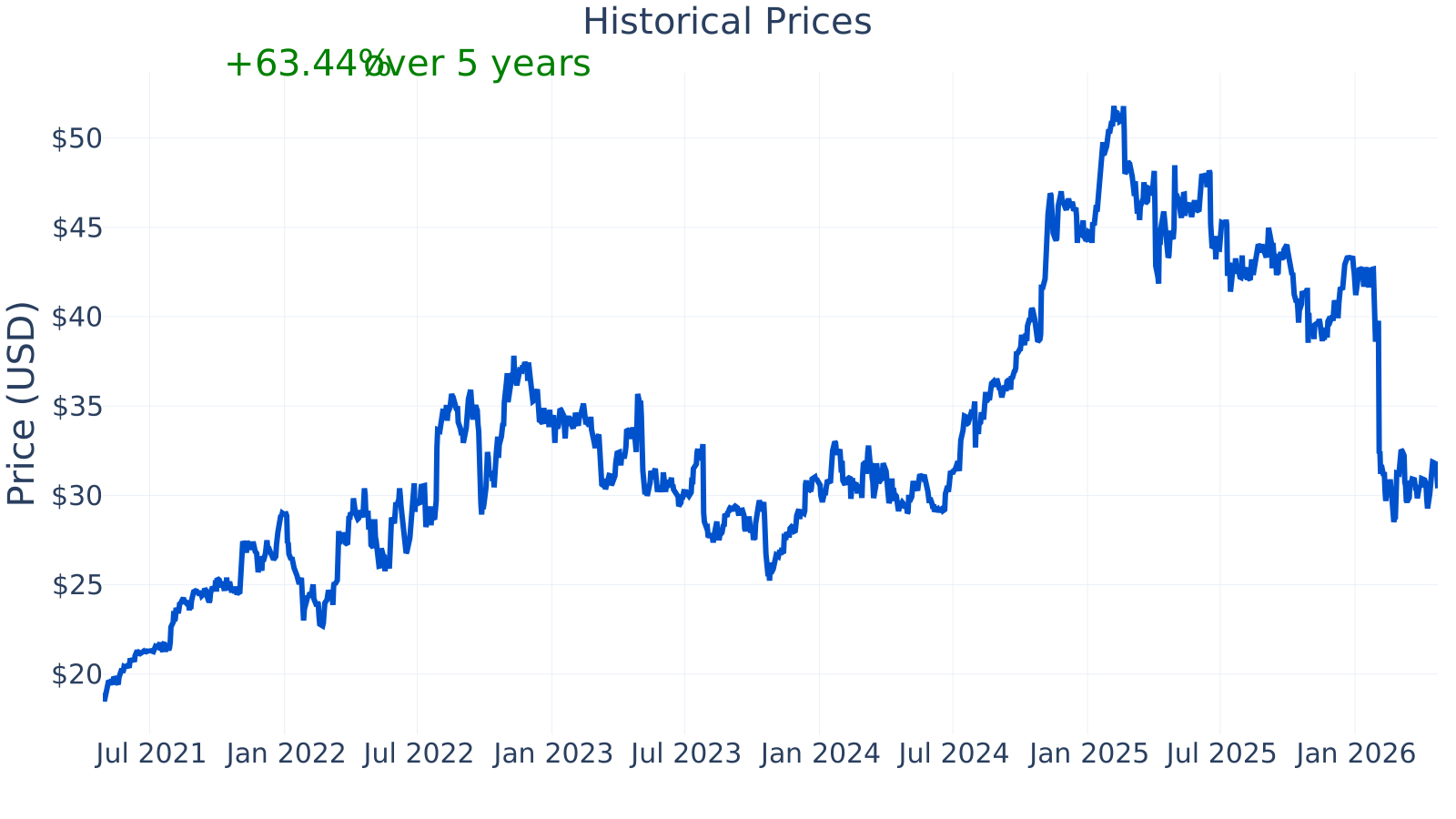
The stock price history shown spans multiple market cycles. It includes a strong run-up into early 2025 followed by a notable pullback into early 2026, illustrating that even established services companies can experience meaningful short- and medium-term volatility.
| Metric | Value | Industry ⓘ |
|---|---|---|
| Date | Apr 27, 2026 | |
| Context | ||
| Sector | Technology | |
| Industry | Information Technology Services | |
| Market Cap ⓘ | $4.75B | |
| Beta ⓘ | 0.90 | |
| Fundamental | ||
| P/E Ratio ⓘ | 19.74 | 17.45 |
| Profit Margin ⓘ | 12.02% | 5.39% |
| Revenue Growth ⓘ | 12.70% | 7.70% |
| Debt to Equity ⓘ | 44.46% | 49.00% |
| PEG ⓘ | 1.00 | |
| Free Cash Flow ⓘ | $298.12M | |
EXL’s market capitalization is about $4.75B and its beta is about 0.90, which is often interpreted as somewhat less volatile than the broader market. The company’s latest P/E ratio is about 19.7 versus an industry median near 17.5. Profit margin is about 12.0% versus an industry median near 5.4%, which suggests EXL is converting a larger share of revenue into profit than a typical peer in its industry group. Year-over-year revenue growth is about 12.7% versus an industry median near 7.7%, indicating above-median growth. Debt-to-equity is about 44% versus an industry median near 49%, implying leverage that is slightly below the peer midpoint. The PEG ratio is about 1.0 (a metric that compares valuation to expected growth), and trailing twelve-month free cash flow is about $298M.
Growth (medium)
EXL operates in an area that benefits from long-running trends: organizations continue to outsource specialized work, modernize internal operations, and use data to improve decisions and productivity. Demand for analytics, automation, and operational efficiency tends to persist because it is tied to cost control, compliance needs, and competitive pressure—factors that can matter in both strong and weak economic environments.
A key part of the company’s growth logic is that once EXL is embedded in a client’s workflow, it can expand the relationship over time—adding more processes, more geographies, more automation, and more analytics. In services businesses, this “land and expand” pattern can support durable revenue if execution and client satisfaction remain strong.
Year-over-year revenue growth was very high in 2021–2022 (often above 20%), then moderated through 2023–2024, and later re-accelerated into the mid-teens by late 2024 and through much of 2025 (ending 2025 around 12.7%). This pattern can be consistent with a larger revenue base and shifting client spending cycles, but it also means the company may need continued execution and new wins to sustain double-digit expansion.
Free cash flow (a cash-based measure that reflects how much cash the business generates after operating needs and capital spending) increased meaningfully over the period shown: roughly $102M (2022), $168M (2023), down to about $122M (2024), then up to about $246M (2025) and about $298M on a trailing basis. Rising cash generation can provide flexibility for reinvestment, acquisitions, debt management, and share repurchases, though the year-to-year movement also shows it is not perfectly steady.
Potential catalysts that can influence longer-term results include: continued adoption of automation and AI-enabled workflows by large enterprises, deeper penetration of analytics in regulated industries, and incremental margin improvement if technology and standardized delivery reduce the cost per unit of work.
Risks (medium)
EXL’s business is closely tied to enterprise client spending and operating priorities. If clients reduce discretionary projects, renegotiate contracts, or bring work back in-house, revenue growth and margins can be pressured. In addition, services contracts can create concentration risk: the loss of a large client, a contract rebid, or performance issues can have an outsized effect.
Competition is a core risk. EXL competes with large global IT services and business process outsourcing providers as well as consulting firms and specialists. Depending on the client need, competitive sets can include companies such as Accenture, Cognizant, Genpact, Infosys, Tata Consultancy Services, Wipro, IBM, and other analytics- and operations-focused service providers. Relative positioning often comes down to domain expertise in specific industries, the ability to deliver measurable outcomes, pricing, and scale. EXL is not the largest player in this broad market, but its profitability metrics suggest it may be operating efficiently versus many peers.
Debt-to-equity has generally been below the industry median across most of the period shown, though it fluctuates. It moved from the low-30% range in parts of 2023 to the mid-40% range by the end of 2025 (about 44%). This indicates moderate leverage: not extreme, but still meaningful, and it can matter during downturns or if interest rates rise and refinancing costs increase.
Profit margin remained consistently above the industry median throughout the period shown. It hovered near 10% for much of 2021–2024 and climbed toward about 12% by 2025, while the industry median was generally around the mid-single digits and trended lower by late 2025. This gap can be a sign of competitive strengths (such as stronger client mix, better execution, or more efficient delivery), but it can also attract competition if peers try to price more aggressively.
Additional risks include execution risk in scaling automation and analytics offerings, talent retention (services rely on skilled employees), and integration risk if acquisitions are used to accelerate capabilities or enter new verticals.
Valuation
The P/E ratio for EXL has varied materially over time, reaching higher levels in 2022 and early 2025 and then declining into early 2026 (around 21.0 on the latest point in the chart). The latest P/E from the key metrics table is about 19.7, slightly above the industry median near 17.5. In plain language, the market is pricing EXL at a modest premium to the typical peer group, which often happens when a company shows better growth and/or stronger profitability.
Whether that premium is “justified” depends on whether EXL can sustain its combination of (1) above-median revenue growth (about 12.7% vs. ~7.7% median) and (2) meaningfully higher profit margins (about 12.0% vs. ~5.4% median). The PEG ratio near 1.0 is a commonly used signal that valuation and growth expectations may be roughly aligned, though this metric depends heavily on forward-looking growth estimates and can change quickly with business conditions.
Conclusion
EXL is a technology-enabled services company focused on improving how enterprises run operations and use data, and the longer-term demand backdrop for efficiency, analytics, and automation appears supportive. Financially, it shows a combination of (a) revenue expansion from 2021 to 2025, (b) improving net income over that period, (c) profit margins that are consistently above the industry median, and (d) solid recent free cash flow generation.
The main trade-offs visible from the fundamentals are that EXL operates in a competitive market with client budget sensitivity, and its growth rate has fluctuated over time. Valuation metrics indicate it has often traded at a premium during strong periods and is currently near (or modestly above) industry typical levels, which places more emphasis on continued execution to maintain growth and margins.
Sources:
- SEC EDGAR — ExlService Holdings Inc filings (Form 10-K, Form 10-Q)
- ExlService Holdings Inc Investor Relations — Annual reports and shareholder materials
- Wikipedia — “EXL Service” (basic company background)
This article is for informational purposes only and does not constitute financial advice. Some content is AI-generated. See Disclaimer