Stock Analysis · Evertec Inc (EVTC)
Overview
Evertec, Inc. (EVTC) is a payments and financial technology company with a strong presence in Puerto Rico and broader Latin America and the Caribbean. In simple terms, it helps move money and data safely between consumers, merchants, banks, and governments. Its services include processing card transactions, operating ATM and payment networks, providing technology services to financial institutions, and supporting digital payment acceptance for merchants.
In its public filings, Evertec generally describes its business through three main operating segments, which also represent its main revenue streams:
- Merchant Acquiring (services that help merchants accept card and digital payments)
- Payment Services (processing and network services related to debit/credit and electronic transactions)
- Business Solutions (technology and outsourcing services, including services provided to financial institutions and other customers)
Because the revenue mix can shift over time (and segment definitions can be updated), the most reliable place to confirm the latest percentage split is the company’s most recent Form 10-K/10-Q segment disclosure.
Across recent years, total revenue increased from about $590M (2021) to about $932M (2025). Over the same period, interest expense increased noticeably (from roughly $23M (2021) to roughly $68M (2025)), which can matter for long-term cash generation when interest rates are higher or when debt levels rise.
Key Figures
| Metric | Value | Industry ⓘ |
|---|---|---|
| Date | Apr 27, 2026 | |
| Context | ||
| Sector | Technology | |
| Industry | Software - Infrastructure | |
| Market Cap ⓘ | $1.82B | |
| Beta ⓘ | 0.84 | |
| Fundamental | ||
| P/E Ratio ⓘ | 13.41 | 29.35 |
| Profit Margin ⓘ | 15.20% | 6.83% |
| Revenue Growth ⓘ | 13.10% | 14.85% |
| Debt to Equity ⓘ | 186.51% | 24.49% |
| PEG ⓘ | 2.14 | |
| Free Cash Flow ⓘ | $160.14M | |
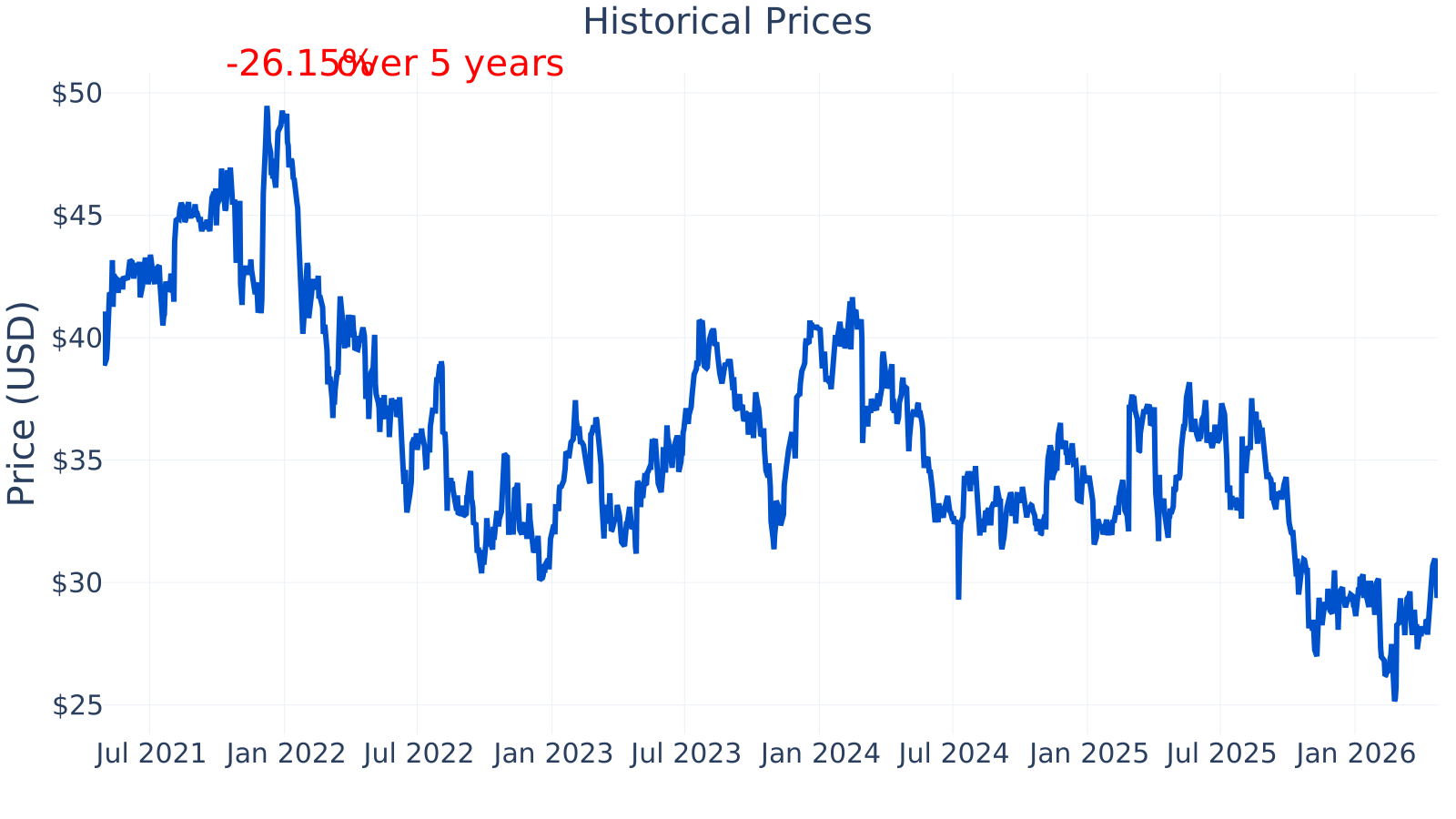
Evertec’s market capitalization is about $1.82B, and its beta of about 0.84 indicates the stock has historically moved somewhat less than the broader market. The company’s P/E ratio (~13.4) is below the median for its software/infrastructure peer group (~29.3), while its profit margin (~15.2%) is above the industry median (~6.8%). Year-over-year revenue growth is shown at about 13.1%, slightly below the peer median (~14.9%). A standout metric is leverage: debt-to-equity (~187%) is far higher than the industry median (~24%). Free cash flow over the trailing twelve months is about $160M.
Growth (Medium)
Evertec operates in electronic payments and financial technology, areas shaped by long-term trends such as increasing card and digital payment usage, more e-commerce activity, and ongoing modernization of bank and merchant systems. These themes can support steady demand, but the pace of growth can vary depending on consumer spending, tourism, and economic conditions in the regions where Evertec is most exposed.
Recent quarterly year-over-year revenue growth has been positive overall, with periods of faster growth (for example, above 20% in several quarters during 2024) and more moderate growth more recently (high single digits to low teens in parts of 2025, ending 2025 around 13%). This pattern is consistent with a business that can benefit from transaction volumes and expansion initiatives, but is not purely “linear” from quarter to quarter.
Free cash flow (a practical measure of cash left after operating needs and capital spending) has fluctuated over the last few years: roughly $212M (TTM in early 2022), down to about $117M (TTM in early 2024), and back to about $168M (TTM in early 2025). For long-term business strength, a key question is whether cash generation stabilizes or grows while the company manages financing costs.
Potential catalysts discussed in company materials typically relate to expanding merchant acceptance, deepening relationships with financial institutions, growing payment volumes, and continuing technology/platform investments. In general, execution matters: growth depends not only on overall payment adoption but also on the company’s ability to win and retain customers and run high-availability infrastructure.
Risks (High)
A central risk for Evertec is leverage. Higher debt can amplify results in both directions: it can support acquisitions or investments, but it also increases required interest payments and refinancing risk.
The debt-to-equity ratio has moved from under 100% in parts of 2022–2023 to levels around 150%–210% in 2024–2025, ending 2025 around 187%. This is well above the industry median shown on the chart (generally around the mid-teens to mid-30% range depending on the quarter), making capital structure a more significant factor here than for many peers.
Profitability is another area to watch because payment and processing businesses can face pricing pressure, investment needs (security, uptime, compliance), and changes in transaction mix.
Evertec’s profit margin has been volatile: it was very high in parts of 2021–2023, then compressed into the high single digits in early-to-mid 2024, and improved again into the mid-teens by 2025 (ending 2025 around 15%). Even after the decline from earlier peaks, the company’s margin remains above the peer median displayed for the industry, which suggests the business has been able to maintain profitability relative to many companies in the same broad category.
Competitive risk is structural. Evertec competes with large global payment processors and merchant acquirers, as well as regional players and bank-owned or bank-affiliated processors. Competitive advantages typically come from scale, reliability, regulatory/compliance capabilities, long-term customer relationships, and local market presence. Evertec’s positioning has often been described around its established infrastructure and relationships in Puerto Rico and parts of Latin America/Caribbean markets, but it is not the largest global player when compared with multinational processors.
Additional long-term risks include:
- Customer concentration and contract renewal risk (losing a major financial institution, network relationship, or merchant portfolio can affect volumes and revenue).
- Regulatory and compliance risk (payments are heavily regulated; requirements can change and raise costs).
- Cybersecurity and operational resilience risk (processing downtime or data incidents can cause direct costs and reputational damage).
- Regional macro and natural event exposure (economic cycles and extreme weather events can influence transaction activity and infrastructure reliability in key geographies).
Valuation
The P/E ratio history shows EVTC trading at a wide range of earnings multiples over time: roughly mid-20s in 2021, dipping near ~10 in parts of 2022–2023, rising above 30 in early-to-mid 2024, and declining again to the low teens by early 2026 (around 13 at the latest point shown). In the most recent periods where an industry median is displayed on the chart, Evertec’s P/E has been below the industry median (for example, in late 2025 and early 2026, EVTC is around the low-to-mid teens versus an industry median around the high 20s to ~30).
How to interpret that gap in plain language: a lower P/E can reflect the market pricing in factors such as higher leverage, region-specific exposure, or uncertainty about how durable margins and growth will be. At the same time, the company shows meaningful profitability and cash generation, so the valuation can also be viewed as tied to whether Evertec can sustain growth while managing debt levels and interest expense.
Conclusion
Evertec is a payments and financial technology company focused on transaction processing, merchant acceptance, and technology services, with deep roots in Puerto Rico and a broader presence across Latin America and the Caribbean. The business has grown revenue over recent years and has produced positive free cash flow, while profitability—though volatile—has remained above the peer median in the period shown.
The most material counterweight in the long-term picture is balance-sheet leverage: debt levels (relative to equity) and interest expense are high compared with typical software/infrastructure peers, making financing conditions and debt management especially important to track over time. Overall, the facts point to a company with real operating scale in its markets, but with a risk profile meaningfully influenced by debt and by the competitive and regulated nature of payments.
Sources:
- SEC EDGAR — Evertec, Inc. Forms 10-K, 10-Q, and 8-K
- Evertec, Inc. Investor Relations — Press releases and investor materials (company-hosted)
- Wikipedia — “Evertec” (basic company background)
This article is for informational purposes only and does not constitute financial advice. Some content is AI-generated. See Disclaimer