Stock Analysis · EverCommerce Inc (EVCM)
Overview
EverCommerce Inc (EVCM) is a software company focused on serving small and mid-sized businesses (“SMBs”). Its products are typically used to run day-to-day operations in service-based industries such as home services, health services, and fitness & wellness. In simple terms, the company sells tools that help businesses schedule appointments, manage customers, take payments, handle marketing, and run administrative workflows.
The business model is primarily recurring software subscriptions, often complemented by payment-related and other transaction-based fees. This recurring setup can create steadier revenue than one-time software sales, but it also depends on keeping customers over time and continuing to deliver useful features.
In recent years, the company’s financial profile shows a shift toward improved operating performance and profitability, even while revenue growth has been uneven.
Across the years shown, total revenue increased from 2021 through 2024, then fell in 2025 (about $699M in 2024 to about $589M in 2025). Over the same period, operating income improved substantially (from a loss in 2021–2022 to positive by 2023 and rising in 2025), which suggests tighter cost control and/or improved efficiency despite the lower top line in 2025.
Key Figures
| Metric | Value | Industry ⓘ |
|---|---|---|
| Date | Mar 16, 2026 | |
| Context | ||
| Sector | Technology | |
| Industry | Software - Infrastructure | |
| Market Cap ⓘ | $1.82B | |
| Beta ⓘ | 1.04 | |
| Fundamental | ||
| P/E Ratio ⓘ | N/A | 27.17 |
| Profit Margin ⓘ | 2.99% | 7.12% |
| Revenue Growth ⓘ | 5.20% | 15.80% |
| Debt to Equity ⓘ | 74.94% | 24.92% |
| PEG ⓘ | 0.36 | |
| Free Cash Flow ⓘ | $86.43M | |
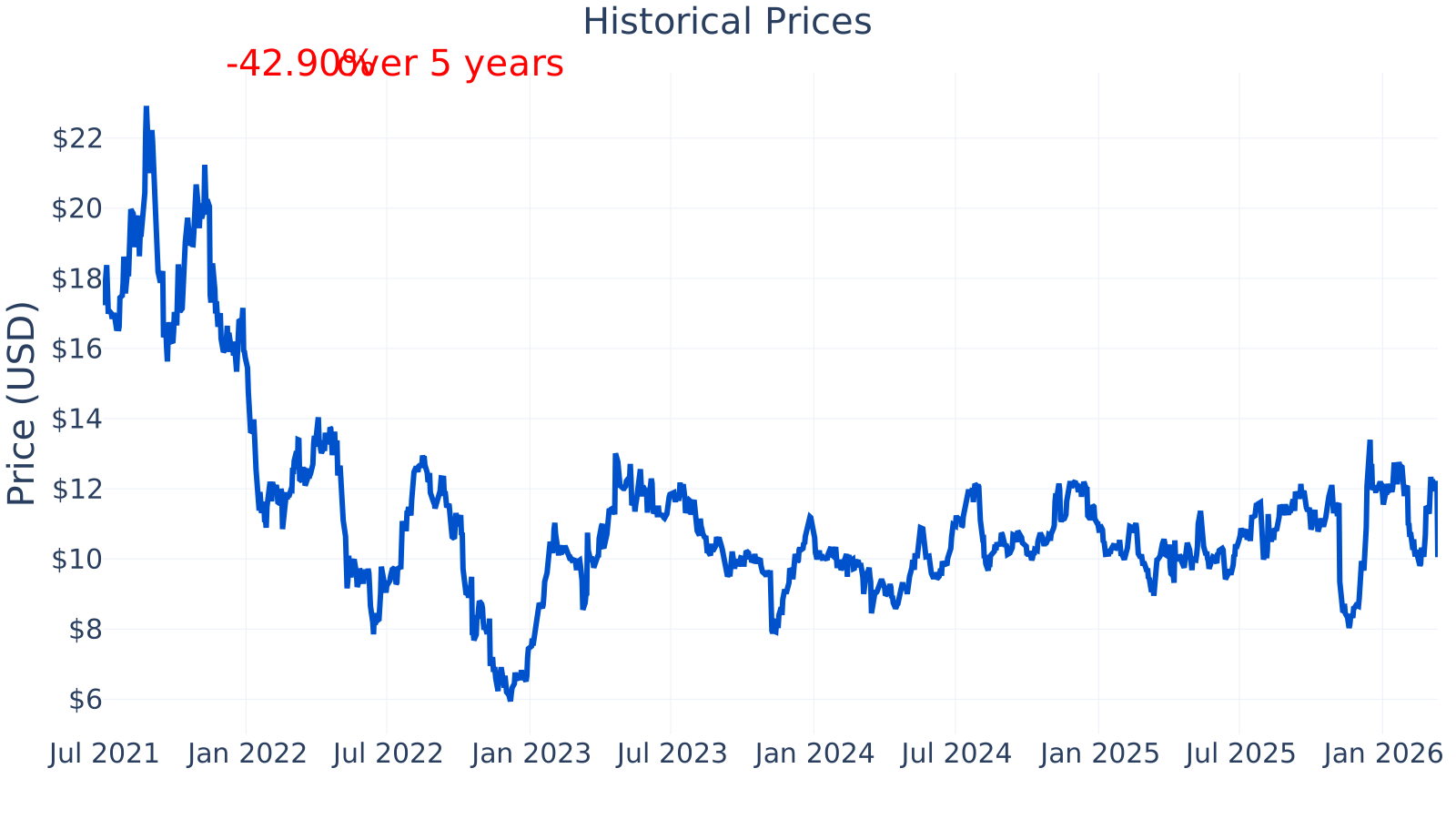
EverCommerce’s market capitalization is about $1.82B and its beta is about 1.04, which indicates price movements that have been broadly similar to the overall market. Profit margin is about 3.0%, below the industry median shown (about 7.1%), reflecting that profitability is present but not yet strong relative to many peers. Revenue growth is about 5.2% year-over-year, also below the industry median shown (about 15.8%), indicating slower recent expansion than the typical company in its listed peer group. Debt-to-equity is about 74.9% versus an industry median around 24.9%, meaning the company is more leveraged than many peers. Free cash flow over the trailing twelve months is about $86.4M, which can be an important support for operational flexibility (such as reinvestment, debt service, or acquisitions).
Growth (medium)
EverCommerce operates in a broad, long-running trend: businesses moving customer management, scheduling, marketing, and payments into cloud software. In general, SMBs continue to adopt tools that reduce manual work and help them attract and retain customers. This is a favorable backdrop, but it is also a competitive space with many vendors targeting similar customers.
A practical growth logic for EverCommerce is to keep expanding product capabilities for specific verticals (for example, home services or fitness studios) and increase revenue per customer by offering multiple integrated tools (software plus payments and related services). If executed well, this can improve retention because switching becomes harder when multiple workflows run on the same platform.
The year-over-year revenue growth pattern shown is volatile: very high growth in 2021–2022, moderating through 2023, turning negative for parts of 2024, briefly returning to small positives, and then turning negative again in late 2025. This uneven trajectory suggests that either end-market demand, customer churn/downsells, product mix, or portfolio changes (such as buying/selling business units) may be influencing reported revenue. For long-term assessment, consistency and the reasons behind the 2025 decline matter as much as the earlier growth.
Free cash flow over the periods shown trends upward overall (from roughly $35M in 2021 to over $110M by early 2025, with the latest table showing about $86M). Even with fluctuations, positive free cash flow can be an important ingredient for funding product development and reducing reliance on external financing.
Risks (high)
A key risk is competition. SMB software markets can have relatively low switching costs for some customers and a large number of alternatives. Competitors range from large horizontal platforms (broad business software suites) to focused vertical vendors that specialize in a single niche. In many categories, larger companies may have advantages in brand recognition, distribution, and the ability to bundle products.
EverCommerce’s competitive advantages tend to be more “execution-based” than “structural.” Advantages can come from deep vertical knowledge, integrations that save customers time, and a suite approach that increases convenience. However, the information available here does not indicate that EverCommerce is the clear leader across all its categories; it participates in multiple verticals where leadership can differ by niche.
Financial risk is also notable due to leverage. Higher debt relative to equity can increase sensitivity to interest costs and reduce flexibility during weaker revenue periods.
The debt-to-equity ratio rises over time in the chart and ends near 74.9%, consistently above the industry median shown (generally in the mid-teens to mid-30% range). This indicates a balance sheet that is more debt-heavy than many peers, which can amplify outcomes—helpful when operations improve, but more challenging if revenue softens or refinancing becomes more expensive.
Profitability risk remains relevant even though margins improved. The company spent several years with negative profit margins before moving slightly positive most recently, so sustaining profitability through business cycles is still a key point to watch.
The profit margin trend improves materially from large negatives in 2021 toward break-even in 2025 and reaches a positive level (about 3.0%) by the end of 2025. Even with this improvement, the margin remains below the industry median shown (about 6.9% at the same time), implying that peers on average are converting revenue into profit more efficiently.
Main competitors vary by vertical and product category, but they typically include: (1) large horizontal platforms that offer scheduling, payments, and customer management features as part of broader ecosystems, and (2) specialized vertical software providers focused on a single industry segment. EverCommerce’s positioning is best described as a multi-vertical operator with a portfolio of solutions, which can diversify end-market exposure but can also make it harder to concentrate scale in one category.
Valuation
The P/E ratio is not consistently meaningful for EverCommerce over much of the period shown, which often happens when net income is negative or very small (P/E can become negative or extremely high and is often not useful). The chart shows a P/E value appearing more recently (about 126.5 at the latest point), while the industry median shown is around 30.2. A higher P/E than peers can reflect expectations of future improvements, but it can also indicate that the current earnings level is still relatively low compared with the company’s market value.
Given the combination of (1) uneven recent revenue growth, (2) improving but still modest profitability relative to peers, and (3) above-median leverage, valuation interpretation tends to rely more heavily on forward-looking expectations and cash-flow durability than on a stable history of earnings-based multiples. In other words, the “justification” of the current price depends largely on whether the company can stabilize revenue trends while maintaining the profitability gains suggested by the margin improvement.
Conclusion
EverCommerce is positioned in the ongoing shift of SMB operations toward cloud-based software, a supportive long-term theme. The company’s recent history shows meaningful improvement in profitability and positive free cash flow, which can be important foundational traits for a software business.
At the same time, the revenue growth pattern has been inconsistent and turned negative in late 2025, leverage is higher than many peers, and profit margins—while improving—still lag the industry median shown. The overall long-term picture therefore depends on whether the company can re-establish steadier revenue performance while protecting the operating improvements that have recently emerged.
Sources:
- SEC EDGAR — EverCommerce Inc filings (Form 10-K, Form 10-Q)
- EverCommerce Inc — Investor Relations materials (company-hosted press releases and presentations)
- Wikipedia — “EverCommerce” (basic company background)
This article is for informational purposes only and does not constitute financial advice. Some content is AI-generated. See Disclaimer


