Stock Analysis · Euronet Worldwide Inc (EEFT)
Overview
Euronet Worldwide Inc (EEFT) is a payments and money movement company. In practical terms, it helps cash and digital payments work across banks, retailers, and consumers. Its operations are typically described through three main business areas: (1) an ATM network that provides cash access and related services, (2) payment processing and related software/services for financial institutions and merchants, and (3) money transfer and other consumer-focused financial services.
Because Euronet operates across several payment “rails” (ATMs, card/electronic processing, and money transfers), its results are influenced by everyday transaction activity: the number of withdrawals, payments processed, and money transfers completed, plus the fees and commissions associated with them.
In company reporting, revenue is commonly discussed by business segment rather than by a single product line. The main revenue engines generally come from:
- Electronic Funds Transfer (EFT): ATM-related services and transaction fees from Euronet’s ATM network and related value-added services.
- epay: payment processing and distribution, often connected to digital content and prepaid-related products through retailer networks.
- Money Transfer: consumer-to-consumer money transfers and related financial services.
Exact percentages by segment can change year to year and depend on how the company reports and defines each segment in its annual filing.
Over recent years, total revenue has increased (from about $3.0B in 2021 to about $4.24B in 2025 in the figures shown). Net income also rose from about $70.7M (2021) to about $309.5M (2025). At the same time, interest expense increased (about $38.3M in 2021 to about $84.5M in 2025), which can matter when evaluating how financing costs affect future profitability.
Key Figures
| Metric | Value | Industry ⓘ |
|---|---|---|
| Date | Feb 16, 2026 | |
| Context | ||
| Sector | Technology | |
| Industry | Software - Infrastructure | |
| Market Cap ⓘ | $2.86B | |
| Beta ⓘ | 0.79 | |
| Fundamental | ||
| P/E Ratio ⓘ | 9.94 | 25.13 |
| Profit Margin ⓘ | 7.29% | 6.91% |
| Revenue Growth ⓘ | 5.90% | 15.25% |
| Debt to Equity ⓘ | 86.22% | 19.82% |
| PEG ⓘ | 0.48 | |
| Free Cash Flow ⓘ | $334.10M | |
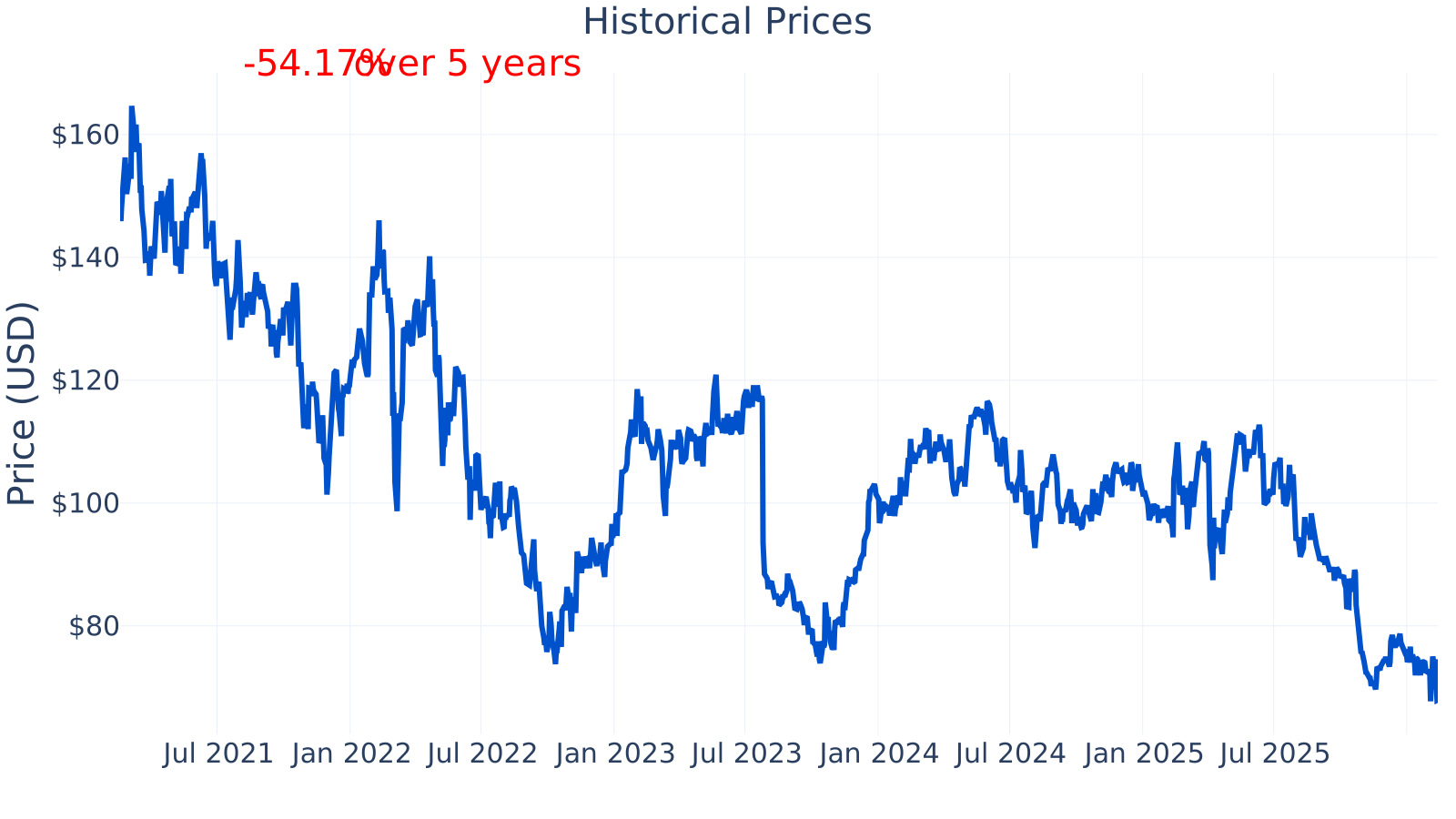
Euronet’s market capitalization is about $2.86B and the stock’s beta is about 0.79, which indicates it has historically moved less than the overall market on average (though it can still be volatile). The P/E ratio is about 9.94 versus an industry median near 25.13, while profit margin is about 7.29% (industry median about 6.91%). Revenue growth year over year is about 5.9% versus an industry median near 15.25%. Debt-to-equity is about 86% compared with an industry median near 19.8%. Free cash flow over the trailing twelve months is about $334.1M, and the PEG ratio is about 0.48 (a metric that relates valuation to growth expectations, and can be sensitive to how “growth” is measured).
Growth (Medium)
Euronet operates in long-running trends around digital payments and cross-border money movement. Even as many economies shift toward cashless payments, cash access (ATMs) can remain important in certain geographies and use cases, while money transfer demand can be supported by migration, remittances, tourism, and international commerce. The company’s mix of services can be a strategic advantage when payment preferences differ across countries and customer segments.
The year-over-year revenue growth shown is positive but moderate in recent periods, mostly in the mid-single digits lately (about 5.9% in the most recent point shown). Earlier periods in the series were higher (including double-digit growth), which suggests growth has not been uniform across cycles.
Free cash flow has been meaningful in the periods shown (for example, roughly $613M in 2021, around $646.8M in 2023, and around $594.5M in 2025). Consistent free cash flow can matter for long-term durability because it is the cash a business generates after funding ongoing investment needs. That cash can be used for debt repayment, acquisitions, and other corporate purposes (the specific use is disclosed in company filings).
Potential catalysts for longer-term growth typically relate to increasing transaction volumes, expansion in underpenetrated geographies, deeper relationships with banks and retailers, and operational improvements (such as better conversion of revenue into operating profit). As with many payment businesses, the mix of transactions and the pricing environment can be as important as overall volume.
Risks (Medium-High)
Euronet’s business is exposed to transaction-driven activity and consumer behavior. A slowdown in economic activity, reduced travel, weaker consumer spending, or lower remittance flows can reduce transaction volumes in one or more segments. The company also operates internationally, which can add currency, regulatory, and country-specific operating risk.
Debt levels are an important monitoring point. The latest debt-to-equity figure shown is about 86% (and it was materially higher in several prior periods), while the industry median shown is much lower. A higher debt load can increase sensitivity to interest rates and refinancing conditions, and it can also reduce flexibility during weaker business conditions.
Profit margin is shown at about 9.18% in the latest period, above the industry median shown (about 7.17%). The longer trend indicates a shift from very low or negative profitability earlier in the series to consistently positive margins in recent years. Even so, margins can be influenced by mix (which segment grows faster), competition, and operating costs, and they may not move in a straight line.
Competitive positioning depends on segment:
- ATM services and independent ATM networks: competition can come from bank-owned ATM networks, independent operators, and alternative cash access options.
- Merchant acquiring and payment processing: competition can include large global and regional payment processors and platform providers.
- Money transfer: competition can include global money transfer providers, banks, and newer digital-first transfer applications.
Competitive advantages can include an established network footprint, integration with financial institutions and retailers, regulatory and compliance capabilities, and scale in specific corridors or regions. At the same time, payments is a highly competitive field where pricing pressure, customer concentration, and technology shifts can compress economics if a provider does not keep pace.
Valuation
The P/E ratio shown (about 9.94) is below the industry median shown (about 25.13), and the historical series displayed indicates the company’s P/E has been substantially higher in the past than it is recently. A lower P/E can reflect market expectations of slower growth, higher perceived risk, or a different business mix versus peers, rather than automatically indicating “cheapness.”
In context, the company shows positive profitability (profit margin around 7–9% in the most recent points) and meaningful free cash flow, which can support valuation. Offsetting that, revenue growth shown is moderate compared with the industry median, and leverage has been higher than the industry median, which can weigh on how investors interpret the earnings multiple. A valuation discussion therefore tends to hinge on whether revenue growth re-accelerates, whether margins remain resilient, and whether the balance sheet becomes more conservative over time.
Conclusion
Euronet Worldwide is a diversified payments and money movement company with multiple transaction-based revenue streams across ATMs, payment processing/distribution, and money transfer. The figures shown point to rising revenue over time, improved profitability versus earlier periods, and strong free cash flow generation in several years.
The long-term picture also includes clear watch items: recent revenue growth appears moderate, debt levels have been higher than the industry median, and the company operates in competitive markets where pricing and technology change can be persistent forces. Valuation metrics shown (including a P/E below the industry median) need to be interpreted alongside these growth and balance-sheet considerations, as the market multiple can reflect both operating progress and perceived risk.
Sources:
- SEC EDGAR — Euronet Worldwide, Inc. — Form 10-K (Annual Report)
- SEC EDGAR — Euronet Worldwide, Inc. — Form 10-Q (Quarterly Report)
- Euronet Worldwide, Inc. Investor Relations — Annual Reports, SEC Filings, and Press Releases
- Wikipedia — “Euronet Worldwide”
This article is for informational purposes only and does not constitute financial advice. Some content is AI-generated. See Disclaimer


