Stock Analysis · Etsy Inc (ETSY)
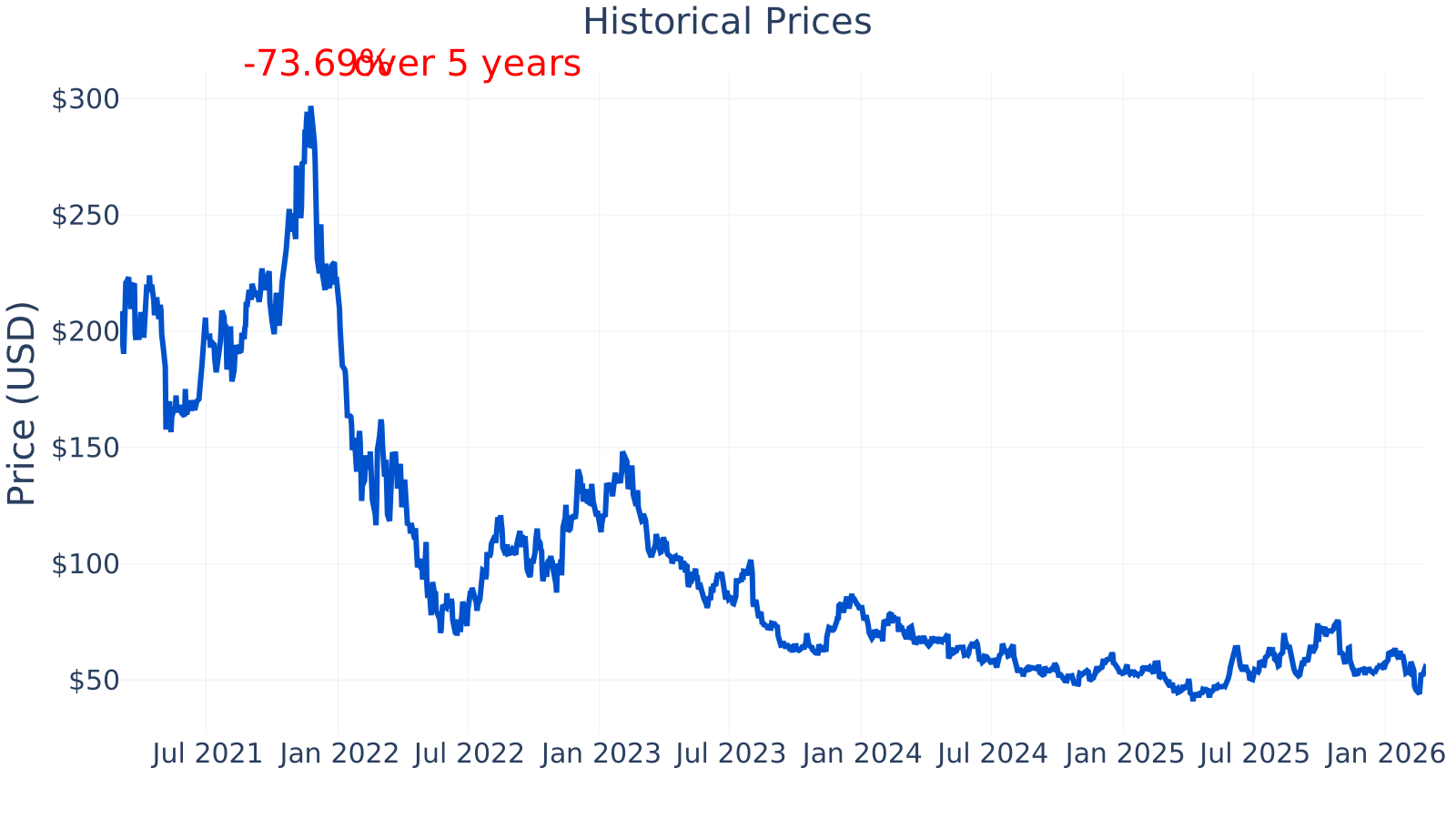
Overview
Etsy Inc. operates an online marketplace focused on handmade goods, vintage items, and craft supplies. Instead of buying and holding inventory like a traditional retailer, Etsy mainly connects independent sellers with buyers and provides tools that help sellers run their businesses (payments, advertising options, shipping-related tools, customer support, and trust & safety features). This “platform” model generally means Etsy’s costs are driven more by technology, marketing, and operations than by warehousing and product sourcing.
Etsy’s revenue is primarily generated from activity on its marketplace and from services sold to merchants. In its filings, the company reports revenue in two main categories:
- Marketplace revenue (primarily transaction fees and other fees tied to selling on Etsy)
- Services revenue (such as payments-related fees and optional seller services, including advertising)
In practice, the largest drivers tend to be fees that scale with Gross Merchandise Sales (the total value of items sold on the platform) plus payments and advertising-related services. The exact split can vary by year; the company provides the definitive breakdown in its annual report.
Business snapshot from recent annual results: Total revenue increased from about $2.33B (2021) to about $2.88B (2025), while net income was positive in most years shown but volatile across the period.
Across 2021–2025, revenue rose steadily (about $2.33B to $2.88B). Operating income and net income were more uneven: 2022 shows a large loss, followed by a return to profitability in 2023–2025. Over the same period, operating expenses increased overall, reflecting the ongoing cost of running and expanding a large online platform (technology development, marketing, and administrative functions).
Key Figures
| Metric | Value | Industry ⓘ |
|---|---|---|
| Date | Mar 02, 2026 | |
| Context | ||
| Sector | Consumer Cyclical | |
| Industry | Internet Retail | |
| Market Cap ⓘ | $5.44B | |
| Beta ⓘ | 1.76 | |
| Fundamental | ||
| P/E Ratio ⓘ | 37.08 | 34.06 |
| Profit Margin ⓘ | 5.65% | 6.50% |
| Revenue Growth ⓘ | 3.50% | 12.40% |
| Debt to Equity ⓘ | -287.12% | 32.25% |
| PEG ⓘ | 2.21 | |
| Free Cash Flow ⓘ | $699.49M | |
Etsy’s market capitalization is about $5.44B, and the stock’s beta of ~1.76 indicates it has historically moved more than the broader market (higher volatility). The latest P/E ratio is ~37.1, slightly above the industry median shown (~34.1). Profit margin is about 5.65% versus an industry median around 6.5%, while revenue growth year over year is about 3.5%, below the industry median shown (~12.4%). Trailing twelve-month free cash flow is about $699M, indicating meaningful cash generation relative to the company’s current size.
Growth (Medium)
Etsy operates in online retail, where long-term growth has been supported by continued e-commerce adoption and consumers shifting portions of spending online. Within that broad space, Etsy’s niche is differentiated: it emphasizes unique and often personalized items, which can be less directly comparable to mass-market retail catalogs. That positioning can matter because it may reduce pure price-based competition for at least part of the assortment.
From a strategy standpoint, Etsy’s growth efforts generally center on improving product discovery (helping buyers find relevant items), making purchasing smoother, expanding and retaining active buyers and sellers, and increasing the number of services sellers use (such as payments and advertising tools). If those initiatives work, growth can come from both more marketplace activity and more revenue per transaction (because more services are used).
Revenue growth has slowed substantially from the unusually high levels seen in 2021 (over 100% year-over-year early in that period) to low single digits more recently (around 3–4% in the latest shown period). This pattern suggests Etsy has moved from a rapid expansion phase into a more mature stage where growth depends more on execution, product improvements, and market share gains than on broad, one-time demand surges.
Free cash flow has been relatively resilient over time, ranging from roughly $529M (2022) to roughly $718M (2025), with the latest trailing figure around $699M. For long-term business durability, steady cash generation can be important because it can support continued investment in the platform and provide flexibility during weaker demand periods.
Risks (High)
A key risk is that Etsy operates in a highly competitive environment for consumer attention and online spending. Even though Etsy has a recognizable brand, shoppers can still compare across many channels (large general marketplaces, niche craft marketplaces, social commerce, and direct-to-consumer websites). Competition can raise marketing costs, reduce seller loyalty, or slow buyer growth.
Another major risk is sensitivity to consumer demand. Many Etsy purchases (gifts, home decor, discretionary items) can be influenced by consumer confidence and household budgets. If discretionary spending weakens, marketplace volume can slow, and because Etsy’s core fees scale with transaction activity, revenue growth can soften as well.
Platform trust is also central. Risks include counterfeit or non-compliant items, inconsistent product quality, shipping issues, and disputes between buyers and sellers. Managing these challenges typically requires sustained investment in trust & safety, policies, and customer support.
The debt-to-equity ratio shown is negative (latest around -287%). A negative value commonly occurs when a company’s accounting equity is negative (for example, after large share repurchases or certain accounting impacts), which can make the ratio less intuitive to interpret than for firms with positive equity. In those cases, understanding balance-sheet risk usually requires reading the company’s filings for details on total debt, cash, and the reasons equity is negative.
Profitability has been volatile. Profit margin was very high in 2021 (above 20%), turned negative in 2022, and then returned to positive levels in 2023–2025. The most recent value shown is about 5.65%, slightly below the industry median (~6.26%). This history indicates that earnings can swing meaningfully with cost levels, marketing intensity, and broader demand conditions.
On competitive advantages, Etsy benefits from a two-sided marketplace (buyers and sellers attract each other), a brand associated with unique and handcrafted goods, and accumulated data that can improve search and recommendations. However, it is not the only channel for handcrafted or personalized goods, and large platforms can sometimes replicate features (such as personalization and storefront tools). Etsy’s position is strongest in its specific niche, while competitors may be stronger in broad e-commerce scale or logistics capabilities.
Valuation
The P/E ratio has varied widely over time, reflecting changes in both the stock price and earnings. The latest P/E is around 37, slightly above the industry median shown (~34). Earlier in the timeline, Etsy’s P/E was often higher (for example, above 50–80 in parts of 2021), then moved lower at points in 2022 and after. A P/E in the high 30s typically implies the market is pricing in a meaningful level of future earnings power relative to today’s profits.
Two additional context points from the metrics: (1) revenue growth is currently modest (low single digits versus a higher industry median), and (2) profit margin is positive but not especially high relative to the industry median. That combination generally makes valuation more sensitive to whether Etsy can re-accelerate growth, expand margins over time, or sustain strong cash generation. The PEG ratio around 2.21 (a valuation measure that relates P/E to growth) also suggests the valuation is not “cheap” relative to the growth rate implied by that metric, though PEG depends heavily on growth assumptions.
Conclusion
Etsy is a specialized online marketplace that monetizes transactions and seller services rather than selling inventory. Over 2021–2025, revenue increased steadily, and free cash flow remained substantial, which points to a business model capable of generating cash even as growth has moderated.
At the same time, the company faces meaningful risks: intense competition for e-commerce demand, sensitivity to discretionary consumer spending, and the ongoing need to protect trust and quality on the platform. Profitability has also shown that it can swing sharply across years. On valuation, Etsy trades at a P/E modestly above the industry median shown, while current growth is below the industry median—meaning long-term outcomes may depend heavily on execution that improves growth and/or margins from today’s levels.
Sources:
- U.S. SEC EDGAR — Etsy, Inc. Form 10-K (Annual Report)
- U.S. SEC EDGAR — Etsy, Inc. Form 10-Q (Quarterly Report)
- Etsy, Inc. Investor Relations — Earnings releases and shareholder materials
- Wikipedia — “Etsy” (company overview and history)
This article is for informational purposes only and does not constitute financial advice. Some content is AI-generated. See Disclaimer


