Stock Analysis · EPAM Systems Inc (EPAM)
Overview
EPAM Systems Inc is a global provider of digital engineering and software development services. In simple terms, it helps organizations design, build, modernize, and run software products and digital platforms. This can include creating customer-facing apps and websites, modernizing older internal systems, migrating workloads to the cloud, improving data and analytics capabilities, and supporting cybersecurity and quality assurance. EPAM delivers these services through teams of engineers and consultants working with clients across multiple industries.
EPAM’s revenue primarily comes from providing services (not physical products). Based on how the company describes its business in its public filings, the main revenue streams are generally:
- Digital engineering and software development services (custom software, product development, and platform engineering)
- Cloud and modernization work (moving systems to cloud environments and updating older technology)
- Data, analytics, and AI-related services (building data platforms and applying advanced analytics to operations)
- Ongoing support and managed services (maintenance, testing, and operational support)
Because EPAM is a services company, its results are heavily influenced by client demand, billable utilization of its staff, pricing, and the mix of higher-value work (for example, complex engineering and consulting) versus more standardized delivery.
Over the years shown, total revenue increased overall (from about $3.76B in 2021 to about $5.46B in 2025). At the same time, costs rose as well, and net income in 2025 (about $378M) was lower than in 2024 (about $455M), suggesting that profitability did not rise in line with revenue during that period.
Key Figures
| Metric | Value | Industry ⓘ |
|---|---|---|
| Date | May 04, 2026 | |
| Context | ||
| Sector | Technology | |
| Industry | Information Technology Services | |
| Market Cap ⓘ | $5.93B | |
| Beta ⓘ | 1.73 | |
| Fundamental | ||
| P/E Ratio ⓘ | 16.72 | 16.84 |
| Profit Margin ⓘ | 6.92% | 5.39% |
| Revenue Growth ⓘ | 12.80% | 7.15% |
| Debt to Equity ⓘ | 3.91% | 56.46% |
| PEG ⓘ | 0.67 | |
| Free Cash Flow ⓘ | $612.69M | |
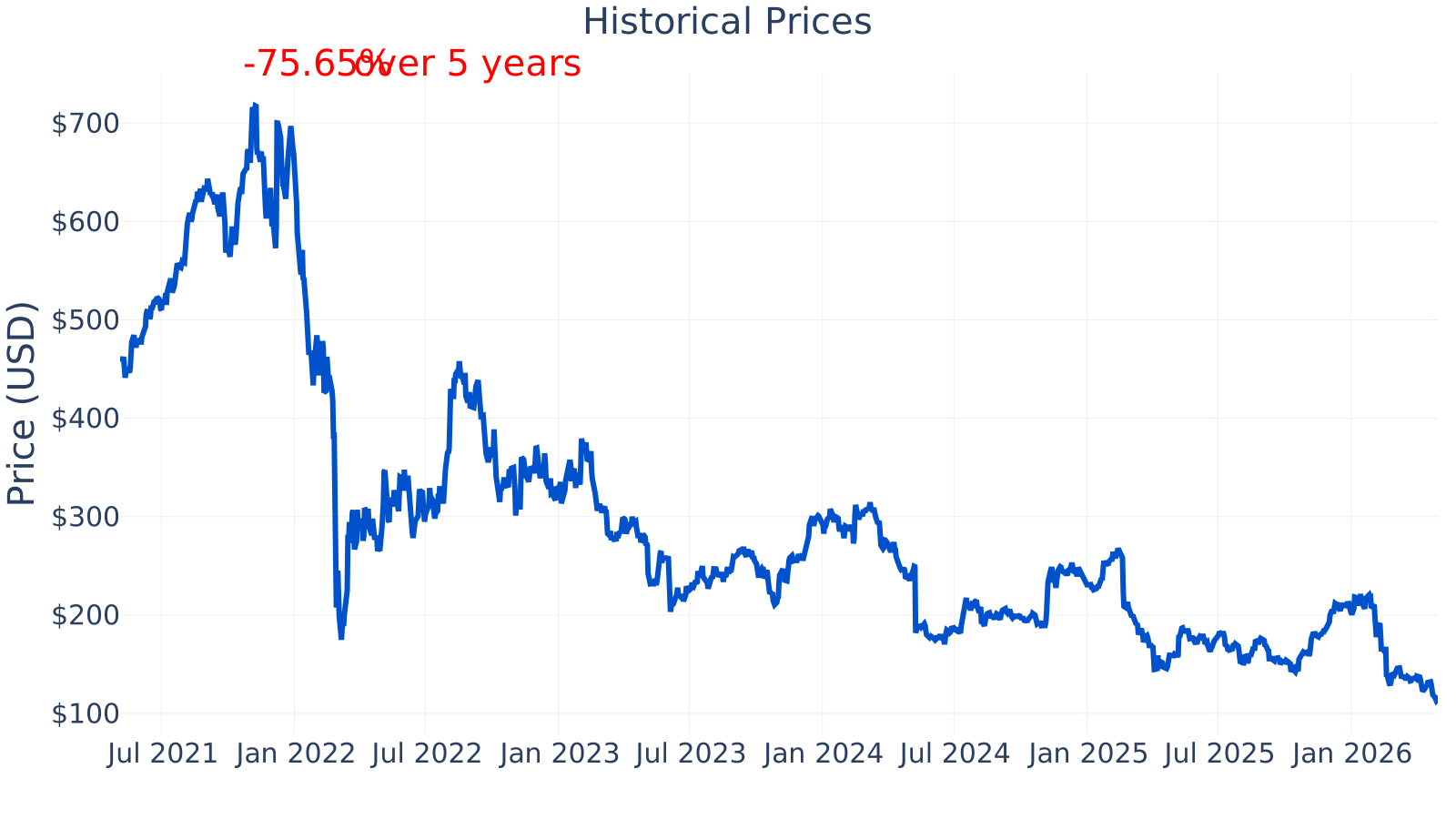
At the latest point shown, EPAM has a market capitalization of about $5.9B and a beta of 1.73, which is consistent with larger-than-average stock price swings compared with the broader market. The P/E ratio is ~16.7, close to the industry median (~16.8). Profitability (profit margin) is about 6.9%, above the industry median (~5.4%). Year-over-year revenue growth is about 12.8%, also above the industry median (~7.2%). Balance-sheet leverage appears low with debt-to-equity around 3.9% versus an industry median around 56.5%. Free cash flow over the trailing twelve months is about $613M.
Growth (Medium)
EPAM operates in the information technology services space, which is supported by long-term trends such as ongoing digital transformation, cloud adoption, cybersecurity needs, and the steady push to modernize older systems. These are not one-time themes: many organizations refresh systems over multiple years, which can create recurring demand for engineering talent and delivery capacity.
EPAM’s strategy (as described in company filings) centers on combining consulting-style client engagement with deep engineering execution, and delivering work through a global workforce. This model can scale when demand is strong, but it is also sensitive to hiring, utilization, and changes in the pace of client spending.
The revenue growth pattern shown is uneven. Growth was very high in 2021–2022, then turned negative through parts of 2023–mid 2024, and returned to positive territory later (reaching low-to-high teens in several quarters in 2025, and about 12.8% at the most recent point shown). For long-term context, this suggests the business can re-accelerate, but it may also go through cyclical slowdowns when customers reduce or delay projects.
Free cash flow increased from 2022 into 2024 (roughly $384M to $578M), then declined in 2025 (roughly $419M) before reaching about $613M in the latest metric snapshot. For a services company, free cash flow matters because it reflects how much cash remains after operating needs and investments, and it can be influenced by profitability, working capital timing (collections and payments), and the pace of hiring.
Potential catalysts (in a neutral, descriptive sense) typically include a broad improvement in enterprise IT spending, an increasing share of complex modernization programs, and expanded demand for data/AI-enabled engineering work—areas where clients may seek external expertise and delivery scale.
Risks (High)
EPAM’s core risks are tied to the nature of project-based IT services. Client budgets can change quickly, projects can be delayed, and pricing pressure can rise when demand softens. Because staff costs are a major part of expenses, periods of lower utilization (engineers not fully allocated to billable work) can compress margins.
Competition is significant. EPAM faces large global IT services firms and consulting organizations as well as specialized digital engineering companies. Commonly recognized competitors in the broader IT services and digital engineering arena include firms such as Accenture, Cognizant, Infosys, Tata Consultancy Services, Wipro, Capgemini, IBM, and other engineering-focused providers. Compared with the largest players, EPAM is smaller in scale, which can be a disadvantage for very large multi-year transformations. On the other hand, EPAM positions itself around engineering depth and delivery execution, which can be an advantage in complex product and platform work. The competitive outcome often depends on client relationships, domain expertise, delivery quality, and the ability to recruit and retain skilled talent.
Financial leverage appears relatively low. Debt-to-equity trends down over time in the chart, ending near 3.9%, well below the industry median (roughly in the 55%–75% range across many periods shown). Lower leverage can reduce financial risk, but it does not eliminate operational risk from changes in demand.
Profit margin has generally remained above the industry median across the period shown, but it declined from earlier, higher levels (for example, low-teens percentages in 2021) toward the high-single-digit range more recently (ending near 6.9%). For a services business, this pattern can reflect changes in pricing, wage inflation, utilization, and the mix of projects (higher-value consulting and engineering versus more commoditized delivery).
EPAM also carries execution risks typical for global delivery organizations: maintaining quality at scale, managing employee turnover, controlling compensation costs, and navigating currency and cross-border operating complexity. In addition, customer concentration (large clients representing meaningful revenue) can matter in IT services; if one major client cuts spending, it can affect growth and utilization.
Valuation
Valuation is often discussed using multiples like the price-to-earnings (P/E) ratio, which compares the stock price to the company’s earnings. EPAM’s latest P/E is about 16.7, close to the industry median of about 16.8, implying the market is valuing EPAM broadly in line with peers on this simple measure.
The historical P/E trend shown is materially higher in 2021–2022 (reaching well above 50 in several periods), then compresses over time, moving into the 20s and 30s more recently. The industry median also changes over time, but EPAM’s multiple moved from a large premium in earlier periods toward levels closer to the peer group in the later periods shown. In plain language, this suggests that the market’s valuation became less “growth priced” than it was earlier, which can happen when growth slows, uncertainty rises, or profitability expectations change.
Whether today’s valuation level is “high” or “low” depends less on the absolute P/E number and more on how durable growth and margins are through an economic cycle. EPAM’s recent metrics show revenue growth above the industry median and profit margin above the industry median, alongside low leverage—while longer-term charts show that both growth and margins can fluctuate meaningfully.
Conclusion
EPAM is a digital engineering and IT services company whose performance is closely tied to corporate technology spending and the company’s ability to deliver complex projects efficiently. The business shows traits that can support long-term durability—global scale delivery, recurring demand for modernization, and profitability that has often been above the industry median—while also showing meaningful cyclicality in revenue growth and a downward shift in margins compared with earlier years.
From a fundamentals perspective, the latest snapshot indicates above-median growth and margins versus the industry median, low financial leverage, and substantial free cash flow generation. At the same time, the history of fluctuating growth rates and compressing margins highlights the importance of monitoring utilization, client demand trends, and cost control over time. On valuation, the current P/E is near the industry median, and the longer-term multiple has come down substantially from earlier peaks, indicating a different market expectation set than in 2021–2022.
Sources:
- U.S. Securities and Exchange Commission — EDGAR database (EPAM Systems Inc filings, including Form 10-K and Form 10-Q)
- EPAM Systems Inc Investor Relations — SEC Filings / Annual Reports (company-hosted)
- Wikipedia — “EPAM Systems” (basic company background)
This article is for informational purposes only and does not constitute financial advice. Some content is AI-generated. See Disclaimer


