Stock Analysis · EPAM Systems Inc (EPAM)
Overview
EPAM Systems Inc is a technology services company that helps organizations build, modernize, and run software and digital products. In practical terms, EPAM’s teams work with clients on things like designing digital customer experiences, developing applications, moving systems to the cloud, improving data and analytics, and integrating newer tools such as automation and artificial intelligence into existing operations.
EPAM primarily earns revenue by providing services to clients (rather than selling a single packaged software product). In its SEC filings, EPAM generally describes its business around delivering:
- Digital engineering and software development services (building and modernizing applications and platforms)
- Consulting and design (product strategy, user experience, and solution architecture)
- Cloud, data, and AI-related work (migration, data platforms, analytics, and AI enablement)
- Ongoing support and managed services (operating and improving systems after launch)
EPAM’s filings also typically discuss diversification across industries and geographies, but the exact revenue percentages by service line are not always presented as a simple breakdown in the provided materials.
How the business “converts” revenue into profit (high-level): EPAM’s cost base is heavily tied to delivery staff and delivery-related expenses, which is typical for IT services companies. This means profitability often depends on utilization (how fully staffed teams are), pricing, and the mix of higher-value work versus commodity-style services.
From 2021 to 2025, revenue rose from about $3.76B to $5.46B. Over the same period, net income moved from about $482M to $378M, showing that earnings did not rise in line with revenue. This kind of pattern is often associated with changes in project mix, pricing, wage inflation, utilization levels, and broader demand cycles in IT spending.
Key Figures
| Metric | Value | Industry ⓘ |
|---|---|---|
| Date | Feb 23, 2026 | |
| Context | ||
| Sector | Technology | |
| Industry | Information Technology Services | |
| Market Cap ⓘ | $7.73B | |
| Beta ⓘ | 1.72 | |
| Fundamental | ||
| P/E Ratio ⓘ | 21.20 | 19.56 |
| Profit Margin ⓘ | 6.92% | 4.91% |
| Revenue Growth ⓘ | 12.80% | 5.70% |
| Debt to Equity ⓘ | 3.91% | 78.25% |
| PEG ⓘ | 1.38 | |
| Free Cash Flow ⓘ | $459.11M | |
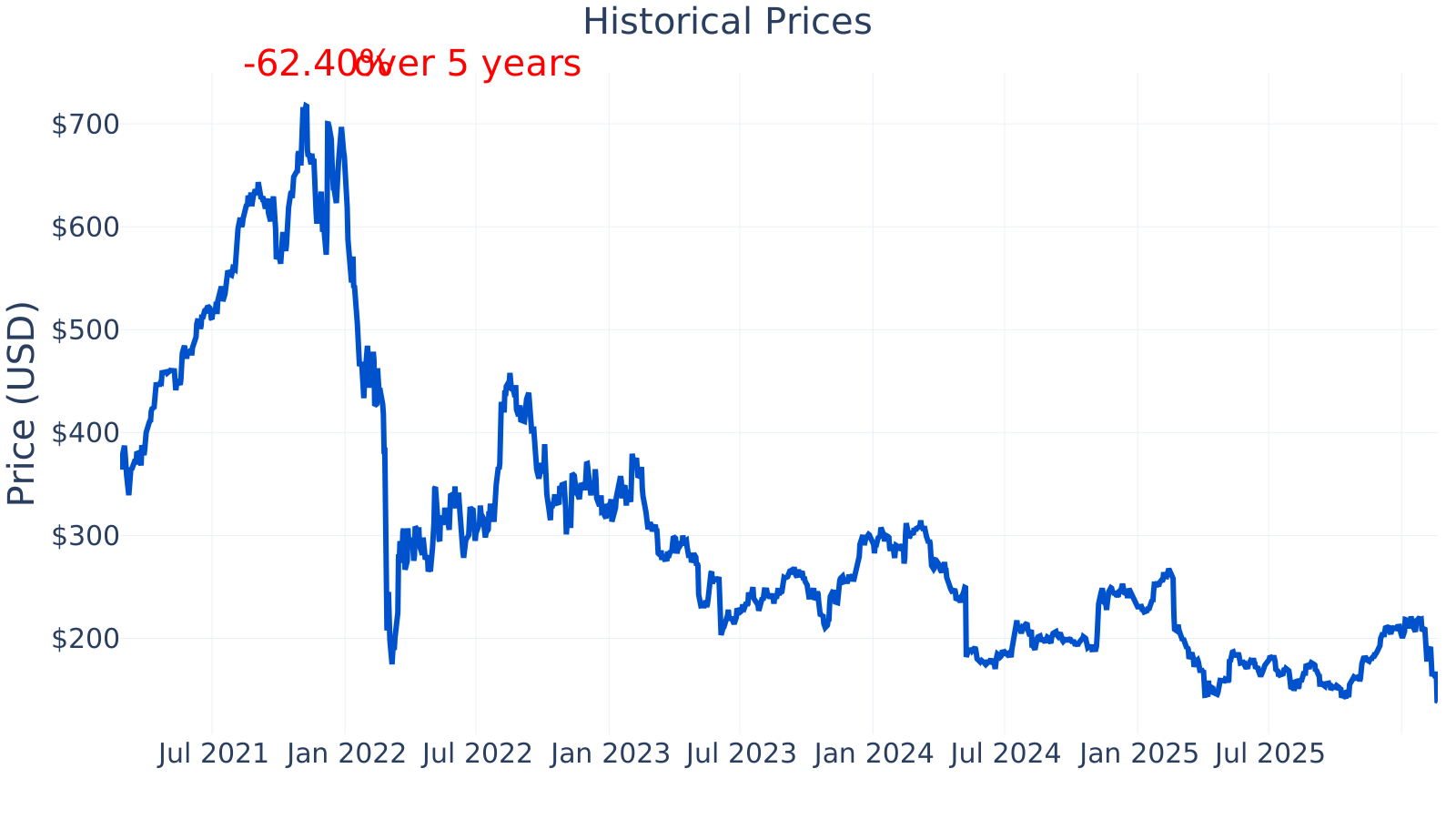
EPAM’s market capitalization is about $7.7B, placing it among mid-sized public technology services companies. The stock’s beta of ~1.72 indicates the share price has historically been more volatile than the broader market.
On profitability, EPAM’s profit margin is ~6.9% versus an industry median around 4.9%, suggesting it has recently converted sales into bottom-line profit more efficiently than many peers in the same broad industry group.
On growth, the latest year-over-year revenue growth is ~12.8%, above the industry median of about 5.7%, indicating EPAM’s recent top-line momentum has been stronger than the typical company in this peer set.
On balance-sheet leverage, EPAM’s debt-to-equity is ~3.9%, far below the industry median near 78%. This points to a comparatively conservative use of debt financing.
On cash generation, free cash flow (TTM) is about $459M, which is a key figure for a services business because it reflects how much cash remains after operating costs and capital spending.
Growth (Medium)
EPAM operates in the information technology services market, where demand is driven by long-running trends such as cloud adoption, application modernization, cybersecurity needs, and data-driven decision-making. Many companies also continue shifting toward digital channels and software-enabled products, which supports ongoing needs for engineering talent and delivery capacity.
EPAM’s strategy, as described in its SEC filings, centers on providing end-to-end capabilities (from consulting and design through engineering and ongoing support) and serving large enterprises across multiple industries. This type of positioning can align with client demand for fewer vendors that can handle complex, multi-year modernization programs.
Revenue growth has been cyclical. It was very high in 2021–2022, then turned negative during parts of 2023–2024, before returning to positive territory and reaching about 12.8% by the end of 2025. This pattern is consistent with an IT services environment where clients can slow spending quickly during uncertainty, then re-accelerate projects when budgets loosen or priorities shift.
Free cash flow has remained meaningful over time, ranging from roughly $384M to $578M in the periods shown, with the most recent value around $419M (as of 2025-03-31 in the series) and $459M in the latest metrics. For long-term durability, consistent cash generation can matter because it provides flexibility for hiring, acquisitions, and weathering weaker demand periods.
Potential catalysts for growth (in a neutral, business-driven sense) often include multi-year modernization commitments, increased adoption of AI-enabled tools in enterprise workflows, and vendor consolidation where clients select a smaller number of strategic engineering partners. The extent and timing of these factors can vary by client industry and the overall corporate spending cycle.
Risks (High)
This article is for informational purposes only and does not constitute financial advice. Some content is AI-generated. See Disclaimer