Stock Analysis · EchoStar Corporation (SATS)
Overview
EchoStar Corporation is a U.S.-based communications company focused on delivering connectivity and video services. Following its combination with DISH Network, the business spans satellite technology and services (including satellite-based connectivity solutions) as well as consumer and business connectivity offerings that rely on wireless and network infrastructure. In simple terms, the company operates “pipes” that move data and video to customers, using a mix of satellite and terrestrial networks.
EchoStar’s revenue is largely tied to providing communications services to end users and enterprise/government customers, plus related equipment and service fees. Based on how the company describes its operations in its filings, the main revenue drivers typically include:
- Subscriber/service revenue (connectivity and video service plans, access fees, and related recurring charges)
- Equipment revenue (devices and customer-premises equipment sold or leased in connection with services)
- Other revenue (including various fees and ancillary services)
Over the last several years, the business has also been shaped by major strategic and financial priorities—most notably building and operating network infrastructure, managing large financing needs, and repositioning parts of the portfolio as customer demand shifts away from legacy pay-TV toward broadband and mobile connectivity.
The income statement flow highlights a company that has experienced meaningful swings in profitability: revenue has trended down from 2021 to 2024, while operating results moved from strong profitability (2021–2022) to a large operating loss in 2023, then back to positive operating income in 2024. Interest expense also increased sharply by 2024 versus earlier years, which can matter a lot for shareholders when debt levels rise.
Key Figures
| Metric | Value | Industry ⓘ |
|---|---|---|
| Date | Feb 23, 2026 | |
| Context | ||
| Sector | Communication Services | |
| Industry | Telecom Services | |
| Market Cap ⓘ | $31.77B | |
| Beta ⓘ | 1.01 | |
| Fundamental | ||
| P/E Ratio ⓘ | N/A | 15.13 |
| Profit Margin ⓘ | -85.36% | 6.50% |
| Revenue Growth ⓘ | -7.10% | 2.00% |
| Debt to Equity ⓘ | 440.08% | 113.97% |
| PEG ⓘ | 0.92 | |
| Free Cash Flow ⓘ | -$1.09B | |
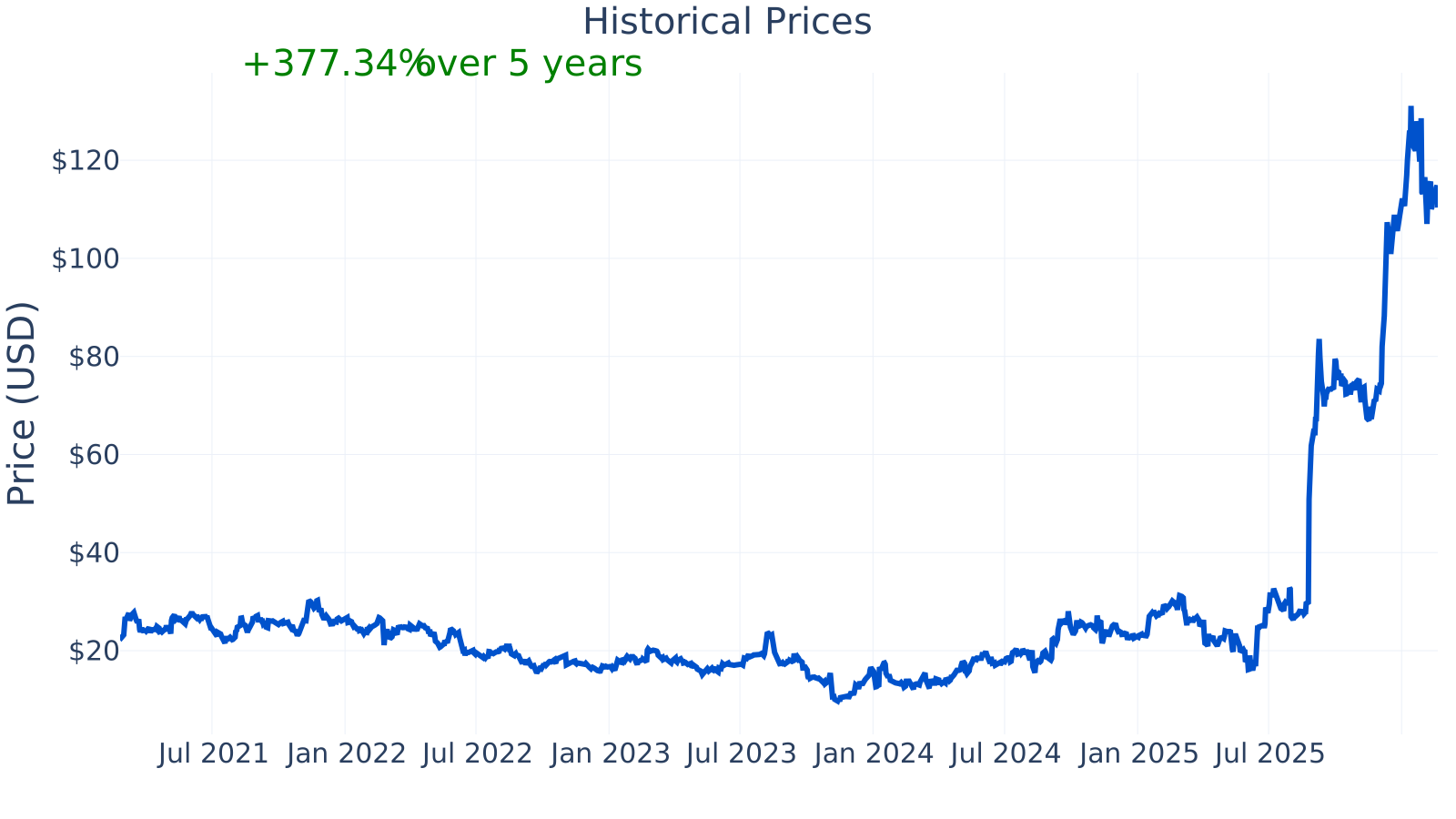
EchoStar’s market capitalization is about $31.8B and the stock’s beta (~1.01) suggests price moves that have historically been roughly in line with the broader market. Recent fundamentals show pressure: profit margin is -85.36% versus an industry median near 6.5%, revenue growth year-over-year is -7.11% versus an industry median near 2%, and free cash flow over the trailing twelve months is -$1.09B. Leverage stands out: debt-to-equity is ~440% compared with an industry median near 114%. The P/E ratio is not shown in the latest snapshot here, which can happen when earnings are negative or otherwise not meaningful for a traditional P/E calculation.
Growth (medium)
The broader communications industry continues to benefit from long-term demand for connectivity—more data usage, more devices, and more need for resilient networks. However, the growth profile depends heavily on which part of the market a company serves. Legacy pay-TV has faced structural headwinds for years, while broadband, mobile, and satellite connectivity can be more durable—especially where fiber and cable are limited or where redundancy is valued.
EchoStar’s strategy centers on operating communications infrastructure and monetizing it through service relationships. The long-term logic is that connectivity demand tends to rise over time, and satellite-based services can fill coverage gaps or provide specialized connectivity where terrestrial networks are expensive or impractical. Potential catalysts typically relate to scaling subscriber relationships, improving network utilization, and translating infrastructure investment into steadier cash generation.
The chart indicates that revenue growth has been volatile. There was an extreme spike in 2023 (not typical for mature telecom businesses and often associated with major business changes), followed by a return to negative growth through 2024 and into 2025 (around mid-to-high single-digit declines most recently). For long-term analysis, consistency matters: repeated negative readings can signal customer losses, pricing pressure, product transitions, or portfolio changes.
Free cash flow turned notably negative starting in 2024 and remained negative into 2025. For infrastructure-heavy communications companies, negative free cash flow can occur during heavy buildout or transition periods, but it increases reliance on cash on hand, asset sales, or external financing until the business produces more cash than it consumes.
Risks (high)
This article is for informational purposes only and does not constitute financial advice. Some content is AI-generated. See Disclaimer


