Stock Analysis · eBay Inc (EBAY)
Overview
eBay Inc. operates an online marketplace that connects buyers and sellers. Unlike many large e-commerce companies, eBay generally does not own inventory for resale; instead, it focuses on running the platform, improving search and discovery, supporting payments and shipping-related tools, and helping sellers reach buyers across a wide range of categories (including new and used goods). This marketplace model typically means eBay’s costs and logistics footprint can be lighter than retailers that stock and ship most items themselves.
In its SEC filings, eBay describes its revenue as primarily driven by fees and services tied to activity on its marketplace. In simple terms, when transactions happen on the platform, eBay earns money from services that support those transactions.
Main revenue sources (high-level):
- Transaction revenue: fees and services that are directly linked to marketplace transactions (for example, seller fees and other transaction-related services).
- Marketing services and other revenue: revenue from advertising and promoted listings, plus other services offered on the platform.
Over recent years, the company’s total revenue has been in the roughly $10–11B range annually (see the flow of revenue and major expense lines below), illustrating a business that is large and established rather than early-stage.
Looking across the years shown, total revenue trends upward from about $9.8B (2022) to about $11.1B (2025). Operating income and net income swing meaningfully by year, which highlights that profits can be influenced by items beyond day-to-day marketplace operations (as reflected in the large net income in 2021 and a net loss in 2022).
Key Figures
| Metric | Value | Industry ⓘ |
|---|---|---|
| Date | Mar 02, 2026 | |
| Context | ||
| Sector | Consumer Cyclical | |
| Industry | Internet Retail | |
| Market Cap ⓘ | $41.07B | |
| Beta ⓘ | 1.38 | |
| Fundamental | ||
| P/E Ratio ⓘ | 21.33 | 34.06 |
| Profit Margin ⓘ | 18.30% | 6.50% |
| Revenue Growth ⓘ | 15.00% | 12.40% |
| Debt to Equity ⓘ | 159.83% | 32.25% |
| PEG ⓘ | 2.09 | |
| Free Cash Flow ⓘ | $1.43B | |
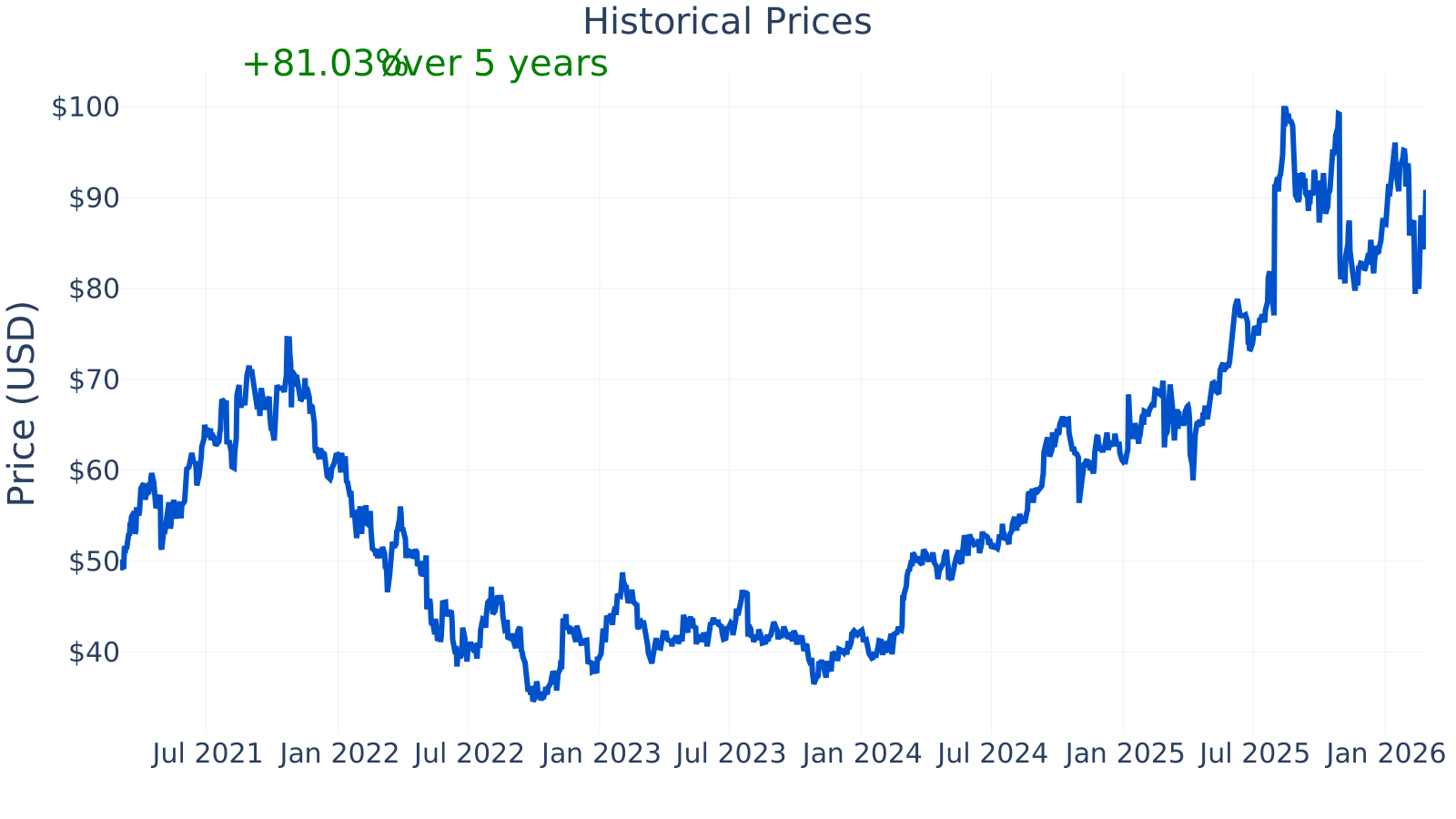
At the latest point shown, eBay’s market capitalization is about $41.1B and its beta is 1.38, which implies the stock has tended to move more than the overall market. The company’s P/E ratio is ~21.3, below the industry median (~34.1), while its profit margin is ~18.3%, well above the industry median (~6.5%). Recent year-over-year revenue growth is ~15.0%, slightly above the industry median (~12.4%). A notable point is leverage: debt-to-equity is ~160% versus an industry median of ~32%, indicating a more debt-heavy capital structure than many peers. Trailing twelve-month free cash flow is about $1.43B, showing the business has been generating cash after operating needs and capital spending.
Growth (Medium)
eBay operates in online retail and digital marketplaces—an industry supported by long-term consumer trends toward e-commerce, recommerce (buying and selling used goods), and cross-border trade. However, within that broad trend, the competitive environment is mature and intense, and growth often comes from taking share in specific categories, improving the buyer experience, increasing seller tools, and expanding higher-value services like advertising.
From the revenue growth pattern shown, eBay moved from negative year-over-year growth in parts of 2021–2022 to low single-digit growth through much of 2023–2024, and then to a higher growth rate by late 2025.
The most recent point shown is about 15% year-over-year revenue growth (2025-12-31). Earlier periods include several quarters of contraction (notably through 2022), followed by a gradual recovery. This kind of trajectory can indicate that growth is possible, but not necessarily smooth or consistent.
Cash generation matters for a marketplace business because it can fund product improvements, marketing, and shareholder returns. eBay’s free cash flow has fluctuated but remains substantial.
Over the periods shown, trailing twelve-month free cash flow ranges roughly from $1.73B (2024-03-31) to $2.39B (2021-03-31), with $2.13B at 2025-03-31. This suggests the company has continued to produce cash through different demand environments, even when revenue growth slowed.
Potential catalysts (in a neutral, factual sense) typically relate to execution: improving the marketplace experience, expanding promoted listings/advertising offerings, strengthening trust and authenticity programs for high-value categories, and growing services that increase seller success and buyer conversion. In filings and investor materials, management also commonly emphasizes operational discipline and product enhancements as drivers of performance over time.
Risks (Medium-High)
The central business risk is competition. Marketplaces benefit from network effects (buyers attract sellers and sellers attract buyers), but many alternatives exist for both sides. If buyers find better prices or experiences elsewhere—or if sellers view fees, tools, or policy enforcement as less favorable—transaction volumes can be pressured.
Competition is not only other general marketplaces but also category-focused platforms and large e-commerce retailers. Major competitors commonly discussed for an online marketplace include large horizontal commerce platforms and specialized resale/marketplace models. eBay’s positioning is often strongest where selection, used goods, collectibles, and specific enthusiast categories matter, but it is not the only destination for these purchases.
Another important risk is financial structure. eBay’s debt-to-equity level is high compared with the industry median, which can increase sensitivity to interest rates, refinancing conditions, and earnings variability.
At the latest point shown, eBay’s debt-to-equity is about 160% versus an industry median near 37%. The series also shows eBay staying well above the median for most of the period displayed, which is a structural difference versus many peers.
Profitability is a strength but also a variable to monitor. Margins can move due to demand changes, product and marketing investments, and non-operating items that affect net income. The margin history shows that eBay’s profitability has been uneven at times, including a period where margins dipped materially.
The latest profit margin shown is about 18.3%, which is notably higher than the industry median (~6.3%). Earlier points include unusually high and volatile values and even negative margin in late 2022. This underscores that while the business can be strongly profitable, reported margins can swing, and understanding what drives those swings (operating performance vs. one-time or non-operating items) is important.
Additional risks described in SEC filings for a company like eBay typically include: regulatory and tax changes (especially across countries), fraud and trust-and-safety challenges, cybersecurity and platform reliability, reliance on third-party service providers, and reputational risk if buyer/seller experiences deteriorate.
Valuation
A simple way many people compare valuation is the price-to-earnings (P/E) ratio, which relates the stock price to earnings. This metric is easiest to interpret when earnings are relatively stable and representative of ongoing business performance.
At the latest point shown, eBay’s P/E ratio is about 21.3 versus an industry median of about 34.1. Historically in the chart, eBay’s P/E has often been below the industry median, though there are also periods where the P/E is not shown (set to 0 in the graphic when it is not meaningful). In practical terms, a lower P/E than peers can reflect different expectations about growth, business mix, risk, or earnings durability.
Another valuation-related data point in the table is the PEG ratio (~2.09), which compares P/E to growth expectations. A higher PEG can indicate that the current P/E is not low relative to growth, though PEG is highly sensitive to how growth is estimated and can be less reliable for companies with uneven growth patterns.
Whether the current price level is “expensive” or “cheap” cannot be concluded from one metric alone. For a mature marketplace company, the main valuation drivers are typically: (1) the ability to sustain or grow marketplace activity, (2) the mix shift toward higher-margin services such as advertising, (3) the stability and quality of earnings and cash flow, and (4) balance-sheet leverage. The combination shown here—solid margins and cash generation, improving recent revenue growth, but higher leverage than peers—creates trade-offs that investors often weigh when interpreting the P/E level.
Conclusion
eBay is a large, established online marketplace business that primarily earns revenue from marketplace transaction-related fees and marketing services. The company shows meaningful cash generation and, at the latest point shown, a profit margin that is well above the industry median. Recent year-over-year revenue growth has improved to the mid-teens, after a period of declines and then low growth.
The main long-term considerations are competitive intensity and differentiation (especially versus other broad marketplaces and category-specific platforms) and financial leverage (with debt-to-equity notably above the industry median). From a valuation perspective, eBay’s P/E ratio is below the industry median in the latest data, which may reflect the market’s view of its growth profile and risk factors rather than profitability alone.
Sources:
- SEC EDGAR — eBay Inc. Form 10-K (Annual Report)
- SEC EDGAR — eBay Inc. Form 10-Q (Quarterly Report)
- eBay Inc. Investor Relations — SEC Filings & Annual Reports
- Wikipedia — “eBay” (basic company background)
This article is for informational purposes only and does not constitute financial advice. Some content is AI-generated. See Disclaimer


