Stock Analysis · eBay Inc (EBAY)
Overview
eBay Inc. operates a global online marketplace that connects buyers and sellers. Instead of owning inventory like a traditional retailer, eBay mainly provides the platform, tools, and services that help transactions happen. The company is best known for consumer-to-consumer and business-to-consumer listings across categories such as collectibles, refurbished goods, auto parts, fashion, and electronics.
At a high level, eBay’s model is based on earning fees when sellers list and sell items, plus earning revenue from services that make the marketplace easier to use (for example, advertising tools for sellers and payment-related services). Because eBay is a marketplace, its performance is closely tied to buyer activity, seller success, and the overall health of online shopping demand.
Main revenue sources (typically the largest to smallest):
- Transaction revenues (fees tied to successful sales and marketplace activity)
- Marketing services and advertising (seller-paid promoted listings and other advertising products)
- Other services (varies by period; may include additional platform-related services)
In recent years, eBay has emphasized improving the buyer experience, strengthening trust features (such as authenticity-related programs in certain categories), expanding advertising, and continuing to refine its payments and platform capabilities—all aimed at keeping the marketplace efficient and competitive.
Across the years shown, total revenue is relatively stable around the ~$10B level, while profitability swings meaningfully. The large net loss in 2022 contrasts with positive net income in surrounding years, highlighting that results can be influenced by items that are not purely day-to-day marketplace operations (for example, investment gains/losses, taxes, and other non-operating effects reflected in filings).
Key Figures
| Metric | Value | Industry ⓘ |
|---|---|---|
| Date | Feb 07, 2026 | |
| Context | ||
| Sector | Consumer Cyclical | |
| Industry | Internet Retail | |
| Market Cap ⓘ | $39.55B | |
| Beta ⓘ | 1.38 | |
| Fundamental | ||
| P/E Ratio ⓘ | 19.19 | 34.01 |
| Profit Margin ⓘ | 20.37% | 6.32% |
| Revenue Growth ⓘ | 9.50% | 11.35% |
| Debt to Equity ⓘ | 148.65% | 34.80% |
| PEG ⓘ | 2.42 | |
| Free Cash Flow ⓘ | $1.53B | |
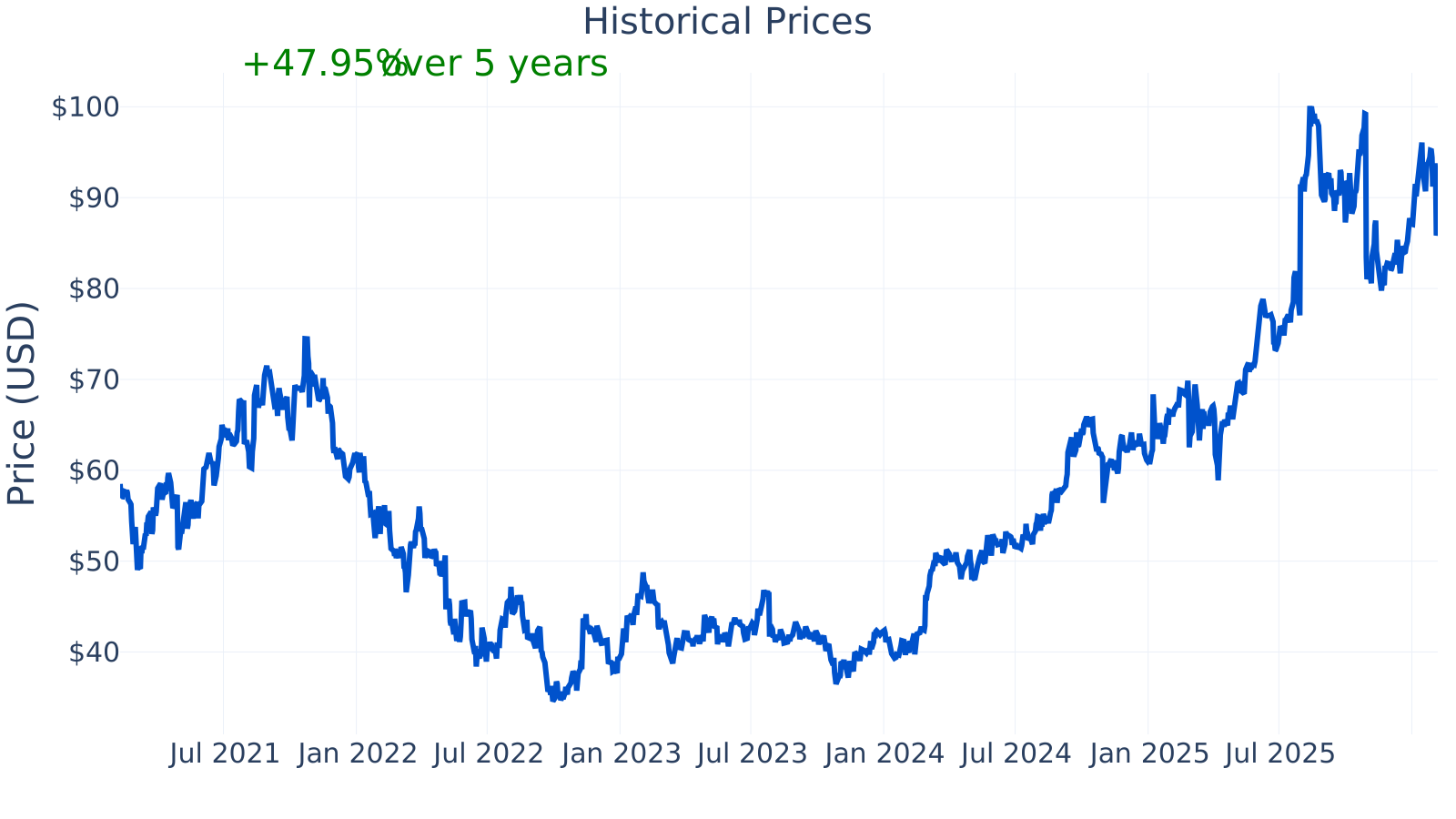
eBay’s market capitalization is about $39.6B and the stock shows a beta of 1.38, which indicates the share price has historically moved more than the broader market. The company’s P/E ratio is ~19.2, below the industry median (~34.0). Profitability stands out: eBay’s profit margin is ~20.4% versus an industry median of ~6.3%. Recent year-over-year revenue growth is ~9.5%, slightly below the industry median (~11.35%). Leverage is notable: debt-to-equity is ~148.7%, well above the industry median (~34.8%). Over the last twelve months, free cash flow is about $1.53B.
Growth (Medium)
eBay operates in e-commerce, a large and mature global industry. Online shopping remains a long-term consumer trend, but the marketplace segment is highly competitive and growth rates can be uneven, especially as consumer spending shifts and competition intensifies. For a mature platform like eBay, growth often depends less on opening “new” internet markets and more on execution: improving the product, increasing seller success, and gaining share in categories where the marketplace format performs well.
A key part of eBay’s strategy has been to focus on areas where it can be differentiated (for example, enthusiast and collectible categories, recommerce/used goods, and parts-and-accessories segments) and to expand higher-margin services such as advertising. In marketplaces, advertising can scale as sellers compete for visibility, which can support revenue even when overall item volume grows slowly.
The year-over-year revenue pattern shown shifts from strong growth in 2021 to declines through much of 2022, then returns to modest growth through 2023–2025, reaching about 9.5% in the most recent point shown. This suggests a recovery from a weaker period, though the overall pace still looks closer to “steady/gradual” than “hyper-growth.”
Free cash flow remains positive across the period shown, moving between roughly $1.73B and $2.39B, and sits around $1.53B in the latest metric table. Consistent free cash flow can be important for a marketplace business because it can help fund product improvements, acquisitions, and capital returns, and it can also provide flexibility during slower demand periods.
Potential catalysts that can influence future growth (without assuming outcomes) include continued expansion of advertising products, improved buyer/seller tools that increase conversion and repeat purchases, and category-specific initiatives that strengthen trust and reduce friction in higher-value transactions.
Risks (High)
This article is for informational purposes only and does not constitute financial advice. Some content is AI-generated. See Disclaimer


