Stock Analysis · Dynatrace Holdings LLC (DT)
Overview
Dynatrace Holdings LLC is a software company that helps organizations monitor and improve the performance, reliability, and security of their digital systems. In plain terms, it provides tools that let IT teams see what is happening across applications, cloud services, servers, and user experiences so issues can be found and fixed faster. The company is positioned in the broader “observability” and application performance monitoring space, which has become more important as businesses run more of their operations through complex cloud and hybrid (cloud + on-premises) technology environments.
Dynatrace mainly earns money from software subscriptions (typically sold to businesses and renewed over time). Based on its SEC filings, revenue is primarily driven by recurring software subscription arrangements, with a smaller contribution from services.
Typical revenue sources (largest to smallest) are:
- Subscription revenue (recurring software access)
- Services revenue (professional services such as implementation and support-related services)
The simplified income flow shows a business model with substantial gross profit (typical for software) while also spending meaningfully on product development and sales efforts to drive growth.
Over the periods shown, total revenue increases steadily (from about $704M in FY2021 to about $1.70B in FY2025). Gross profit rises alongside revenue, while research and development and selling/administrative expenses also grow, reflecting continued investment in the product and go-to-market capacity.
Key Figures
| Metric | Value | Industry ⓘ |
|---|---|---|
| Date | Feb 07, 2026 | |
| Context | ||
| Sector | Technology | |
| Industry | Software - Application | |
| Market Cap ⓘ | $10.16B | |
| Beta ⓘ | 0.81 | |
| Fundamental | ||
| P/E Ratio ⓘ | 20.19 | 27.79 |
| Profit Margin ⓘ | 27.33% | 6.02% |
| Revenue Growth ⓘ | 18.10% | 15.80% |
| Debt to Equity ⓘ | 3.12% | 25.15% |
| PEG ⓘ | 1.60 | |
| Free Cash Flow ⓘ | $476.06M | |
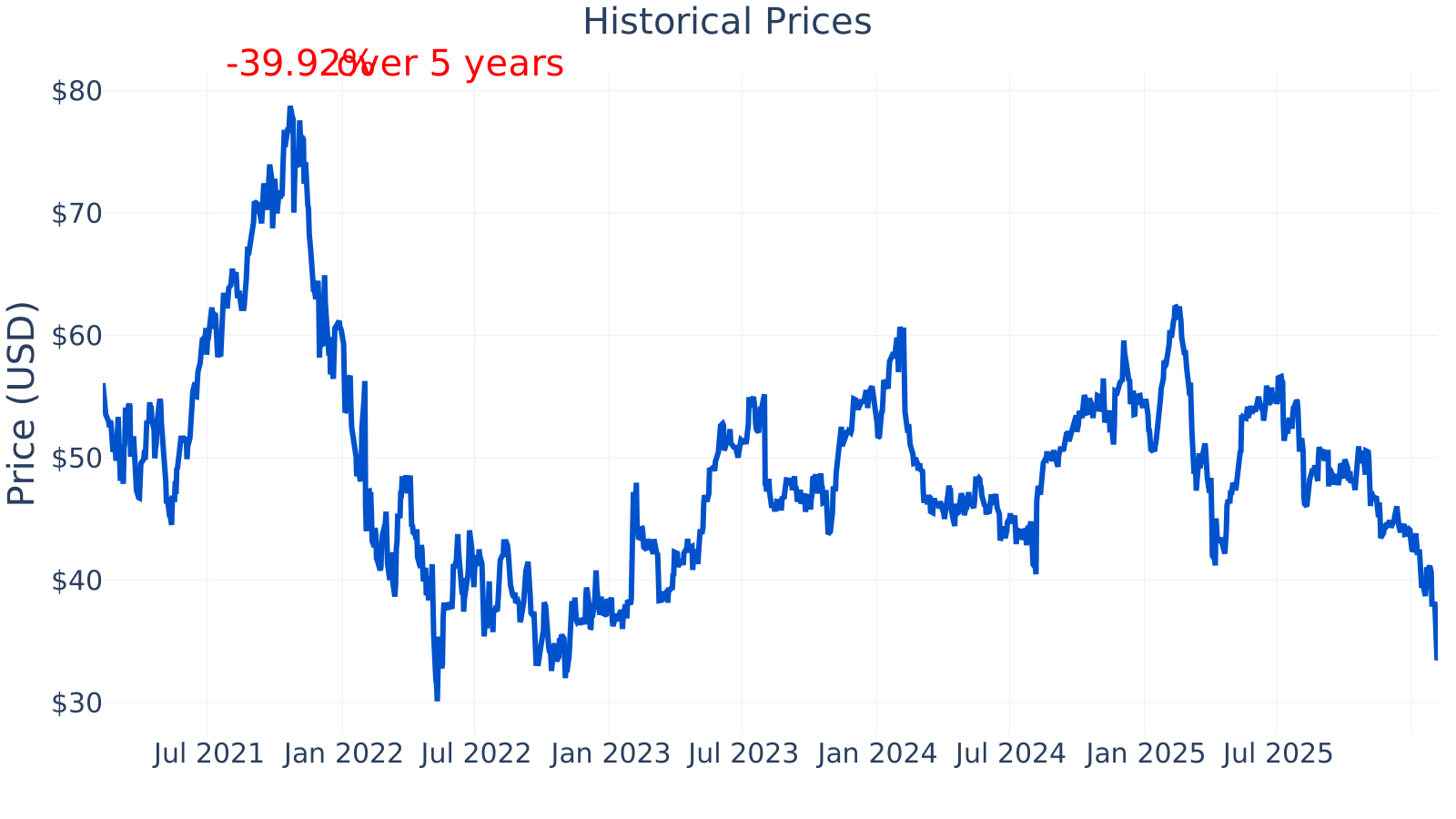
Dynatrace’s market capitalization is about $10.16B, and its beta of 0.81 suggests the stock has historically moved less than the overall market on average. The company’s P/E ratio is ~20.2, below the industry median shown (~27.8). Profitability stands out versus the industry median: profit margin ~27.3% versus an industry median around 6.0%. Year-over-year revenue growth is about 18.1%, slightly above the listed industry median (~15.8%). Balance sheet leverage appears low with debt-to-equity ~3.1% (industry median ~25.2%). Trailing twelve-month free cash flow is about $476M, indicating the core business is generating cash after operating needs and capital expenditures.
Growth (Medium)
Dynatrace operates in an area of software that tends to benefit from long-term trends: more cloud adoption, more complex software systems, and higher expectations for uptime and fast digital experiences. As businesses add more services, data, and interconnected components, monitoring and automation tools generally become more essential. This supports a backdrop where demand can expand over time, even though spending can fluctuate with corporate IT budgets.
Strategically, Dynatrace’s model is built around recurring subscriptions and a platform approach (one set of tools that can be expanded across more applications and environments within a customer). For long-term growth, this structure typically relies on (1) adding new customers and (2) expanding usage inside existing customers as their technology footprint grows.
The year-over-year revenue growth rate trends down from the mid-30% range in 2021 toward the high-teens more recently, with the latest shown around 18%. That pattern can be consistent with a company scaling to a larger revenue base: growth remains positive, but sustaining very high percentages becomes harder over time.
Free cash flow increases from roughly $206M (FY2021) to about $434M (FY2025), with the latest trailing figure around $476M. Rising cash generation can matter because it gives a company more flexibility to invest in product development, sales capacity, and resilience during weaker economic periods—without relying heavily on borrowing or new share issuance.
Risks (Medium)
Dynatrace’s results and valuation can be sensitive to business spending cycles. When enterprises slow hiring or reduce IT projects, new software commitments and expansions can take longer, affecting growth rates. A second risk is competitive pressure: observability and monitoring software is a crowded category, and pricing or product differentiation can shift as rivals add features and bundle tools into broader software suites.
Competition is also tied to platform consolidation. Large software vendors can bundle monitoring features with adjacent products (cloud platforms, security suites, IT service management), potentially making it harder to win deals purely on point-solution merits. In addition, technology changes (new cloud services, new application architectures, and AI-driven operations) require continuous product innovation; falling behind can reduce customer expansion and renewals over time.
Financial leverage appears low. Debt-to-equity declines substantially over the time shown, reaching about 3% in the latest period versus an industry median near 28%. Lower leverage can reduce financial risk, though it does not remove operating or competitive risks.
Profit margin improves markedly over time, reaching about 27% most recently, well above the industry median (roughly 6%). Sustaining this gap can be a competitive advantage if it reflects durable pricing power and efficient operations; however, margins can also be influenced by accounting items and the timing of expenses, so it is important to monitor whether strong profitability persists across multiple periods.
In terms of competitive positioning, Dynatrace is generally described in its filings as a platform provider focused on end-to-end observability. Main competitors commonly include large platform and monitoring vendors such as Datadog, New Relic, Splunk (now part of Cisco), IBM, and cloud-provider offerings (for example, native monitoring tools from major cloud platforms). The company’s competitive advantages typically center on breadth of monitoring coverage across environments, automation capabilities, and the ability to scale across large enterprises—while the key challenge is differentiating clearly in a fast-moving market where customers compare multiple tools and switching costs can vary by deployment.
Valuation
The latest P/E ratio shown is about 20.2, compared with an industry median around 27.8. Historically, the company’s P/E was much higher in earlier periods and then moved down substantially into 2025 as earnings and/or market pricing changed. In general, a lower P/E relative to earlier years can reflect a mix of slower growth expectations, higher current profitability, changes in interest-rate conditions, or shifts in how the market values software companies.
From a fundamentals context, the combination of positive revenue growth (high-teens), strong profit margin (high-20s), meaningful free cash flow (hundreds of millions), and low leverage helps explain why the market may assign a valuation multiple that is still above many non-software businesses, even if it is below some software peers. Whether that valuation remains justified over time will largely depend on how durable growth is, how competitive intensity affects margins, and how consistently the company converts revenue into cash.
Conclusion
Dynatrace is a subscription-based software company focused on keeping modern digital systems running smoothly, a need that tends to grow as organizations rely more on cloud and complex applications. The business shows a pattern of rising revenue over multiple years, improving profitability, increasing free cash flow, and comparatively low balance-sheet leverage.
The main uncertainties for long-term outcomes are centered on competitive dynamics in observability software and the sensitivity of enterprise software spending to broader economic cycles. The company’s recent financial profile—especially high profit margin versus industry median and solid cash generation—suggests operational strength, while the slowing (but still positive) revenue growth rate highlights the importance of continued product innovation and expansion within customers.
Sources:
- SEC EDGAR — Dynatrace Holdings LLC/Form 10-K (Annual Report) (most recent filing used for business description and revenue composition)
- SEC EDGAR — Dynatrace Holdings LLC/Form 10-Q (Quarterly Reports) (recent updates on operations and risk factors)
- Dynatrace Investor Relations — Annual Report materials and shareholder communications (company-hosted)
- Wikipedia — “Dynatrace” (basic public background and history)
This article is for informational purposes only and does not constitute financial advice. Some content is AI-generated. See Disclaimer