Stock Analysis · D-Wave Quantum Inc (QBTS)
Overview
D-Wave Quantum Inc (QBTS) is a quantum computing company. In simple terms, it builds specialized quantum computers and related software/services that aim to solve certain optimization-type problems (finding the “best” answer among many possibilities) that can be difficult or time-consuming for traditional computers in specific cases. The company also provides access to its quantum systems through cloud-based offerings, so customers can run workloads without owning the hardware.
Based on its public filings, D-Wave’s business model combines quantum computing systems, ongoing support and services, and cloud access/subscriptions. Revenue can vary meaningfully from year to year because a single system sale (hardware) can be large relative to the company’s overall revenue base, while cloud and services tend to be more recurring in nature.
Main revenue sources are typically described along these lines in company filings (exact percentages can change by period and are not always consistently disclosed in a way that supports a single, stable split):
- Quantum computing systems (sales of quantum computers and related elements)
- Maintenance and professional services (support, implementation work, and customer success activities)
- Cloud access and subscriptions (usage-based and/or subscription access to run problems on D-Wave systems)
D-Wave’s recent financial profile shows a business that has been scaling revenue but still spending heavily on research, engineering, and operating costs to build the product and expand commercial adoption.
Over the periods shown, total revenue rises from about $6.3M (2021) to about $24.6M (2025), while operating expenses remain much larger than gross profit. Research and development stays a major cost line, and selling/general/administrative expenses also grow as the company attempts to expand commercialization.
Key Figures
| Metric | Value | Industry ⓘ |
|---|---|---|
| Date | Apr 14, 2026 | |
| Context | ||
| Sector | Technology | |
| Industry | Computer Hardware | |
| Market Cap ⓘ | $5.42B | |
| Beta ⓘ | 1.77 | |
| Fundamental | ||
| P/E Ratio ⓘ | N/A | 26.69 |
| Profit Margin ⓘ | N/A | 4.46% |
| Revenue Growth ⓘ | 19.20% | 25.20% |
| Debt to Equity ⓘ | 0.90% | 5.95% |
| PEG ⓘ | N/A | |
| Free Cash Flow ⓘ | -$75.84M | |
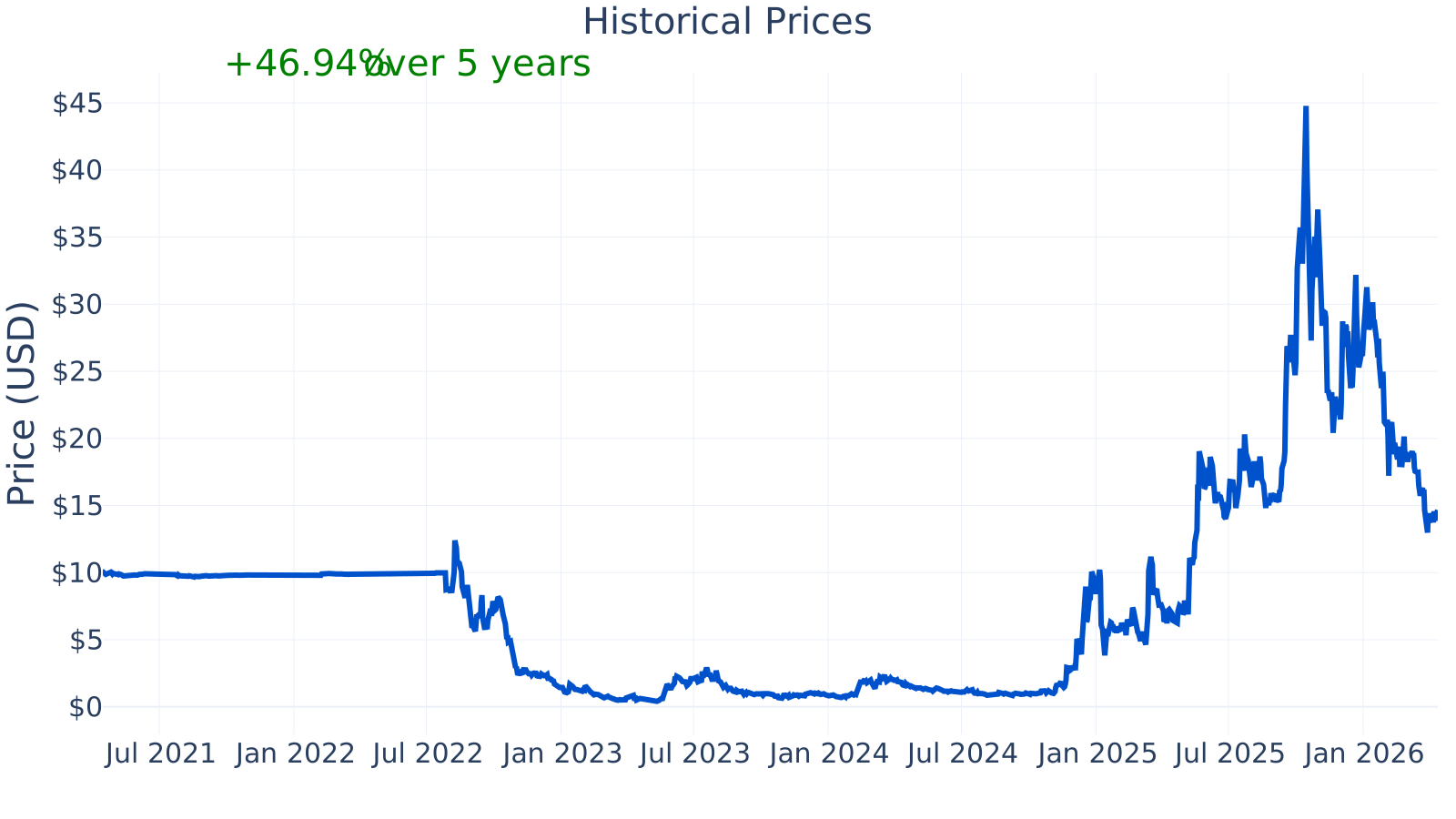
D-Wave’s market capitalization is about $5.4B. The stock’s beta (~1.77) indicates it has historically moved more than the overall market, which is consistent with earlier-stage, high-uncertainty technology companies. The company’s profit margin is negative (industry median is about 4.46%), and free cash flow over the last twelve months is about -$75.8M, which signals ongoing cash burn. Revenue growth (year-over-year) is shown at about 19.2% (industry median about 25.2%). Debt-to-equity is very low at roughly 0.9% (industry median about 5.95%), though this ratio can move sharply for small companies depending on equity levels and financing activity.
Growth (High)
Quantum computing is widely viewed as a long-horizon technology category with potentially meaningful impacts in areas like optimization, materials science, and certain types of simulation and machine learning workflows. That said, it is still an emerging market where the timing and scale of broad commercial adoption remain uncertain. For D-Wave, the growth question is less about whether “computing demand” grows (it generally does) and more about whether quantum approaches become economically valuable for real customer workloads at scale.
D-Wave’s strategy—combining quantum hardware with cloud access and customer-facing services—aims to reduce friction for adoption. If customers can test and deploy use cases through cloud access and professional services, that can help move from experiments to production workloads over time. A potential catalyst for long-term growth is broader acceptance of quantum solutions for practical optimization problems, including repeatable use cases that justify recurring spend (cloud usage, subscriptions, and services).
Year-over-year revenue growth is volatile, which is common for smaller companies. The pattern includes several quarters of strong growth and some periods of contraction, followed by a very large spike (over 500%) in one quarter and continued elevated growth rates thereafter. This type of variability can happen when the revenue base is small and timing of customer contracts or system-related revenue recognition shifts between quarters.
Free cash flow remains negative across the periods shown (roughly -$36.8M to -$60.2M in earlier points, and around -$52.2M at the latest shown point), which implies the business has not yet reached self-funding operations. For long-term outcomes, a key operational milestone is whether revenue growth and gross profit expansion can eventually narrow operating losses and reduce cash burn.
Risks (Very High)
The main risk is that the company is still in a phase of significant losses and cash burn. That creates dependence on future financing, cost reductions, materially higher revenue, or some combination of these. Even if the technology is promising, commercialization can take longer than expected, and delays can require additional capital. For shareholders, additional capital raises can dilute ownership if done through issuing new shares.
A second risk is technical and market adoption uncertainty. Quantum computing is complex, and customers typically demand clear economic value versus classical computing alternatives. If many problems can be solved cheaply with conventional methods, or if quantum advantage is limited to narrow niches, revenue may not scale as hoped. In addition, customer procurement cycles can be long, and early-stage projects can be small and experimental rather than large, recurring deployments.
Competition is also intense. D-Wave operates in a landscape that includes large, well-funded technology companies and specialized quantum startups. Competitors may focus on different quantum approaches (for example, gate-model systems) and may bundle quantum experimentation into broader cloud platforms. D-Wave’s positioning is often associated with its focus on quantum annealing and on optimization-focused applications, but leadership depends on the specific workload and on how the market ultimately values different quantum architectures.
The most recent debt-to-equity value shown is very low (about 0.9%, versus an industry median around 1.31% at the same point). However, earlier periods show extreme and even negative values, which can occur when equity is small or negative. This history highlights that leverage ratios for smaller, loss-making firms can swing sharply and may not be stable indicators on their own.
Profitability remains a major challenge. The profit margin is deeply negative across the timeline, while the industry median is modestly positive in many periods. The most recent point shown is roughly -1,444%, indicating losses that are large relative to revenue. Even allowing for one-time items, this scale of negative margin underscores that the company is not yet operating near break-even and is still in a high-investment, high-uncertainty stage.
Valuation
Traditional valuation tools like the price-to-earnings (P/E) ratio are often not meaningful for companies with persistent net losses, because earnings are negative and the ratio may be undefined or not representative. That is the case here.
The P/E series is effectively not meaningful for the company across the periods shown, while the industry median P/E remains in a more typical range (often in the teens to 30s in the chart). In practice, when a company is loss-making, valuation discussions tend to rely more on qualitative factors (addressable market, product progress, customer traction) and on other quantitative measures (such as revenue scale and growth, gross margin trajectory, operating expense discipline, and cash runway), rather than earnings multiples.
With a market capitalization around $5.4B and revenue that was about $24.6M in 2025 (per the financial flow summary shown), the market is assigning value based largely on expectations for substantial future growth and eventual profitability. That kind of expectation-based pricing can be highly sensitive to execution progress, contract timing, and shifts in market sentiment.
Conclusion
D-Wave is positioned in a long-horizon, emerging computing category and has grown revenue over the multi-year period shown. Its operating profile, however, reflects a company still investing heavily to build and commercialize its technology, with continuing negative free cash flow and very large negative profit margins.
From a long-term, fundamentals-focused perspective, the central issues to track over time are whether revenue growth becomes more consistent, whether gross profit expands meaningfully, and whether operating losses and cash burn narrow in a sustained way. Competitive pressure and the uncertain pace of quantum adoption remain defining uncertainties, and the stock’s historical volatility suggests that outcomes can be heavily influenced by changing expectations about the technology and the company’s execution.
Sources:
- SEC EDGAR — D-Wave Quantum Inc filings (Form 10-K, Form 10-Q, Form 8-K)
- D-Wave Quantum Inc Investor Relations — Press Releases and Shareholder Materials
- D-Wave Quantum Inc — Annual Report (as filed with the SEC)
- Wikipedia — “D-Wave Systems” (company background and history)
This article is for informational purposes only and does not constitute financial advice. Some content is AI-generated. See Disclaimer