Stock Analysis · Duolingo Inc (DUOL)
Overview
Duolingo, Inc. is a software company best known for its Duolingo mobile app, which helps people learn languages through short, game-like lessons. Over time, the company has expanded beyond languages with additional learning offerings (such as math and music), while keeping its core product focused on daily practice, personalization, and engagement. The company’s model is built around a very large user base using a free version, with a smaller portion upgrading to paid subscriptions and others generating advertising revenue.
Duolingo’s revenue mix is centered on digital monetization of its learning platform. In its SEC filings, the company describes revenue primarily coming from subscriptions (paid plans), advertising (mainly from users on the free tier), and in-app purchases/other items. The typical ordering by size is:
- Subscriptions (largest)
- Advertising
- In-app purchases / other revenue (smallest)
Because the exact percentages can shift over time and depend on the reporting period, the most reliable way to confirm the current split is the latest annual report (Form 10-K) revenue note and segment discussion.
Over the last few years, total revenue has increased substantially (from about $369 million in 2022 to about $1.04 billion in 2025). Over the same period, operating income moved from negative territory (losses) to positive, which suggests that growth has been accompanied by improving operating efficiency.
Key Figures
| Metric | Value | Industry ⓘ |
|---|---|---|
| Date | Mar 02, 2026 | |
| Context | ||
| Sector | Technology | |
| Industry | Software - Application | |
| Market Cap ⓘ | $5.16B | |
| Beta ⓘ | 0.85 | |
| Fundamental | ||
| P/E Ratio ⓘ | 14.06 | 25.64 |
| Profit Margin ⓘ | 40.03% | 7.25% |
| Revenue Growth ⓘ | 41.10% | 16.65% |
| Debt to Equity ⓘ | 6.96% | 24.64% |
| PEG ⓘ | N/A | |
| Free Cash Flow ⓘ | $376.64M | |
Duolingo’s market capitalization is about $5.16 billion. The stock’s beta of ~0.85 indicates it has historically moved somewhat less than the broader market, although individual growth stocks can still be volatile. The table shows a P/E ratio of ~14.1 versus an industry median around 25.6, while the company’s profit margin is ~40.0% versus an industry median around 7.2%. Revenue growth year-over-year is about 41.1% versus an industry median around 16.7%. Debt-to-equity is about 7.0%, which is well below the industry median near 24.6%. Free cash flow over the trailing twelve months is about $376.6 million.
Growth (high)
Duolingo operates at the intersection of consumer mobile apps, online education, and subscription software. These areas have structural tailwinds: global smartphone usage, increased acceptance of app-based learning, and the broader shift toward subscriptions for digital services. Language learning, in particular, is global by nature, which can support expansion without needing physical distribution.
A key part of Duolingo’s strategy is that product improvements can scale to a large user base at relatively low marginal cost compared with traditional education models. The company emphasizes engagement features (streaks, leagues, gamification) to encourage daily use, and it continually updates course content and product features. Over time, a growing user base can translate into more subscription conversions and higher advertising impressions, which is why execution on retention and monetization is central to the long-term story.
Revenue growth has remained elevated across the periods shown, generally around the high-30% to low-50% range year-over-year, ending most recently near 35.0%. Even with some moderation from earlier highs, this pace is still meaningfully above the industry median shown on the table.
Free cash flow has increased strongly over time—from roughly $6.0 million (TTM in 2021) to about $290.2 million (TTM in early 2025), and the latest metric table shows about $376.6 million TTM. For long-term business durability, this matters because it suggests the company is not only growing but also generating cash that can be reinvested into product development, marketing, and infrastructure (or simply strengthen the balance sheet).
Risks (medium)
Duolingo’s biggest business risk is that user attention is hard to keep. Consumer apps can be subject to changing tastes, competition for screen time, and “novelty wear-off.” If engagement declines, subscription growth and advertising revenue can slow. Another risk is platform dependence: distribution and monetization rely heavily on mobile operating systems and app stores, where policy or fee changes can impact performance.
Competition is also a material factor. In language learning, alternatives include other dedicated apps and platforms, and more general education or content platforms. Competitors can include language-learning apps (such as Babbel and Busuu) and broader ecosystems that can substitute for language practice (online tutoring, free content platforms, or AI-driven tools). Duolingo’s competitive advantages described in its filings typically relate to its brand recognition, large user community, strong product engagement loop, and data-driven iteration. Whether it is “the leader” depends on the definition (users, downloads, revenue), but it is widely recognized as one of the best-known consumer language-learning apps globally.
Financial leverage appears relatively low. The debt-to-equity ratio has generally stayed in the single digits and is around 7% most recently, below the industry median (roughly 27% at the latest point shown). Lower leverage can reduce financial risk during downturns, though it does not eliminate operational risk.
Profitability has improved dramatically over time. The profit margin was negative through much of 2021–2023, turned positive in late 2023, and rose through 2024 and 2025. The latest value shown is around 40%, far above the industry median (about 7%). A margin that high can sometimes be influenced by one-time items in a given period, so it is typically something to verify in the most recent 10-K/10-Q discussion of results (for example, whether there were unusual tax effects or other non-recurring impacts).
Valuation
Valuation is often discussed using the price-to-earnings (P/E) ratio, which compares the stock price to the company’s earnings. A higher P/E can indicate the market is expecting stronger future growth, but it can also mean the stock price is more sensitive to disappointments. A lower P/E can indicate more modest expectations, but it can also reflect uncertainty about the durability of earnings.
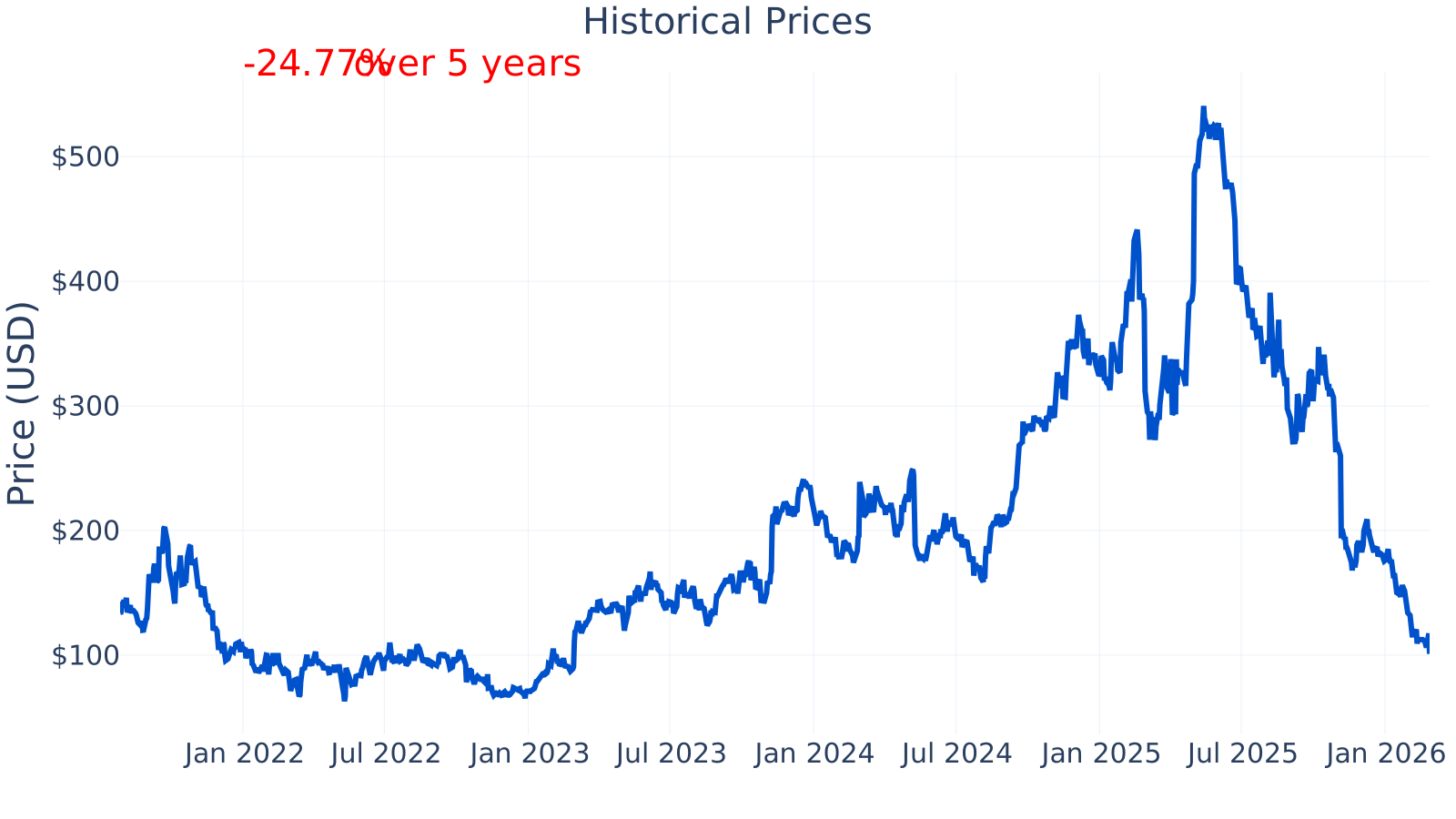
Duolingo’s P/E ratio has moved sharply over time, reaching very high levels in parts of 2024–2025 (well above the industry median), and then falling substantially more recently. The latest point shown is around 21.2, below the industry median near 36.0 at that time. Interpreting that shift requires context: the P/E can drop because the stock price falls, because earnings rise, or both. Given Duolingo’s rapid growth and improving profitability, part of the change may reflect rising earnings, but the historical stock price pattern also shows large swings, which can meaningfully affect valuation multiples.
Conclusion
Duolingo is a consumer-focused education software company that monetizes primarily through subscriptions, supported by advertising and in-app purchases. The business has shown strong top-line growth over multiple years, a clear improvement in profitability, and rising free cash flow, alongside relatively low balance-sheet leverage.
The main points to weigh for a long-term view are execution and durability: sustaining engagement, keeping its product differentiated as learning tools evolve (including AI-driven alternatives), and maintaining healthy monetization without harming user experience. On valuation, the P/E ratio has fluctuated widely, and the stock price history suggests meaningful volatility; more recently, the P/E shown is lower than earlier peaks and below the industry median, but interpreting that requires checking the latest filings for the quality and repeatability of earnings.
Sources:
- SEC EDGAR — Duolingo, Inc. Form 10-K (Annual Report)
- SEC EDGAR — Duolingo, Inc. Form 10-Q (Quarterly Reports)
- Duolingo Investor Relations — Shareholder letters / quarterly results materials (press releases)
- Duolingo Investor Relations — Earnings call materials and transcripts (company-hosted/public)
- Wikipedia — “Duolingo” (basic company background)
This article is for informational purposes only and does not constitute financial advice. Some content is AI-generated. See Disclaimer


