Stock Analysis · Dream Finders Homes Inc (DFH)
Overview
Dream Finders Homes, Inc. (DFH) is a U.S. homebuilder. In simple terms, the company designs, markets, and sells newly built homes—typically working with third-party subcontractors for construction—across multiple markets. Like other homebuilders, its results are closely tied to housing demand, mortgage rates, land availability, construction costs, and how quickly it can sell and deliver finished homes.
For most homebuilders, the largest revenue stream is the sale of homes to buyers at closing. Additional revenue can come from related services (for example, arranging mortgages or title services through affiliates or partners). Based on how homebuilders generally report results in their filings, revenue is typically concentrated as follows (exact percentages can vary by year and are detailed in the company’s SEC filings):
- Home sales (homebuilding revenue) — typically the vast majority of total revenue
- Financial services / other related revenue — usually a smaller portion compared with home sales
Over the past several years, the company’s income statement shows that revenue expanded materially from 2021 through 2024, followed by a decline in 2025. Net income also rose through 2024 and then fell in 2025, reflecting a more challenging operating environment.
From 2021 to 2024, total revenue increased from about $1.9B to about $4.45B, while net income rose from about $122M to about $335M. In 2025, revenue dipped to about $4.32B and net income declined to about $217M. A notable change is interest expense, which is minimal in earlier years shown but rises sharply in 2024 (about $177M), highlighting how financing costs can meaningfully affect homebuilder profitability when rates and/or debt costs increase.
Key Figures
| Metric | Value | Industry ⓘ |
|---|---|---|
| Date | Mar 02, 2026 | |
| Context | ||
| Sector | Consumer Cyclical | |
| Industry | Residential Construction | |
| Market Cap ⓘ | $1.68B | |
| Beta ⓘ | 1.86 | |
| Fundamental | ||
| P/E Ratio ⓘ | 6.36 | 13.00 |
| Profit Margin ⓘ | 5.02% | 8.65% |
| Revenue Growth ⓘ | -22.30% | -6.05% |
| Debt to Equity ⓘ | 37.59% | 33.34% |
| PEG ⓘ | N/A | |
| Free Cash Flow ⓘ | -$126.37M | |
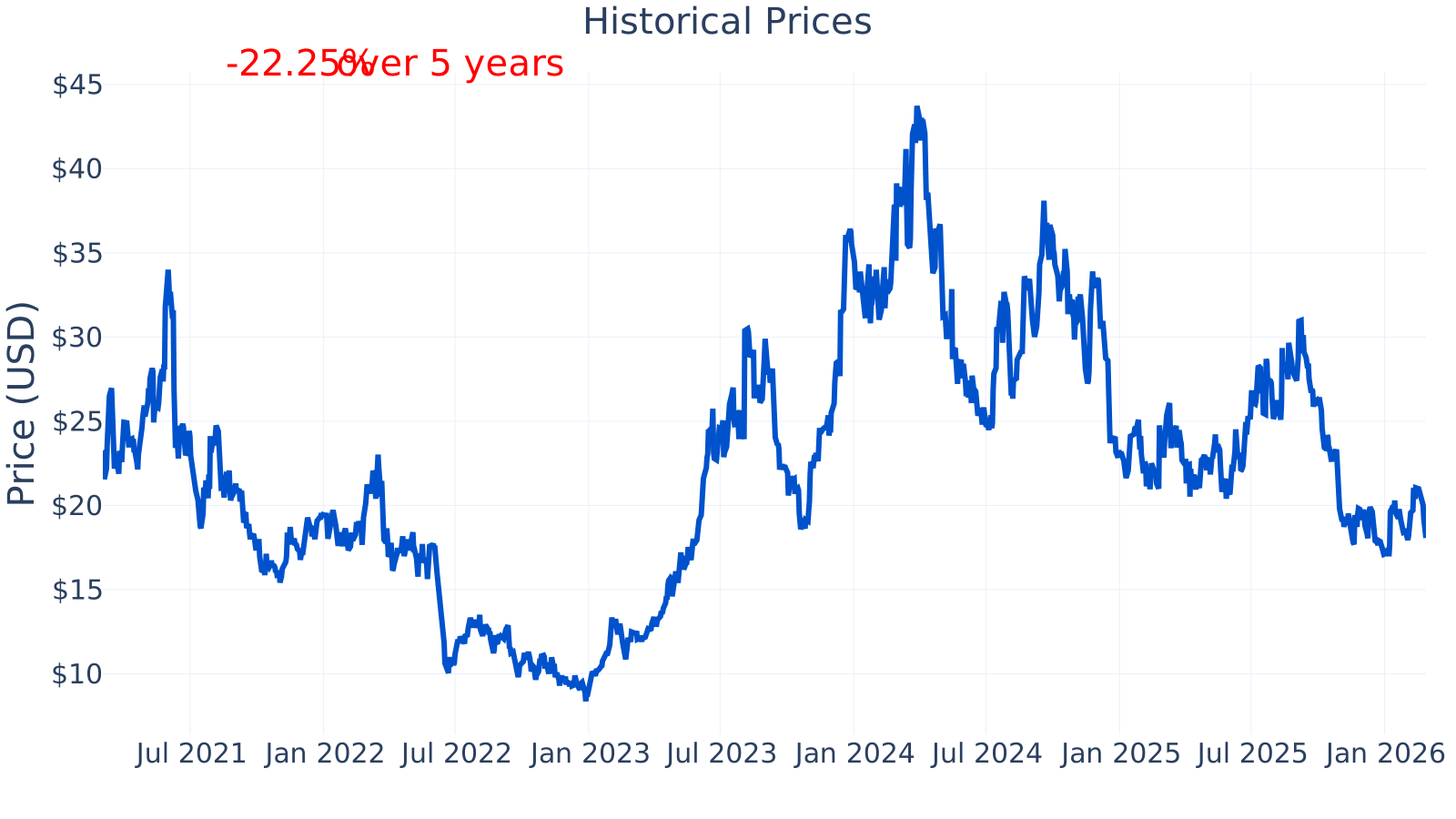
Dream Finders Homes has a market capitalization of about $1.68B and a relatively high beta (~1.86), meaning the stock price has tended to swing more than the broader market. The P/E ratio is about 6.36 versus an industry median near 13.00, while the net profit margin is about 5.02% versus an industry median near 8.65%. Revenue growth year-over-year is currently negative (about -22.3%) compared with an industry median around -6.05%. Debt-to-equity is about 37.6% versus an industry median near 33.3%. Free cash flow over the trailing twelve months is negative (about -$126M).
Growth (Medium)
Residential construction is a long-running, essential industry (people need housing), but it is also highly cyclical. Demand often strengthens when mortgage rates are lower and consumer confidence is higher, and it can weaken quickly when borrowing costs rise or affordability declines. Because of this, “growth” for a homebuilder often comes in waves rather than in a smooth line upward.
Dream Finders Homes’ recent revenue trend shows this cyclical pattern. After strong growth earlier in the period shown, revenue growth cooled and turned negative in the most recent year-over-year reading.
The chart shows very strong growth rates in 2021–2022 (triple-digit year-over-year growth at points), followed by a steady slowdown. By late 2025, year-over-year revenue growth fell to roughly -22.3%, indicating a contraction compared with the prior year—consistent with a tougher housing demand and affordability environment.
A practical way to think about future growth catalysts for a homebuilder includes: (1) lower mortgage rates or improved affordability, (2) easing construction and labor constraints, (3) a favorable mix of communities/markets, and (4) operational discipline that protects margins when conditions soften. These items can improve results, but they are influenced by macroeconomic forces that management cannot fully control.
Free cash flow has been uneven: it was positive in 2021, turned negative in 2022, improved strongly by 2024 (about $157M), then swung negative again by 2025 (about -$80M). This variability is common in homebuilding because cash needs can rise when a company invests in land and inventory (homes under construction) and can improve when homes close and inventory converts into cash.
Risks (High)
The largest risk is the industry’s sensitivity to interest rates and housing affordability. When mortgage rates rise, monthly payments increase, and demand for new homes can slow. Even when demand holds up, builders can face incentives/discounts, higher financing costs, or a need to adjust production pace—each of which can pressure profitability.
A second major risk is cost and execution risk. Homebuilders manage land acquisition/development, construction timelines, subcontractors, and materials pricing. Delays or cost inflation can compress margins. The company’s profit margin trend shows that profitability has weakened recently compared with both its own earlier period and the industry median.
Net profit margin was around 7%–8% for much of 2022–2024, but it declined through 2025, reaching about 5.02% at the end of 2025. Over the same timeframe, the industry median also declined but remained higher (about 8.65% at the latest point shown). This gap suggests Dream Finders Homes has recently been generating less net profit per dollar of revenue than the typical peer in its industry set.
Balance-sheet and refinancing risk can also matter in homebuilding, especially when interest rates are elevated. Debt is often used to fund land and construction. Dream Finders Homes’ latest debt-to-equity ratio is lower than it was earlier in the time series, and it is now closer to the industry median, though leverage can still change quickly depending on inventory investment and market conditions.
The debt-to-equity ratio was above 100% for several years shown earlier (and peaked near ~191% in 2022), then declined meaningfully. By the latest point shown, it is about 37.6%, roughly in line with the industry median (~34.8%). Even with improved leverage, interest expense can still be an important swing factor for net income when borrowing costs are high.
In terms of competitive position, Dream Finders Homes participates in a competitive market with many national and regional builders. Competitive advantages in homebuilding usually come from scale in purchasing, land sourcing, local market knowledge, construction efficiency, and maintaining an appealing product at the right price points. The company is not the sole leader of the industry; it competes with larger national homebuilders and numerous regional players. This means pricing power is limited, and results can be heavily influenced by local conditions in the specific markets where it operates.
Valuation
One common valuation yardstick is the P/E ratio (price compared with earnings). Dream Finders Homes’ current P/E (about 6.36) is below the industry median (about 13.00). A lower P/E can indicate the market is placing a lower value on each dollar of current earnings, which can happen when investors expect earnings to fall, view profits as cyclical, or see higher risk.
Historically, the company’s P/E moved from the mid-to-high teens in 2021 toward lower levels in 2022, then rose again into 2024, and more recently fell back into the mid-to-high single digits. The latest value shown (about 8.15 in early 2026 on the chart) is also below the industry median at that point (about 11.12). Interpreting this requires context: recent revenue growth is negative and profit margins have compressed, so a lower P/E may be reflecting a more cautious view of near-term earnings durability in a cyclical business.
Because homebuilding earnings can rise and fall with the housing cycle, valuation metrics can change quickly even if the stock price does not move much. For long-term context, the key question is often whether profitability and cash generation normalize over a full cycle—and how much balance-sheet risk is taken to get there—rather than focusing on a single year’s earnings.
Conclusion
Dream Finders Homes is a residential construction company whose results are driven primarily by selling new homes. Financial results shown here highlight strong expansion from 2021 through 2024, followed by softer performance in 2025, with negative year-over-year revenue growth, declining net profit margin, and negative trailing free cash flow—patterns that are consistent with a cyclical industry facing affordability and interest-rate pressure.
At the same time, leverage appears substantially lower than earlier years in the period shown, and the stock’s P/E ratio is below the industry median. These facts together suggest the market is weighing cyclical and profitability risks against the company’s earnings level. A neutral long-term assessment typically centers on how the company performs across a full housing cycle—especially its ability to protect margins, manage land/inventory investment, and control financing costs as conditions change.
Sources:
- SEC EDGAR — Dream Finders Homes, Inc. filings (Form 10-K, Form 10-Q, Form 8-K)
- Dream Finders Homes, Inc. — Investor Relations materials and press releases (company-hosted)
- Wikipedia — “Dream Finders Homes” (basic company background)
This article is for informational purposes only and does not constitute financial advice. Some content is AI-generated. See Disclaimer


