Stock Analysis · Douglas Dynamics Inc (PLOW)
Overview
Douglas Dynamics, Inc. (PLOW) designs and manufactures equipment used on work trucks, with a focus on snow and ice control. Its products are typically installed on pickup trucks and other light- to medium-duty vehicles and are used by a mix of commercial customers (such as contractors) and governmental buyers (such as municipalities). The business is closely tied to winter weather patterns and to replacement/upgrade cycles for trucks and attachments.
In its SEC filings, the company describes two operating segments that shape how revenue is generated: Work Truck Attachments (including snowplows, spreaders, and related parts/accessories) and Work Truck Solutions (which includes upfit and storage solutions, such as toolboxes and related products). A meaningful portion of sales also comes from parts and accessories tied to the installed base of equipment, which can support recurring demand beyond new equipment purchases.
Main revenue sources (reported as business segments in filings) typically include:
- Work Truck Attachments (snow & ice equipment and related parts/accessories)
- Work Truck Solutions (truck upfit and storage solutions)
Looking across recent years, total revenue moved from about $541M (2021) to $656M (2025). Over the same period, costs rose as well, so profitability depended heavily on pricing, product mix, and operating expense control. Net income has fluctuated (about $30.7M in 2021, $38.6M in 2022, $23.7M in 2023, $56.2M in 2024, and $46.9M in 2025), showing that results can vary notably from year to year.
Key Figures
| Metric | Value | Industry ⓘ |
|---|---|---|
| Date | May 08, 2026 | |
| Context | ||
| Sector | Consumer Cyclical | |
| Industry | Auto Parts | |
| Market Cap ⓘ | $1.05B | |
| Beta ⓘ | 1.26 | |
| Fundamental | ||
| P/E Ratio ⓘ | 20.37 | 24.76 |
| Profit Margin ⓘ | 7.83% | 3.56% |
| Revenue Growth ⓘ | 19.80% | 5.40% |
| Debt to Equity ⓘ | 34.75% | 64.27% |
| PEG ⓘ | 1.19 | |
| Free Cash Flow ⓘ | -$4.09B | |
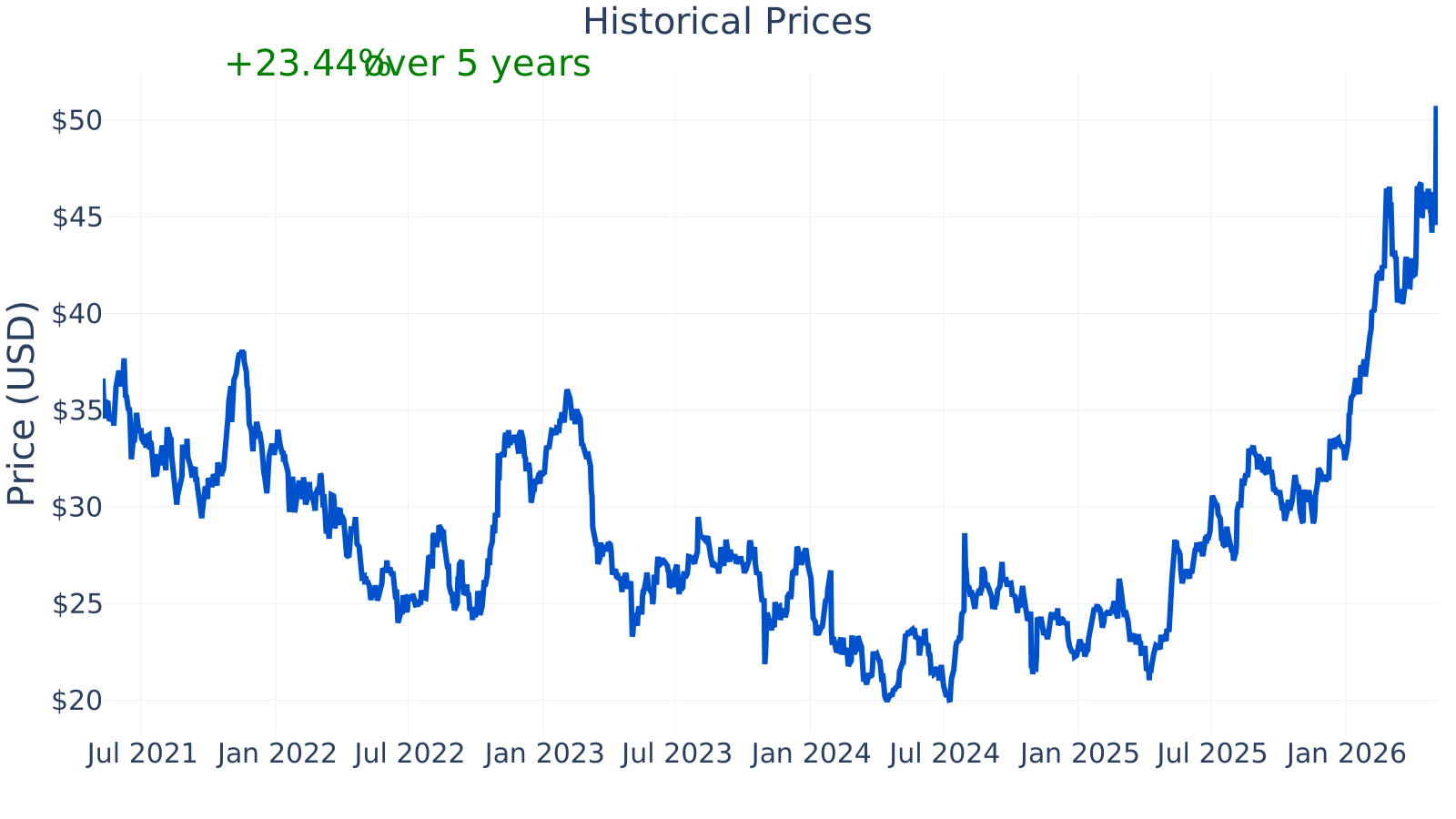
The latest snapshot shows a company with roughly $1.05B in market value and a beta of ~1.26, meaning the stock has tended to move somewhat more than the broader market. The P/E ratio is ~20.4, below the industry median shown here (~24.8). Profitability stands out versus the peer median: the company’s profit margin is ~7.83% versus an industry median of ~3.57%. The latest year-over-year revenue growth is ~19.8%, above the industry median (~5.4%). Balance-sheet leverage (by this measure) is lower than the peer median, with debt-to-equity ~34.7% versus an industry median of ~64.3%. One item to treat carefully is free cash flow (TTM) of about -$4.09B, which is unusually large relative to the size of the company and may reflect non-recurring movements (for example, working-capital swings or a one-time item); it is worth reconciling this with the company’s cash flow statement discussion in the most recent 10-K/10-Q.
Growth (Medium)
Douglas Dynamics participates in markets tied to work-truck utilization and winter weather readiness. Snow and ice control is a long-standing, necessary function for many regions, so demand can be resilient over long periods; however, it is not a steady “always up and to the right” market. A large driver of year-to-year performance is the severity and timing of winter seasons, which influences both equipment purchases and in-season parts demand.
From a strategy standpoint, the company’s mix of (1) equipment sales and (2) parts/accessories for an installed base can support repeat purchases over time. In addition, the “work truck solutions” side can potentially broaden demand beyond winter-specific spending, which may help reduce (but not eliminate) weather-driven seasonality.
Recent year-over-year revenue growth has been volatile, including some negative periods and several strong positive quarters. The latest reading is around +19.8%, which is higher than the industry median in the table, but the quarter-to-quarter pattern suggests results can swing with conditions and comparisons.
Free cash flow has also been uneven over the periods shown: modestly negative in 2022–2023, positive in 2024–2025, and then a very large negative figure in the most recent trailing period. Because free cash flow is often affected by short-term changes in inventory, receivables, and payables (especially in seasonal businesses), the key long-term question is whether the company can consistently convert earnings into cash over a full cycle.
Risks (High)
The most important business risk is weather-driven demand. A mild winter can reduce in-season ordering and delay purchases, while a severe winter can lift demand but also strain supply chains and operations. This can make forecasting difficult and can cause earnings and cash flow to vary materially from one year to the next.
Another core risk is exposure to input costs and supply availability (steel, components, freight, and labor). If costs rise faster than pricing power allows, margins can compress. The company also depends on a network of distributors/dealers and on end-customer budgets (including municipal procurement), both of which can shift with economic conditions.
Leverage (as measured by debt-to-equity) has trended down sharply in the most recent period shown, to about 34.7%, below the industry median of about 64.3%. Lower leverage can reduce financial risk, but it does not remove operating volatility tied to seasonality and demand swings.
Profit margin has generally been above the industry median across much of the timeline shown, which can indicate operational advantages (brand strength, dealer reach, product mix, pricing discipline, or manufacturing efficiency). One data point appears extremely high in the latest period, which is unusual for an operating manufacturer; it is worth cross-checking the company’s reported trailing profitability in filings to understand whether any non-recurring item affected the calculation.
On competition, the company operates in a space where brand reputation, dealer relationships, and installed base matter. It is commonly associated with established brands in snow and ice equipment (as described in its filings). Competitive pressure can come from other attachment makers, alternative equipment types, and pricing competition—especially in softer demand environments. How well Douglas Dynamics is positioned depends on its ability to protect its dealer network, innovate on features and reliability, and maintain cost competitiveness.
Valuation
Using the price-to-earnings (P/E) ratio as a simple valuation yardstick, the current P/E shown (~20.4) is below the industry median in the table (~24.8). Over the historical window displayed, the company’s P/E has moved through a range that includes the high teens/low 20s in many periods, a drop into the ~10–11 area during parts of 2024–2025, and a return above 20 more recently. That pattern indicates that valuation can shift meaningfully with changes in earnings expectations and with the cyclicality/seasonality of results.
Because this business can experience sizable swings in profitability and cash generation, a single-point P/E should be interpreted alongside (1) multi-year earnings power, (2) cash flow consistency through different winter seasons, and (3) balance-sheet resilience. The unusually large negative trailing free cash flow figure shown earlier is particularly important to reconcile with filings before drawing conclusions from earnings-based multiples alone.
Conclusion
Douglas Dynamics is a specialized manufacturer tied to work trucks, with a well-defined focus on snow and ice control and a secondary set of products aimed at broader truck upfitting needs. Financial results over recent years show that revenue and earnings can be profitable but not steady, reflecting exposure to winter severity, customer timing, and cost conditions.
From the latest snapshot, the company shows above-median profit margin, above-median recent revenue growth, and lower leverage than the peer median, which are constructive fundamentals on their face. At the same time, the company carries meaningful business variability, and the recent trailing free cash flow figure shown is a key item that warrants careful interpretation using the cash flow statement and management discussion in SEC filings. Valuation indicators like the P/E ratio appear within a range that has shifted with the cycle, reinforcing the importance of looking at normalized performance over multiple years rather than a single period.
Sources:
- U.S. SEC EDGAR — Douglas Dynamics, Inc. Form 10-K (Annual Report) (business description, segments, risk factors, financial statements)
- U.S. SEC EDGAR — Douglas Dynamics, Inc. Form 10-Q (Quarterly Reports) (updates to results, seasonality, liquidity and cash flow discussion)
- Douglas Dynamics Investor Relations — Press releases and SEC filing archive
- Wikipedia — “Douglas Dynamics” (basic company background)
This article is for informational purposes only and does not constitute financial advice. Some content is AI-generated. See Disclaimer


