Stock Analysis · Dorman Products Inc (DORM)
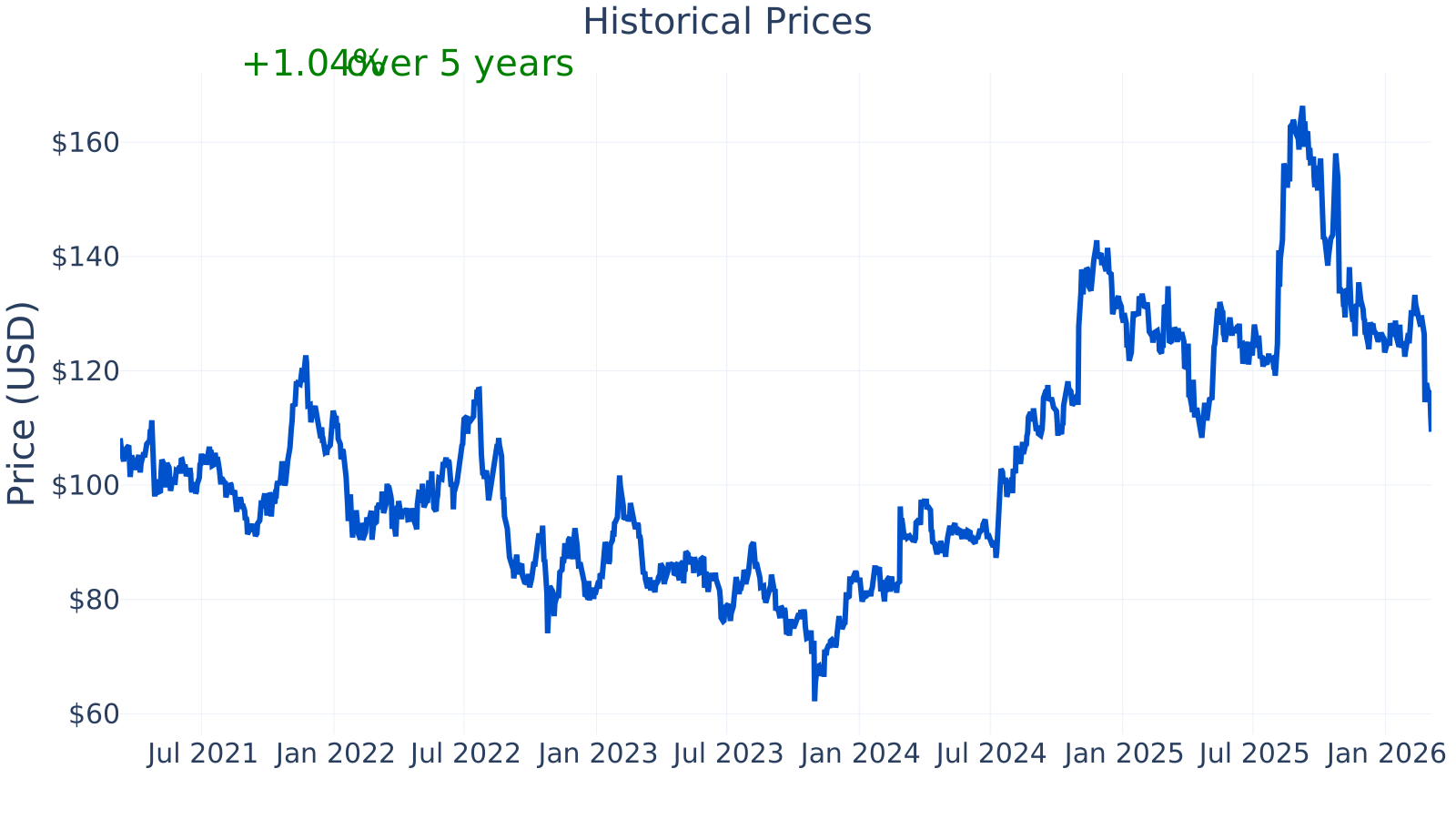
Overview
Dorman Products, Inc. is an automotive parts supplier focused on the “aftermarket,” meaning replacement parts used to repair and maintain vehicles after they leave the original manufacturer. The company is known for offering a wide catalog of parts—often targeting components that tend to fail over time or that may not be widely available from original equipment sources. Its products are generally sold through automotive parts retailers, distributors, and professional repair channels, ultimately serving both do-it-yourself customers and repair shops.
From a business model standpoint, Dorman’s activity is closely tied to the size and age of the vehicle fleet on the road, the pace of repairs, and the ability to develop and source parts that customers need at the right price and availability. Operationally, the company’s results are influenced by product mix (which parts sell more), input costs, logistics and warehousing execution, and how effectively it can manage inventory levels across a broad set of stock-keeping units.
Main sources of revenue are typically described in company filings by product category and/or sales channel or customer type; the exact split and percentages can change over time and should be taken from the most recent annual report.
Over the 2021–2025 period shown, total revenue increased materially (from about $1.35B in 2021 to about $2.13B in 2025). Gross profit also grew over that span, while selling, general, and administrative costs increased as well. Operating income rose from roughly $172M (2021) to roughly $304M (2025), and net income increased from roughly $132M (2021) to roughly $204M (2025). Interest expense was notably higher in 2022–2024 than in 2021, consistent with a period of higher borrowings and/or higher interest rates.
Key Figures
| Metric | Value | Industry ⓘ |
|---|---|---|
| Date | Mar 09, 2026 | |
| Context | ||
| Sector | Consumer Cyclical | |
| Industry | Auto Parts | |
| Market Cap ⓘ | $3.34B | |
| Beta ⓘ | 0.92 | |
| Fundamental | ||
| P/E Ratio ⓘ | 16.47 | 23.88 |
| Profit Margin ⓘ | 9.59% | 3.56% |
| Revenue Growth ⓘ | 0.80% | 4.90% |
| Debt to Equity ⓘ | 42.86% | 76.35% |
| PEG ⓘ | 1.17 | |
| Free Cash Flow ⓘ | $75.67M | |
Dorman Products has a market capitalization of about $3.34B and a beta near 0.92, which indicates its share price has historically moved somewhat similarly to the broader market (slightly less volatile than “beta 1” in this snapshot). The company’s P/E ratio is about 16.5 versus an industry median near 23.9, while profit margin is about 9.6% versus an industry median around 3.6%. Revenue growth year-over-year is about 0.8% compared with an industry median near 4.9%. Debt-to-equity is about 42.9% versus an industry median around 76.3%. Trailing twelve-month free cash flow is about $75.7M, and the PEG ratio is about 1.17 (a valuation ratio that relates price multiples to growth expectations).
Growth (Medium)
The automotive aftermarket is generally supported by long-lived demand drivers: vehicles require ongoing maintenance and repair over time, and an aging vehicle fleet can support steady replacement-part needs. This can make the industry less dependent on new vehicle sales than many other auto-related businesses. However, it is not typically a “hyper-growth” area; results often depend on execution, product launches, supply chain performance, and the competitive landscape.
A practical way to look at Dorman’s recent trajectory is that revenue grew strongly earlier in the period shown and then shifted into a slower-growth phase more recently.
Year-over-year revenue growth was high through 2021–2022 (often in the double digits and higher), then cooled in 2023–2025 with periods near flat to mid-single-digit growth. This pattern can reflect tougher comparisons after a strong growth phase, normalization of demand, changes in customer ordering patterns, pricing/cost dynamics, and/or product mix shifts.
Cash generation matters for long-term business flexibility (inventory investment, new product development, and balance-sheet strength). Dorman’s free cash flow has been uneven, with a sharp dip around 2023 followed by a strong rebound.
Free cash flow moved from about $136M (2021) to about $81.7M (2022), dropped to about $3.5M (2023), and then recovered to about $190M (2024–2025). A swing like this is often tied to working-capital movements (inventory and receivables) and operating conditions; it is typically something readers verify against management’s discussion in the annual report to understand whether it was temporary or structural.
Potential catalysts in an aftermarket parts business commonly include expanding product coverage (new SKUs and categories), improving fill rates and delivery times, gaining shelf space with retailers/distributors, and using scale to improve sourcing and logistics efficiency. The durability of those catalysts depends on competitive responses and execution consistency.
Risks (Medium)
Dorman operates in a competitive, price-sensitive environment where customers (retailers, distributors, and repair channels) have bargaining power and can shift volume among brands. Execution risk is meaningful: because the catalog is large, forecasting demand and managing inventory are constant challenges. Too much inventory can pressure cash flow, while too little inventory can lead to missed sales and customer dissatisfaction.
Competition is also a key factor. Dorman participates in the aftermarket ecosystem alongside major parts retailers and distributors, as well as a wide range of branded and private-label parts manufacturers. Competitive pressure can show up through pricing, promotional activity, access to distribution, and the ability to introduce replacement parts for common failure points faster than peers. Dorman is widely recognized for its breadth of “hard-to-find” replacement parts, which can function as a differentiator, but it is not the only scaled player in the aftermarket, and competitors may have advantages in certain categories, customer relationships, or global sourcing.
Balance-sheet risk is tied to leverage and interest costs. While Dorman’s debt-to-equity has been below the industry median recently, the ratio increased meaningfully in parts of 2022–2023 before declining again.
Debt-to-equity rose from very low levels in early 2021 to higher levels by late 2022 (peaking above 80%), then trended down through 2024–2025 to roughly 42.9% most recently—below the industry median near 76.3%. Lower leverage can reduce financial strain during downturns, but the earlier rise shows that leverage can change over time depending on strategy, acquisitions, working-capital needs, and financing conditions.
Profitability is another central risk area because margins can compress due to input costs, freight, warehousing costs, pricing pressure, or unfavorable product mix. Dorman’s profit margin fell materially in 2022–2023 and then recovered.
Profit margin moved from roughly 10–11% in 2021 to a low near 4–5% in mid-2023, then improved through 2024–2025 to about 9.6% most recently. Over much of the timeline shown, Dorman’s margin has been above the industry median, which may indicate relatively strong operating performance and/or favorable mix versus peers—while also highlighting that profitability can fluctuate across cycles.
Valuation
Valuation is often discussed in terms of how much the market is paying for a company’s earnings relative to peers and relative to its own history. For Dorman, the latest P/E is about 16.5 compared with an industry median around 23.9 in this snapshot, and the historical pattern shows the P/E moving across a wide range over time.
Across 2021–2025, Dorman’s P/E ratio ranged from the mid-teens to the high 20s at different points, with the most recent point shown near the mid-teens. The industry median also moved over time, and Dorman’s multiple has sometimes been above and sometimes below that median. Interpreting whether the current multiple is “high” or “low” depends on expectations for future earnings stability and growth, the company’s risk profile (including leverage and margin variability), and how durable recent margin recovery proves to be.
Another way to triangulate context is to pair valuation with operating outcomes: revenue growth has recently been modest, profit margins recovered to levels above the industry median, and leverage appears below the industry median. Those elements can help explain why the company might trade at a different earnings multiple than peers at a given moment, without relying on a single ratio.
Conclusion
Dorman Products is an automotive aftermarket supplier whose performance is tied to ongoing vehicle maintenance and repair needs. Over the 2021–2025 period shown, the company increased revenue and earnings, experienced a notable dip and subsequent recovery in profit margins, and showed large swings in free cash flow that later normalized. Its leverage level most recently appears lower than the industry median, while profitability appears higher than the industry median, alongside recently modest year-over-year revenue growth.
When evaluating Dorman as a long-term equity, the central facts to weigh are (1) the steadier demand characteristics of the aftermarket balanced against competitive and pricing pressure, (2) the sustainability of the improved margins after the 2022–2023 trough, (3) the company’s ability to maintain healthy cash generation while managing inventory, and (4) how the current earnings multiple compares with its own history and the broader peer group given these operating conditions.
Sources:
- U.S. SEC EDGAR — Dorman Products, Inc. Form 10-K (Annual Report) (Business description, risk factors, MD&A, financial statements)
- U.S. SEC EDGAR — Dorman Products, Inc. Form 10-Q (Quarterly Reports) (updates to operating results and risk disclosures)
- Dorman Products, Inc. Investor Relations — Press Releases (earnings releases and company updates)
- Wikipedia — “Dorman Products” (basic company background)
This article is for informational purposes only and does not constitute financial advice. Some content is AI-generated. See Disclaimer


