Stock Analysis · Dorman Products Inc (DORM)
Overview
Dorman Products, Inc. (DORM) is an automotive parts supplier focused on the “aftermarket,” meaning replacement parts sold after a vehicle is built (as opposed to parts sold to automakers for new vehicles). The company is best known for developing “problem-solving” parts—replacement components that address common failures or hard-to-find items—and selling them primarily through automotive parts distributors and retailers that serve repair shops and do-it-yourself customers.
In its SEC filings, Dorman describes its business as designing, sourcing, and marketing a wide range of replacement and upgrade parts across many vehicle systems (for example, underhood, chassis, body, and electronics). The basic long-term demand driver is the size and age of the vehicle fleet: as vehicles stay on the road longer, repairs and replacements generally rise.
Public filings typically describe revenue by product categories and customer channels, but exact category percentages can vary by reporting period. In simple terms, the main revenue sources are:
- Aftermarket replacement parts sold through traditional automotive distribution (repair-focused channel)
- Parts sold through retail-oriented channels that serve do-it-yourself customers
- Specialty and under-served replacement categories (often tied to “problem-solving” applications)
Overall, Dorman’s business model depends on consistently adding new products, keeping availability high, and earning shelf space and mindshare with distributors and retailers.
Across recent years, revenue expanded meaningfully, and operating income rose as well. At the same time, selling, general, and administrative expenses increased in absolute dollars, reflecting the cost of running a broad product and distribution-focused business at larger scale.
Key Figures
| Metric | Value | Industry ⓘ |
|---|---|---|
| Date | Feb 08, 2026 | |
| Context | ||
| Sector | Consumer Cyclical | |
| Industry | Auto Parts | |
| Market Cap ⓘ | $3.98B | |
| Beta ⓘ | 0.91 | |
| Fundamental | ||
| P/E Ratio ⓘ | 16.20 | 25.56 |
| Profit Margin ⓘ | 11.62% | 3.38% |
| Revenue Growth ⓘ | 7.90% | 4.95% |
| Debt to Equity ⓘ | 37.42% | 66.87% |
| PEG ⓘ | 1.37 | |
| Free Cash Flow ⓘ | $105.42M | |
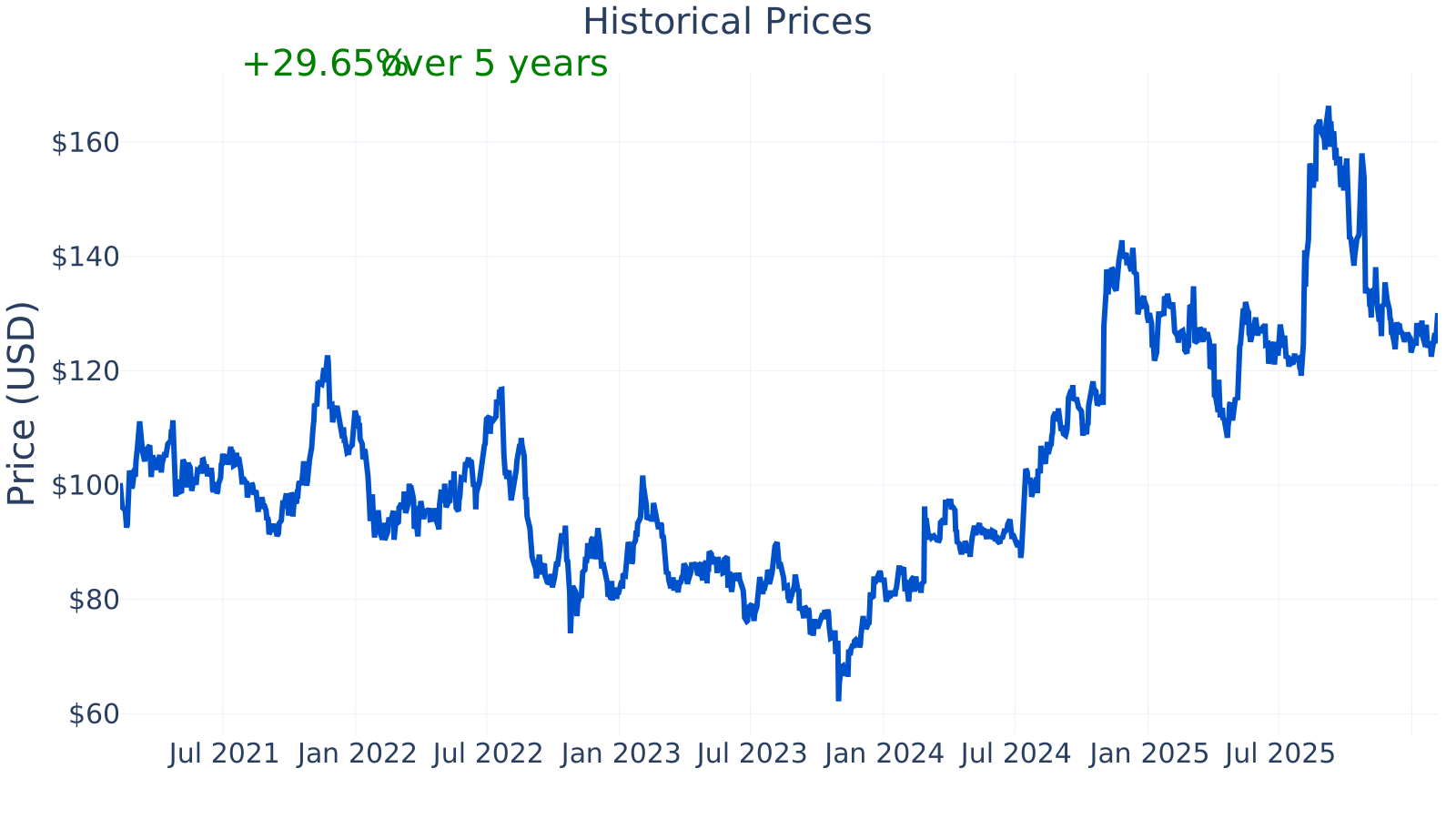
Dorman’s market capitalization is about $4.0 billion and its beta is 0.91, which is often interpreted as somewhat less day-to-day volatility than the broader market. Profitability stands out versus the auto parts peer group shown: the net profit margin is ~11.6% compared with an industry median near 3.4%. Recent year-over-year revenue growth is ~7.9% (industry median ~5.0%). Leverage appears lower than the peer median: debt-to-equity ~37% versus an industry median near 67%. The current P/E ratio is ~16.2 versus an industry median around 25.6. Trailing twelve-month free cash flow is about $105.4 million.
Growth (Medium)
Dorman operates in the automotive aftermarket, an industry that is often supported by long-lived vehicles, ongoing maintenance needs, and a steady flow of repairs regardless of new car sales cycles. A practical tailwind for the category is that modern vehicles tend to be more complex and expensive to repair, which can increase the value of reliable replacement solutions and availability—areas where Dorman positions itself.
The company’s strategy centers on regularly launching new parts (especially in categories where availability is limited), expanding coverage for more makes/models/years, and using scale to serve distributors reliably. This approach can support growth if Dorman continues to identify high-demand repair problems and brings products to market quickly.
The pattern shows strong growth earlier in the period, followed by a clear slowdown and even a small decline around late 2023, with growth returning to mid-to-high single digits more recently (roughly 7–8% year over year in the latest points). This is consistent with a business that can grow through product expansion and share gains, but is not immune to normalization after unusually strong periods.
Free cash flow has been uneven across the timeline: it was strong in 2021, fell sharply by 2023, and then rebounded substantially in 2024 and remained high into 2025 (near $190 million in the last two points shown, though the latest table value is about $105 million on a trailing basis). For long-term business health, the key question is whether the rebound reflects sustainable earnings quality and working-capital discipline, or whether cash generation is likely to fluctuate with inventory and demand cycles.
Potential catalysts discussed in company materials often relate to new product launches, expansion into underpenetrated repair categories, operational efficiency initiatives, and the ability to maintain strong in-stock performance for customers. Because Dorman participates in a mature industry, incremental execution (new SKUs, better availability, and disciplined cost control) tends to matter more than “breakthrough” adoption.
Risks (Medium)
This article is for informational purposes only and does not constitute financial advice. Some content is AI-generated. See Disclaimer