Stock Analysis · Donnelley Financial Solutions Inc (DFIN)
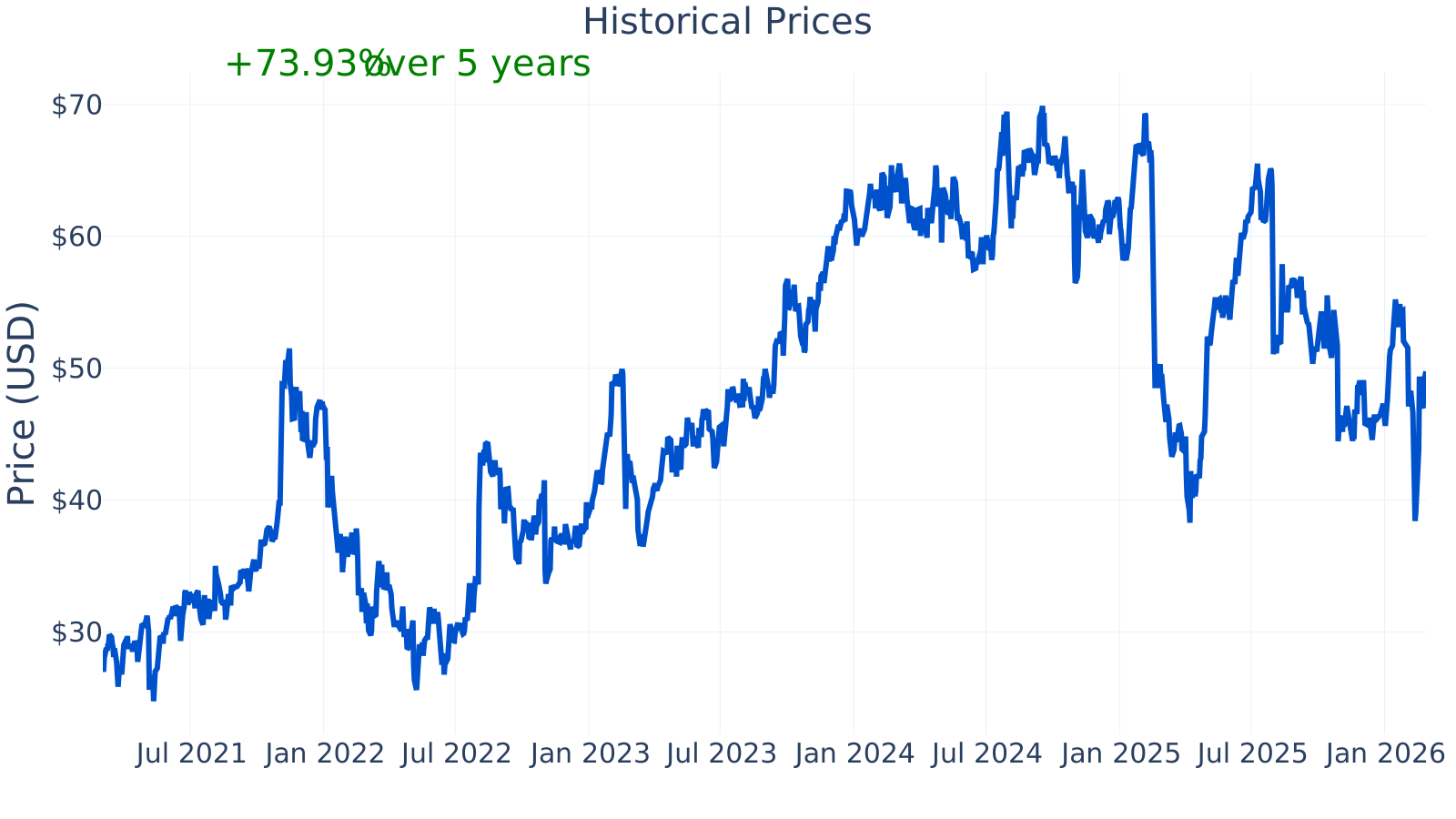
Overview
Donnelley Financial Solutions Inc. (DFIN) provides software and services that help organizations create, manage, and file regulated business information. In plain terms, it supports complex document workflows where accuracy, version control, audit trails, and on-time delivery matter—especially for filings and communications with investors and regulators.
The company is best known for supporting activities such as SEC reporting, investor communications, and compliance-heavy transactions. This positions DFIN at the intersection of software tools (recurring/contracted revenue) and service work (often tied to event-driven projects like transactions or capital markets activity).
Public reporting typically groups DFIN’s activities into (1) software and technology-enabled solutions (including compliance and reporting platforms) and (2) transactional or compliance-related services that can fluctuate with market activity. Percentages by revenue mix are not included in the information provided here; for exact segment breakdowns, the company’s annual report (Form 10‑K) is the primary reference.
Across recent years shown, total revenue trends downward (from about $993M in 2021 to about $767M in 2025). Over the same span, cost of revenue declines meaningfully, which supports gross profit resilience. Operating income remains positive throughout, but net income is more volatile (notably lower in 2025), suggesting that items below operating income (such as taxes, interest, and other non-operating impacts) can materially affect bottom-line results.
Key Figures
| Metric | Value | Industry ⓘ |
|---|---|---|
| Date | Mar 02, 2026 | |
| Context | ||
| Sector | Technology | |
| Industry | Software - Application | |
| Market Cap ⓘ | $1.32B | |
| Beta ⓘ | 0.86 | |
| Fundamental | ||
| P/E Ratio ⓘ | 43.27 | 25.64 |
| Profit Margin ⓘ | 4.22% | 7.25% |
| Revenue Growth ⓘ | 10.40% | 16.65% |
| Debt to Equity ⓘ | 47.94% | 24.64% |
| PEG ⓘ | 4.88 | |
| Free Cash Flow ⓘ | $104.60M | |
Donnelley Financial Solutions has a market capitalization of about $1.32B and a beta of 0.86, which is commonly interpreted as somewhat less volatile than the overall market. The latest P/E ratio is about 43.27 versus an industry median near 25.64, while the PEG ratio is 4.88 (often read as a higher valuation relative to growth expectations). Profit margin is about 4.22% versus an industry median around 7.25%. Year-over-year revenue growth is about 10.40% versus an industry median around 16.65%. Debt-to-equity is about 47.94% versus an industry median around 24.64%. Trailing twelve-month free cash flow is approximately $104.6M.
Growth (Medium)
DFIN operates in areas that are supported by long-running needs: public-company reporting requirements, investor communications, and regulated documentation. These needs tend to persist across economic cycles because compliance obligations do not disappear. However, parts of DFIN’s business can still be sensitive to capital markets activity (for example, when transaction volumes rise or fall, related project work can follow).
Revenue growth has been uneven over the period shown: several quarters of negative year-over-year growth occurred through 2022–2024, followed by a return to positive growth (about 10.36%) in the most recent point shown. This pattern can be consistent with a business that has both recurring components and more cyclical, activity-driven components.
Free cash flow over the trailing twelve months is shown around $104.6M, with the historical points indicating it has generally remained positive but has fluctuated (roughly ranging from the mid-$80M to low-$120M over the years displayed). For long-term business durability, consistently positive free cash flow can matter because it is a source of flexibility for reinvestment, debt reduction, or returning capital to shareholders (subject to management decisions disclosed in filings).
Potential catalysts for future performance typically center on (1) deeper adoption of software platforms within existing customers (expanding usage over time), (2) continued migration from manual document processes to integrated software workflows, and (3) normalization or strengthening in transaction-related activity that drives project revenue. The degree to which DFIN can convert service-heavy relationships into more recurring software revenue can also influence the stability of results over long periods.
Risks (High)
A key risk is revenue sensitivity to market activity for transaction-related work. When IPOs, debt issuance, M&A, or other capital markets activities slow, certain compliance and deal-related volumes can decline. This can pressure top-line performance even if the company’s more recurring offerings remain stable.
Debt-to-equity is about 47.94% versus an industry median near 24.64%. While this is not automatically problematic, it does suggest DFIN uses more leverage than many peers in its broader application software grouping. The historical pattern also shows leverage has moved around substantially over time, which can increase financial risk if operating conditions weaken or if refinancing becomes more expensive.
Profit margin is currently about 4.22%, below the industry median near 7.41% at the most recent point shown. The longer trend indicates margins were much higher earlier in the period (often in the low double-digits) before compressing sharply in late 2025. This makes profitability quality and sustainability an important monitoring point, because small changes in pricing, costs, or mix (software vs. services) can have an outsized impact on net income when margins are thin.
Competition is another material risk. DFIN operates in markets where customers demand high reliability, strong security, and proven workflows. Competitors can include other governance, risk, and compliance software providers, as well as financial printing/communication and filing solution vendors. In addition, large enterprise software providers can compete indirectly by expanding document management, workflow, and compliance features in broader platforms. Competitive advantages in this space often come from customer switching costs (embedded workflows, templates, approvals, integrations), reputation, and deep domain expertise—yet customers may still consolidate vendors or negotiate pricing, especially when budgets tighten.
Finally, regulatory and operational execution risks matter. DFIN supports high-stakes deliverables with deadlines; outages, security incidents, or major implementation problems can harm customer relationships and create legal or reputational exposure. The company’s filings typically discuss these and other risks (including cyber risk) in detail.
Valuation
The latest P/E ratio shown for DFIN is about 43.27, above the provided industry median near 25.64. Historically, DFIN’s P/E has varied widely over the period shown, spending much of 2022–2024 in the roughly high-single-digit to mid‑20s range, and then rising sharply to above 40 at the most recent point. When a P/E rises quickly, it can reflect a higher share price, lower trailing earnings, or both. This matters here because net income has shown meaningful volatility in the multi-year income flow, and the most recent profit margin is relatively low.
The valuation picture also includes the PEG ratio (about 4.88), which is commonly used as a quick check of price relative to growth. A higher PEG can indicate that the market price is high relative to the growth rate being achieved or expected, although PEG is sensitive to how growth is measured and may not fully capture cyclicality in earnings.
Overall, the combination of (1) a higher-than-median P/E, (2) profit margin below the industry median, and (3) mixed recent revenue growth suggests the market is assigning a valuation that may rely on improvement in profitability and/or confidence in longer-term earnings power rather than purely on recent reported profitability.
Conclusion
DFIN is a specialized provider of software and services for regulated communications and reporting, with business lines that can blend recurring platform usage with more cyclical, activity-driven work. The company remains free-cash-flow positive in the periods shown, which can support operational flexibility. At the same time, recent years include declining total revenue in the annual flow presented, a sharp drop in recent net profit margin, and leverage that is higher than the industry median.
From a long-term perspective, the core need for compliance and regulated communications provides a durable demand foundation, while the main uncertainties center on cyclicality in transaction volumes, competitive pressure, and whether profitability returns to stronger levels. Valuation measures shown (including a P/E above the industry median and a relatively high PEG) indicate that the market price embeds expectations that may require sustained execution to validate.
Sources:
- U.S. Securities and Exchange Commission (SEC) — EDGAR Database — Company Filings (Form 10‑K, 10‑Q, 8‑K) for Donnelley Financial Solutions Inc.
- Donnelley Financial Solutions Inc. — Investor Relations — SEC Filings and Annual Report materials
- Wikipedia — “Donnelley Financial Solutions” (basic company background)
This article is for informational purposes only and does not constitute financial advice. Some content is AI-generated. See Disclaimer


