Stock Analysis · Domino's Pizza Inc (DPZ)
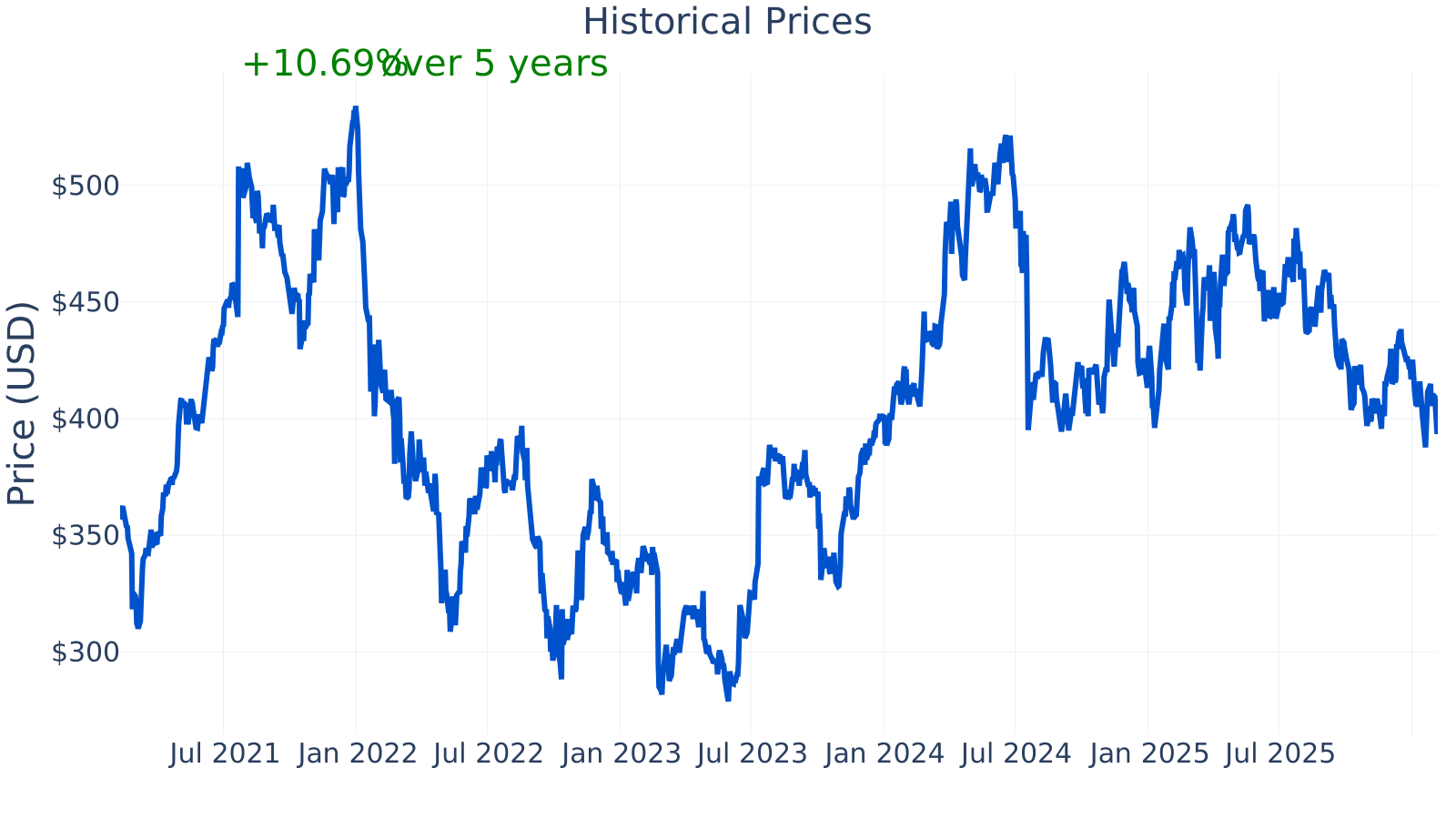
Overview
Domino’s Pizza, Inc. is a global pizza company built around a heavily franchised model. In practical terms, many Domino’s-branded stores are owned and operated by franchisees, while Domino’s supports them with the brand, digital ordering platforms, advertising, supply chain services, and operational standards. The business is designed to scale by growing store count and improving sales at existing locations, while keeping corporate-owned restaurant exposure relatively limited.
Its revenue is primarily generated through a combination of selling food and supplies to franchisees (via its supply chain network), collecting royalties and fees from franchisees, and sales from a smaller base of company-owned stores. Based on the company’s segment reporting in annual filings, the main sources of revenue are typically:
- Supply chain (ingredients, food, and other items sold to franchise stores)
- U.S. franchises (royalties and fees tied to franchisee sales, plus certain other franchise-related revenue)
- International franchises (royalties and fees tied to franchisee sales outside the U.S.)
- Company-owned stores (direct restaurant sales, usually the smallest portion)
This mix matters for long-term shareholders because it means Domino’s economics are influenced not only by consumer demand for pizza, but also by franchisee health, supply chain volumes, and the company’s ability to keep its system competitive (pricing, promotions, delivery/carryout convenience, and digital experience).
Across recent years, total revenue has trended upward (about $4.36B in 2021 to about $4.71B in 2024). Operating income and net income also rose over this period, suggesting profitability improved despite the normal cost pressures a restaurant system faces (ingredients, labor, and logistics).
Key Figures
| Metric | Value | Industry ⓘ |
|---|---|---|
| Date | Feb 07, 2026 | |
| Context | ||
| Sector | Consumer Cyclical | |
| Industry | Restaurants | |
| Market Cap ⓘ | $13.41B | |
| Beta ⓘ | 1.17 | |
| Fundamental | ||
| P/E Ratio ⓘ | 23.09 | 29.16 |
| Profit Margin ⓘ | 12.16% | 7.98% |
| Revenue Growth ⓘ | 3.10% | 6.90% |
| Debt to Equity ⓘ | -128.65% | 69.29% |
| PEG ⓘ | 2.06 | |
| Free Cash Flow ⓘ | $631.52M | |
Domino’s is shown with a market capitalization of about $13.4B and a beta of ~1.17, indicating the stock has tended to move somewhat more than the broader market. The company’s P/E ratio is ~23.1, below the displayed industry median (~29.2). Profitability stands out: the profit margin is ~12.2% versus an industry median of ~8.0%. Growth is more moderate: year-over-year revenue growth is ~3.1% versus an industry median of ~6.9%. Free cash flow over the trailing twelve months is about $632M, which can be an important resource for reinvestment, debt service, and shareholder returns.
Growth (Medium)
Domino’s operates in the broad restaurant industry, where demand tends to be resilient over long periods but can swing with consumer budgets, competition, and changes in food and labor costs. Within that, pizza delivery and carryout are mature categories in the U.S., while international markets can still offer room for additional store growth depending on the country and local competitive landscape. The company’s model is structured to grow through franchise expansion, comparable sales improvements, and continued emphasis on convenience (especially digital ordering and delivery/carryout execution).
The year-over-year revenue growth pattern shows variability over time, including periods of low or slightly negative growth and later re-acceleration. More recently, growth appears positive again (low-to-mid single digits in the latest periods shown), which is consistent with a mature brand that may rely more on execution, market share, and store growth than on rapid category expansion.
Free cash flow has remained substantial in absolute dollars (roughly the mid-$400M to $600M range across the periods shown). This type of cash generation can help support long-term flexibility, but the strategic impact depends on how it is allocated (for example: technology, supply chain capacity, marketing, franchise support, and the balance between debt reduction and shareholder returns).
Potential catalysts for future growth often include continued net unit expansion (more stores), improved store-level economics for franchisees (supporting reinvestment), product and menu innovation, and sustained performance of the digital ordering ecosystem. Domino’s filings also emphasize execution and system-wide initiatives that can lift franchisee sales, which in turn can lift royalty-based revenue.
Risks (High)
Domino’s faces the standard risks of the restaurant business—consumer demand shifts, promotional intensity, commodity and food input volatility, and labor availability/costs. Because it is a franchise system, a key operational risk is franchisee economics: if franchisees struggle with profitability, store growth and reinvestment may slow, and brand execution can suffer.
The debt-to-equity metric is shown as negative for Domino’s in the periods provided, while the industry median is positive. A negative debt-to-equity ratio commonly happens when a company has negative shareholders’ equity (often influenced by significant share repurchases and accumulated accounting effects). This can make debt-to-equity less intuitive to interpret than it is for most companies; however, it still highlights that the capital structure should be monitored closely because leverage and interest obligations can matter more when equity is negative.
Profit margin has generally been above the industry median across the timeframe shown, often by several percentage points (roughly ~10%–13% versus an industry median often in the ~6%–10% range). This suggests Domino’s has maintained relatively strong profitability compared with many restaurant peers, which can reflect scale, franchise economics, supply chain contribution, and operational efficiency. Even so, margins can be pressured if the system must discount aggressively to protect market share or if input costs rise faster than pricing.
Competition is intense. Domino’s competes with large global pizza chains and many local/regional operators, as well as broader quick-service and fast-casual options that compete for the same meal occasions. In the U.S. pizza category, major national competitors include companies such as Pizza Hut and Papa Johns, alongside many independent pizzerias and third-party delivery marketplaces that expand consumer choice. Domino’s competitive advantages often cited in filings include its large store base, brand awareness, established franchise model, supply chain capabilities, and technology-driven ordering and operations. The sustainability of these advantages depends on execution: delivery times, product value perception, and the ongoing quality of the digital experience.
Valuation
From an earnings-multiple perspective, Domino’s current P/E ratio of ~23.1 is below the provided industry median (~29.2). Over the historical period shown, Domino’s P/E has fluctuated meaningfully (with periods in the 20s, and higher levels at certain points), reflecting changing expectations about growth, margins, and the broader market environment.
Valuation context depends on how the market weighs several offsetting factors: (1) Domino’s relatively strong margins versus peers, (2) moderate recent revenue growth versus the industry median, (3) the company’s meaningful free cash flow generation, and (4) balance-sheet considerations implied by the negative debt-to-equity measure (often linked to negative equity). In other words, the multiple is not just about “growth,” but also about durability of profits, competitive intensity, and capital structure risk.
Conclusion
Domino’s is a scaled global restaurant brand with a franchise-driven model that typically emphasizes system growth, royalties and fees, and supply chain volume. Recent figures show solid profitability versus the restaurant industry median and substantial free cash flow, alongside comparatively modest revenue growth.
The long-term picture is shaped by the company’s ability to keep franchisees healthy, defend its position in a highly competitive market, and maintain strong execution in value, convenience, and digital ordering. At the same time, the capital structure signals that leverage and interest costs deserve attention, especially given the negative debt-to-equity readings. The current valuation multiples sit below the provided industry median, which suggests the market is balancing Domino’s strengths (margin profile and cash generation) against the risks and the pace of growth.
Sources:
- U.S. SEC EDGAR — Domino’s Pizza, Inc. Form 10-K (Annual Report) (latest available filing)
- U.S. SEC EDGAR — Domino’s Pizza, Inc. Form 10-Q (Quarterly Reports) (latest available filings)
- Domino’s Pizza Investor Relations — Annual Report materials and investor presentations (company-hosted)
- Wikipedia — “Domino’s Pizza” (basic company background and history)
This article is for informational purposes only and does not constitute financial advice. Some content is AI-generated. See Disclaimer


