Stock Analysis · Walt Disney Company (DIS)
Overview
The Walt Disney Company is a global entertainment business built around well-known brands and storytelling. It creates and licenses movies and TV series, runs streaming platforms, operates theme parks and resorts, sells consumer products, and earns fees from sports and other media distribution. A key feature of Disney’s model is that the same intellectual property (characters, franchises, and stories) can be monetized across multiple channels (cinemas, streaming, merchandise, and theme park attractions), which helps extend the life of content beyond its initial release.
In its SEC filings, Disney reports two main operating segments: Entertainment (streaming and traditional media/content) and Sports (primarily ESPN). Theme parks, resorts, cruise lines, and consumer products are also major businesses, typically reported under an “Experiences” segment in Disney’s filings.
Main revenue streams (largest to smallest may vary by year):
- Experiences: theme parks and resorts, cruise line, vacation products, and related consumer products/licensing
- Entertainment: streaming services, linear TV networks, content sales/licensing, and theatrical distribution
- Sports: ESPN and related sports media, including affiliate fees and advertising
Across the business, the biggest underlying revenue types are typically a mix of park guest spending, subscription revenue (streaming), and affiliate fees/advertising (especially in sports and TV). Exact percentages depend on the fiscal year and how Disney groups its reporting.
Over the last several fiscal years shown, total revenue increased from about $67.4B (FY2021) to about $94.4B (FY2025). Operating income also rose (about $4.0B to $13.8B), while interest expense stayed in a similar range (roughly $1.4B–$1.8B), meaning operating performance became a bigger driver of results than financing costs over this period.
Key Figures
| Metric | Value | Industry ⓘ |
|---|---|---|
| Date | Feb 06, 2026 | |
| Context | ||
| Sector | Communication Services | |
| Industry | Entertainment | |
| Market Cap ⓘ | $186.15B | |
| Beta ⓘ | 1.42 | |
| Fundamental | ||
| P/E Ratio ⓘ | 15.76 | 43.45 |
| Profit Margin ⓘ | 12.80% | 5.18% |
| Revenue Growth ⓘ | 5.20% | 3.60% |
| Debt to Equity ⓘ | 43.00% | 90.45% |
| PEG ⓘ | 5.06 | |
| Free Cash Flow ⓘ | $7.06B | |
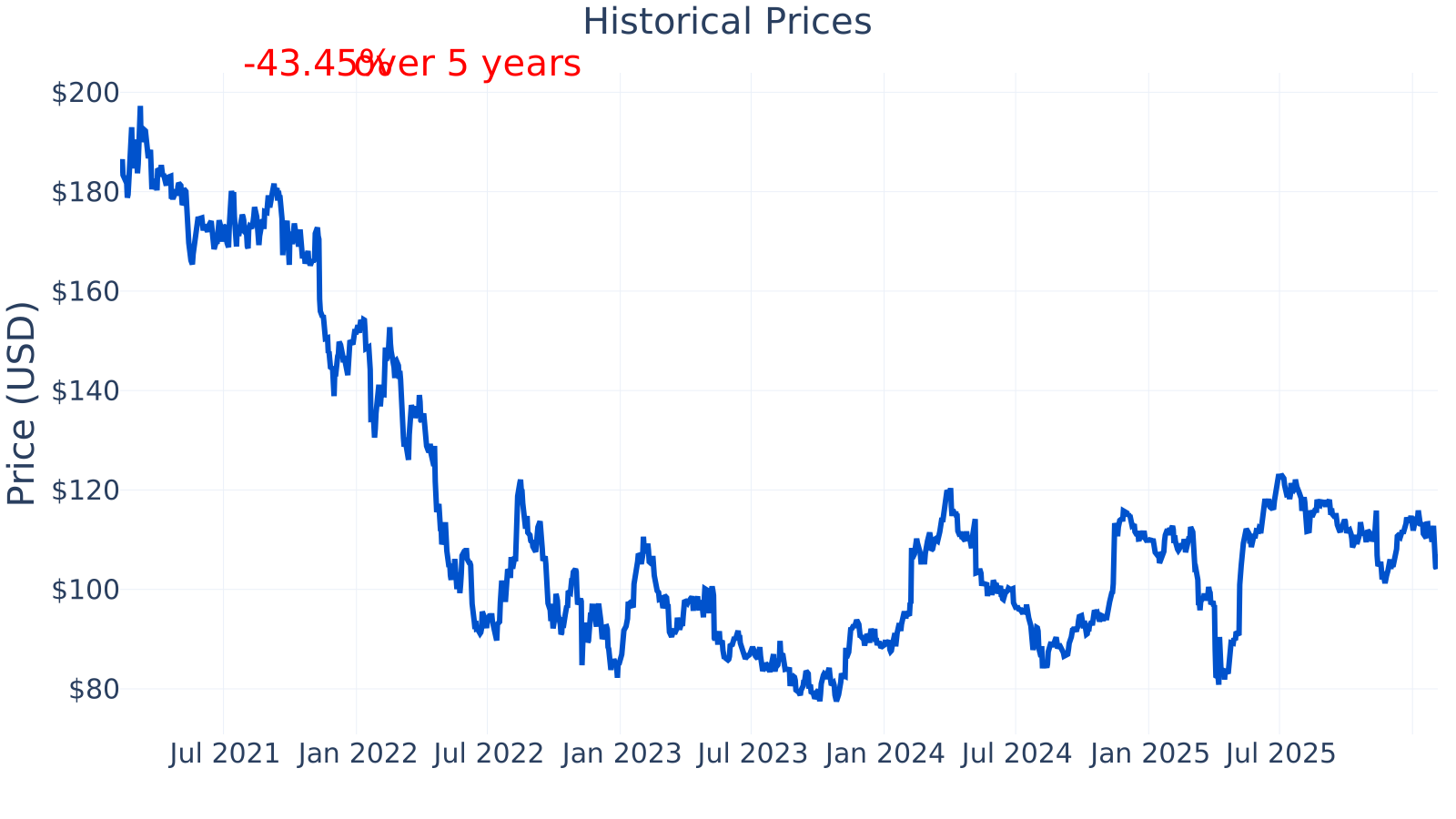
Disney’s market capitalization is about $186B, placing it among the largest global media and entertainment companies. The stock’s beta (~1.42) suggests it has tended to move more than the overall market. On profitability, the latest profit margin is ~12.8%, higher than the industry median shown (~5.2%). Year-over-year revenue growth is about 5.2%, modestly above the industry median shown (~3.6%). Leverage, measured by debt-to-equity (~43%), is below the industry median shown (~90%). Trailing free cash flow is about $7.06B.
Growth (Medium)
Disney operates in large, long-lived entertainment markets, but they are not uniformly “fast-growing.” Streaming remains an important distribution shift, yet it is competitive and increasingly mature in many countries. Theme parks and destination experiences tend to grow with consumer travel and discretionary spending over time, although they can be cyclical during economic slowdowns. Sports broadcasting continues to be valuable, but the industry is adjusting to changes in traditional cable bundles and how viewers consume live events.
Disney’s strategy for future growth is built around combining (1) content creation, (2) direct-to-consumer distribution, and (3) monetization through experiences and merchandise. In practical terms, a successful franchise can generate value in multiple ways: attracting streaming subscribers, supporting theatrical releases, and becoming a theme-park “anchor” that drives attendance and in-park spending.
Revenue growth was very strong in parts of 2021–2022 (reflecting reopening and comparison effects), then moderated. More recently, growth has generally been in the low-to-mid single digits, with the latest value shown around 5.2%. That pattern is consistent with a large, mature company where growth often depends on execution, content performance, and attendance trends rather than pure market expansion.
Free cash flow (cash generated after operating needs and capital spending) improved materially from the earlier periods shown (around $1.3B–$1.6B) to much higher levels in 2024–2025 (peaking above $10B and most recently shown at $7.06B). For a business like Disney—where parks require ongoing investment and media economics can shift—free cash flow is an important indicator of financial flexibility (for reinvestment, debt reduction, or other corporate uses).
Potential catalysts over the long term typically relate to (a) sustained improvement in streaming economics (profitability and churn management), (b) continued strength and capacity expansion in theme parks and cruises, and (c) the evolution of sports distribution models that preserve the value of premium live rights.
Risks (Medium-High)
Disney faces several meaningful risks tied to both consumer behavior and industry structure. A major one is content and streaming execution: producing hit content is uncertain, and streaming businesses can be pressured by subscriber churn, pricing sensitivity, and high ongoing content investment. Another key risk is cyclicality in Experiences: theme parks, cruises, and vacations are discretionary purchases that can soften during recessions or periods of weaker consumer confidence.
Sports is another complex area. ESPN has historically benefited from the traditional pay-TV bundle, but the broader industry continues to shift toward streaming and smaller bundles. That transition can affect affiliate fees, advertising dynamics, and the economics of sports rights over time.
Disney also has regulatory and political exposure given its scale and the visibility of its brands, as well as currency and international exposure because it operates globally. Finally, like other large media companies, it carries risks from technology change (distribution platforms, advertising technology, and viewer habits) and reputation/brand considerations.
Debt-to-equity trended down from roughly the mid-60% range in 2021 to the low-40% range more recently (latest shown around 43%), generally below the industry median line shown. Lower leverage can reduce financial risk, but Disney still has meaningful fixed obligations (including interest expense and large operating cost structures), so resilience depends on maintaining demand across parks and media.
Profit margin improved substantially from negative levels in early 2021 to low single digits in 2022–2024, and then rose into the low teens more recently (latest shown around 12.8%). The industry median line shown is lower (around 5.2% recently), indicating Disney’s profitability has recently compared favorably versus the peer set used here. Even so, margins can remain volatile for media companies due to content amortization, advertising cycles, and the mix between parks and media.
Competitive positioning is strong in brand and intellectual property, which can be a durable advantage. Disney is widely viewed as a leader in family entertainment and one of the global leaders in theme parks. However, it is not alone in each market it competes in:
- Streaming/video: Netflix, Amazon (Prime Video), Apple TV+, Max (Warner Bros. Discovery), Paramount+, and others
- Theme parks: Universal (Comcast) and regional park operators (competition varies by geography)
- Sports media: other sports networks and digital platforms competing for rights and audiences
Disney’s advantage is the ability to connect franchises across streaming, theaters, merchandise, and parks. The main competitive challenge is that several rivals have large budgets and global distribution, which keeps pressure on content costs and customer acquisition.
Valuation
Disney’s current P/E ratio is about 15.8, which is below the industry median shown (about 43.4). The historical trend displayed shows Disney’s P/E was much higher earlier in the period (including elevated levels in 2021–2024) and then moved down into the teens by late 2025. In general terms, a lower P/E can reflect some combination of improved earnings, a lower stock price relative to earnings, or a market view that future growth is more moderate or risks are higher.
Valuation is best interpreted alongside business quality and uncertainty. Disney’s recent margin improvement and stronger free cash flow support the idea that earnings quality has improved versus earlier years. At the same time, streaming competition, sports distribution shifts, and consumer cyclicality can justify more conservative valuation multiples than those seen during periods of strong optimism.
Conclusion
Disney is a diversified entertainment company with globally recognized brands and multiple ways to monetize intellectual property across content, streaming, sports, and theme parks. The recent financial picture shown includes improved profitability, higher free cash flow versus earlier years, and leverage that appears lower than the industry median shown.
At the same time, Disney operates in areas where outcomes can change quickly: streaming economics depend on scale and discipline in spending, sports media is navigating structural change, and theme parks are sensitive to the economic cycle. The stock’s valuation metrics shown (including a P/E below the industry median line provided here) should be considered in the context of these opportunities and uncertainties rather than in isolation.
Sources:
- The Walt Disney Company — Form 10-K (Annual Report), SEC filings (EDGAR)
- The Walt Disney Company — Form 10-Q (Quarterly Report), SEC filings (EDGAR)
- The Walt Disney Company — Investor Relations materials (public releases and presentations)
- Wikipedia — “The Walt Disney Company” (general background)
This article is for informational purposes only and does not constitute financial advice. Some content is AI-generated. See Disclaimer


