Stock Analysis · Diodes Incorporated (DIOD)
Overview
Diodes Incorporated is a semiconductor company that designs and supplies a broad range of “everyday” chips used to control power and move signals inside electronic devices. In simple terms, many of its components help electronics run efficiently (power management) and communicate reliably (signal processing). The company sells its products into end markets such as consumer electronics, computing, communications, industrial equipment, and automotive systems, typically through electronics distributors and directly to large customers.
Diodes’ product portfolio is commonly described as a mix of discrete components (like diodes and transistors) and more integrated chips (like power management and signal conditioning integrated circuits). This mix matters because demand tends to fluctuate with the broader electronics cycle: when customers build fewer devices, they often reduce semiconductor orders and work down inventory.
In its annual reporting, Diodes generally discusses revenue by product categories and by end-market exposure. A simple way to think about the company’s revenue drivers is:
- Analog and power management products (used for power conversion, battery charging, voltage regulation, and protection)
- Discrete products (diodes, rectifiers, transistors, MOSFETs)
- Logic, timing, and connectivity products (signal routing, interface, and related functions)
Percentages by product line can change year to year; the most reliable breakdowns come directly from the company’s latest Form 10-K and Form 10-Q filings.
Across the years shown, revenue and profits have moved with the industry cycle: revenue rose into 2022, then fell sharply in 2023–2024, with a partial rebound in 2025. Operating expenses (including R&D and SG&A) did not decline as quickly as revenue during the downturn years, which contributed to a significant squeeze in operating income and net income.
Key Figures
| Metric | Value | Industry ⓘ |
|---|---|---|
| Date | Feb 16, 2026 | |
| Context | ||
| Sector | Technology | |
| Industry | Semiconductors | |
| Market Cap ⓘ | $3.30B | |
| Beta ⓘ | 1.65 | |
| Fundamental | ||
| P/E Ratio ⓘ | 49.70 | 45.38 |
| Profit Margin ⓘ | 4.46% | 10.84% |
| Revenue Growth ⓘ | 15.40% | 15.50% |
| Debt to Equity ⓘ | 1.69% | 25.62% |
| PEG ⓘ | 0.88 | |
| Free Cash Flow ⓘ | $137.15M | |
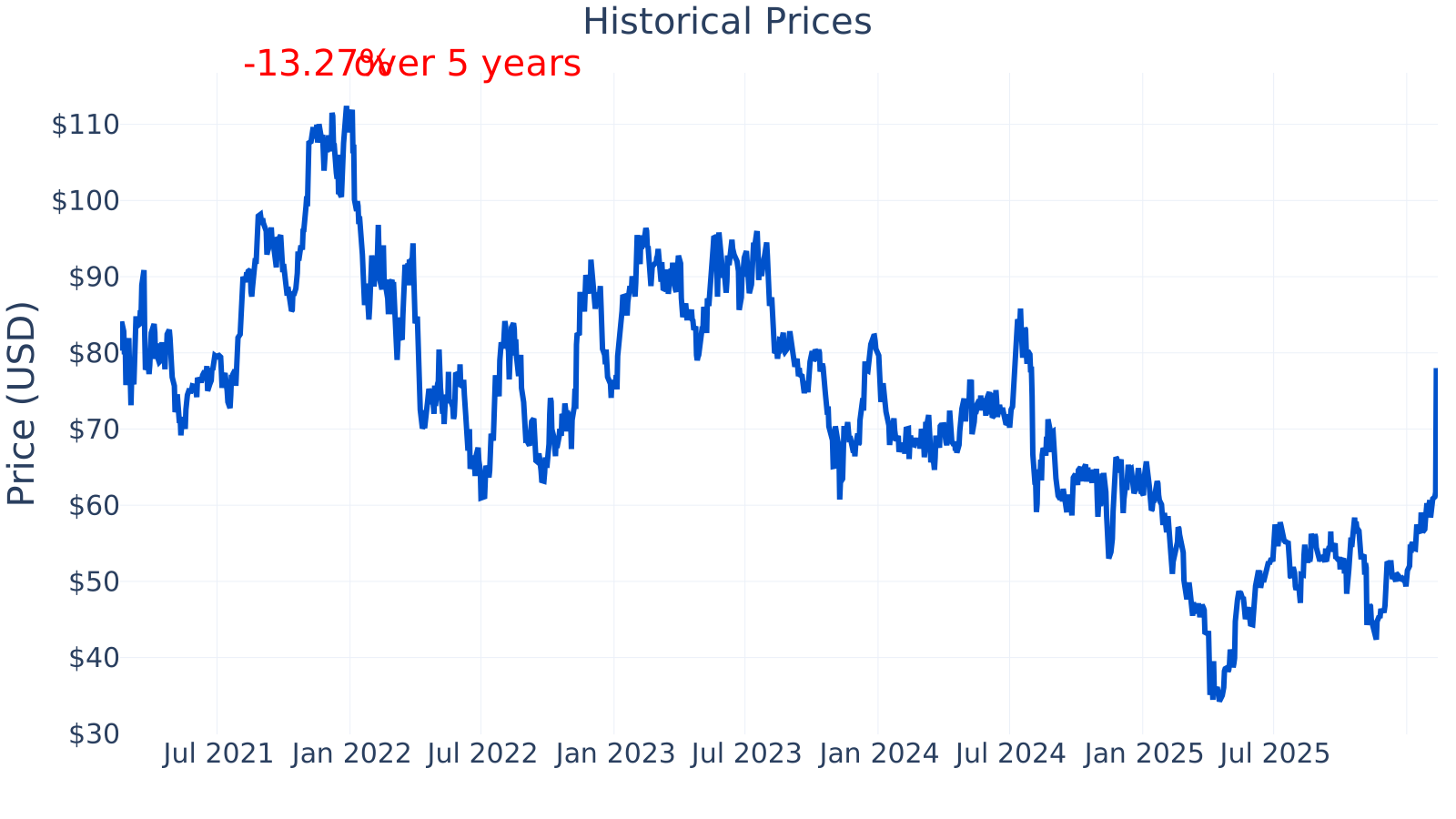
Diodes Incorporated has a market capitalization of about $3.30B and a relatively high historical price sensitivity to the market (beta around 1.65). The latest P/E ratio is about 49.7, slightly above the industry median near 45.4. Recent profitability is notably lower than the industry median, with a 4.46% net profit margin versus an industry median around 10.84%. Year-over-year revenue growth is approximately 15.4%, roughly in line with the industry median (~15.5%). Balance sheet leverage appears low with debt-to-equity around 1.69% (industry median ~25.62%). Trailing twelve-month free cash flow is about $137.2M, and the PEG ratio is shown near 0.88 (PEG can vary depending on the earnings forecast inputs used).
Growth (Medium)
Semiconductors are a long-term growth industry because more electronics content is being added to everyday products. Drivers often cited by companies in this space include increased electrification and electronic content in vehicles, factory automation, energy efficiency requirements, and continued demand for data/communications hardware. Diodes participates in these trends primarily through power and analog components that are needed broadly across devices, rather than through a single “winner-takes-all” chip category.
A key feature of Diodes’ business is that it tends to be cyclical. That means growth is not always smooth: customers may order heavily during strong demand periods, then pause and reduce inventory during slowdowns. Strategy-wise, the company’s long-term approach—broad product catalog, multiple end markets, and ongoing investment in R&D—can be a reasonable fit for a world that keeps adding power management and signal chips to more devices, but results can vary widely year to year.
The year-over-year revenue pattern highlights this cyclicality: very strong growth in 2021, cooling in 2022, a steep contraction through 2023 and much of 2024, followed by a return to positive growth by late 2024 and into 2025 (ending around +15% YoY).
Free cash flow also shows a cycle: it was healthy through 2021–2023, dropped sharply around 2024 (to roughly $26.8M on the period shown), and then recovered to around $138.8M by 2025. For long-term business resilience, the ability to return to positive, meaningful cash generation after a downturn is often a key point to monitor.
Risks (High)
The main risk is industry cyclicality. When electronics demand softens, customers can quickly reduce orders, which can pressure revenue and margins. A related risk is inventory corrections across the supply chain: even if end-user demand is only mildly weaker, customer inventory reductions can create a sharper temporary drop in semiconductor orders.
From a balance sheet perspective, Diodes’ debt-to-equity has moved down substantially over time and is very low at about 1.69% in the latest period shown, compared with an industry median near 21%–26% across the timeline. Lower leverage can reduce financial risk during downturns, though it does not remove the risk of earnings volatility.
Profitability is another important risk area. Net profit margin peaked around 2022–2023 (mid-teens in the periods shown) and then compressed significantly through 2024 and into 2025, ending near 4.46%, below the industry median (about 10.84% in the latest snapshot). This type of margin compression can happen when factories and supply chains are underutilized, pricing weakens, or product mix shifts; regardless of the cause, lower margins can make valuation metrics look less favorable and can reduce flexibility for investment.
Competition is intense in semiconductors, especially in categories like discretes and analog/power where many suppliers offer overlapping products. Competitive advantages in this area typically come from breadth of portfolio, customer relationships, qualification history (especially in automotive/industrial), cost structure, manufacturing and packaging capabilities, and the ability to supply reliably through cycles. Diodes is not generally described as “the” market leader across these categories; instead, it operates as a diversified supplier in a crowded field.
Main competitors often include large analog and power-focused semiconductor vendors as well as discrete specialists. Examples commonly referenced by market participants for overlapping areas include onsemi, STMicroelectronics, Infineon Technologies, Texas Instruments, Analog Devices, NXP Semiconductors, Vishay Intertechnology, and Littelfuse. Many of these competitors are significantly larger, which can provide scale advantages in manufacturing, R&D, and customer coverage. Diodes’ positioning is typically more focused on being a broad, cost-effective supplier across many standard and application-specific parts rather than dominating a single flagship category.
Valuation
Valuation metrics for cyclical semiconductor companies can be difficult to interpret because earnings can swing significantly across the cycle. Diodes’ P/E ratio has varied widely over the period shown—lower during the stronger earnings phase (often in the low teens in 2022–2023) and rising sharply when earnings weakened (reaching elevated levels in 2024–2025). The latest P/E is about 49.7, slightly above the industry median (~45.4) in the latest snapshot.
In context, a higher P/E can reflect expectations of an earnings recovery, but it can also simply indicate that current earnings are temporarily depressed versus normalized levels. With the company’s recent profit margin around 4.46% (below the industry median) and revenue growth returning to positive territory, the key valuation question becomes how sustainably margins and earnings can normalize as the cycle improves. Another contextual datapoint is the PEG ratio (~0.88) shown in the metrics table; while PEG can be a helpful shorthand, it depends heavily on the growth assumptions used and can change materially with updated forecasts.
Conclusion
Diodes Incorporated is a diversified semiconductor supplier focused on power management, analog, and discrete components that are broadly used across many electronics categories. The long-term industry backdrop benefits from rising electronics content in vehicles, industrial systems, and energy-efficient devices, but the business remains highly cyclical.
The recent record shows a pronounced downturn in revenue and profitability in 2023–2024, followed by a return to positive year-over-year revenue growth in 2025 and a recovery in free cash flow. Balance sheet leverage appears low relative to peers, which can be an important stabilizer during weaker parts of the cycle. At the same time, recent net profit margins are well below the industry median, and valuation based on current earnings appears elevated versus the company’s own lower P/E levels during stronger earnings periods.
From a long-term, fundamentals-focused perspective, the main items to track over time are whether revenue growth remains positive through the cycle, whether profit margins rebuild toward prior levels, and whether cash generation stays durable without meaningfully increasing financial leverage.
Sources:
- U.S. Securities and Exchange Commission (SEC) EDGAR — Diodes Incorporated Form 10-K (Annual Report)
- U.S. Securities and Exchange Commission (SEC) EDGAR — Diodes Incorporated Form 10-Q (Quarterly Reports)
- Diodes Incorporated — Investor Relations materials and SEC filings repository
- Wikipedia — “Diodes Incorporated” (basic company background)
This article is for informational purposes only and does not constitute financial advice. Some content is AI-generated. See Disclaimer


