Stock Analysis · Dillard's Inc (DDS)
Overview
Dillard’s, Inc. (DDS) is a U.S. department store retailer. It sells a wide range of consumer products—most notably apparel and accessories—through a network of physical stores and its online channel. Like most department stores, its day-to-day performance is closely tied to consumer spending, merchandise trends, and how efficiently it manages inventory and promotions.
From a business model perspective, Dillard’s generates most of its revenue from retail sales (merchandise sold to customers). It also earns revenue from other activities tied to running a retail footprint, such as service-related items and other smaller lines reported in its filings. In its annual reporting, the company’s results are generally discussed as a single operating segment (retail operations), which means revenue is not typically broken into many separate segments in a way that makes a clean percentage split by category straightforward from the top line alone.
At a high level, the main revenue drivers are:
- Merchandise sales in stores (the core driver of revenue)
- Merchandise sales online (part of retail sales, growing in importance across the industry)
- Other retail-related income (smaller items disclosed in filings)
One way to understand how sales turn into profit is to look at how much is spent on merchandise costs and operating expenses relative to revenue over time.
Over the last several fiscal years shown, total revenue has been broadly stable to slightly down (about $6.6–$7.0B range), while profitability has eased from peak levels. Gross profit declined from roughly $3.0B (FY2023) to about $2.47B (FY2026), and operating income moved from about $1.15B (FY2023) to about $0.69B (FY2026). This points to a tougher retail environment and/or less favorable pricing/promotional conditions compared with earlier years.
Key Figures
| Metric | Value | Industry ⓘ |
|---|---|---|
| Date | Mar 02, 2026 | |
| Context | ||
| Sector | Consumer Cyclical | |
| Industry | Department Stores | |
| Market Cap ⓘ | $9.40B | |
| Beta ⓘ | 1.34 | |
| Fundamental | ||
| P/E Ratio ⓘ | 16.56 | |
| Profit Margin ⓘ | 8.69% | |
| Revenue Growth ⓘ | -3.00% | |
| Debt to Equity ⓘ | 15.21% | |
| PEG ⓘ | -1.28 | |
| Free Cash Flow ⓘ | $620.28M | |
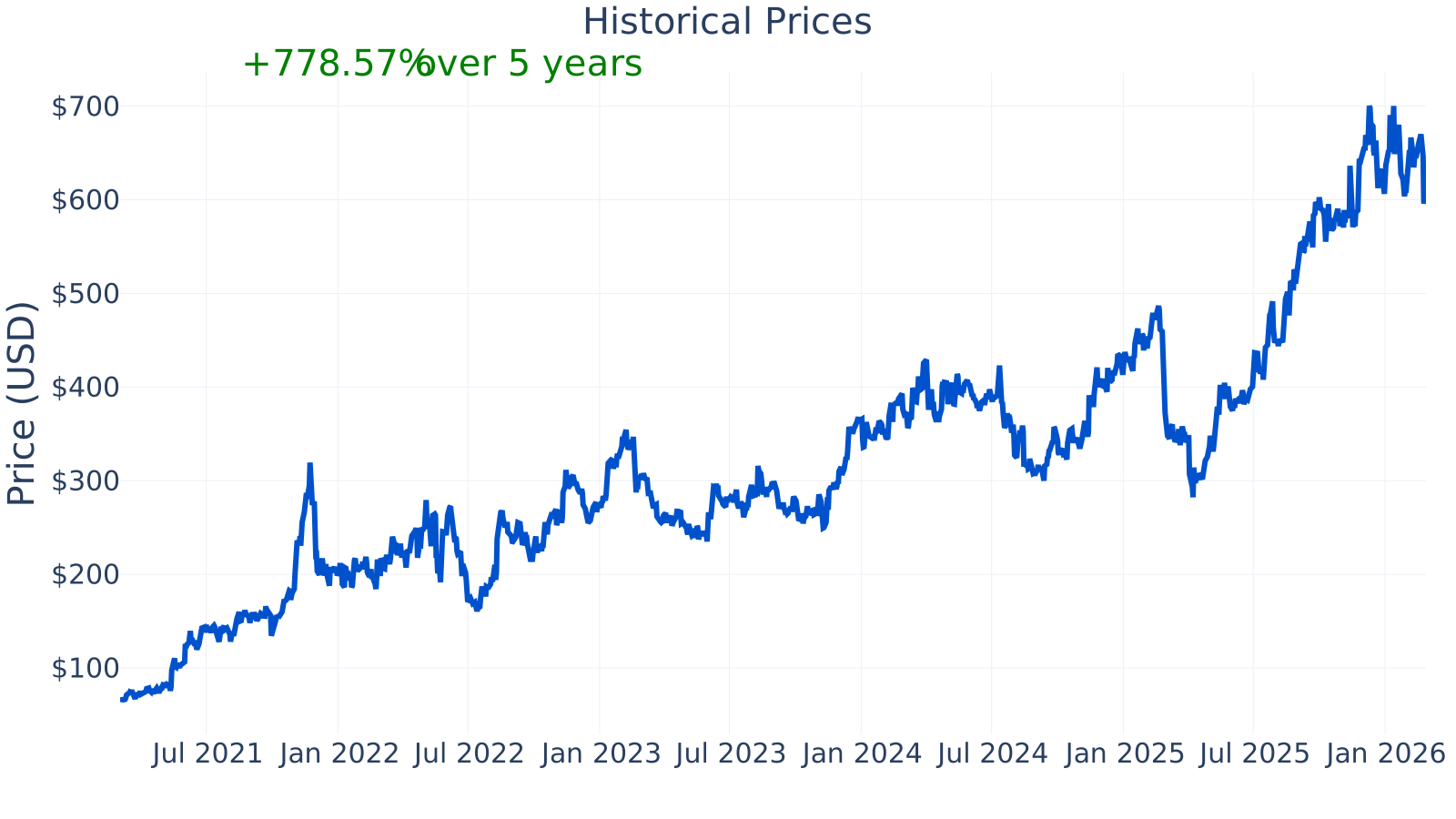
Dillard’s is currently a mid-sized public retailer by market value (about $9.4B). The stock’s beta of 1.34 suggests it has tended to move more than the broader market, which can matter for investors who prefer steadier price behavior. Recent profitability remains positive, with a profit margin around 8.7%, while year-over-year revenue growth is about -3.0%, indicating modest sales pressure. Balance-sheet leverage appears moderate with debt-to-equity around 15%. The company also generated meaningful cash, with trailing twelve-month free cash flow around $620M. The P/E ratio around 16.6 provides a simple (though imperfect) snapshot of how the market is valuing current earnings.
Growth (Low)
Department stores are generally considered a mature part of retail rather than a fast-expanding industry. Over long periods, growth often comes less from opening large numbers of new stores and more from improving merchandising, customer experience, loyalty programs, inventory discipline, and the mix between full-price and discounted selling.
For Dillard’s specifically, recent sales trends have been mixed, with several periods of negative year-over-year comparisons following a stronger post-pandemic rebound earlier in the series.
The pattern shows very high growth rates in 2021–2022 (reflecting reopening and unusually strong demand) followed by a normalization where growth moved closer to zero and then negative in multiple periods. The latest point is around -3%, which is consistent with a slower consumer environment and tougher comparisons.
Cash generation is often a practical indicator of how much flexibility a retailer has to reinvest in stores, technology, or return capital while still funding day-to-day needs like inventory.
Free cash flow has remained solid but lower than earlier peaks: roughly $1.17B (FY2022) down to about $620M (FY2026). This suggests Dillard’s has continued to produce meaningful cash, though at a reduced level compared with the strongest years in the period shown.
Potential catalysts for future growth (in a general, factual sense) typically include a stronger consumer cycle, improved merchandise assortments, more effective inventory management (supporting fewer markdowns), and continued development of digital capabilities. However, in a mature retail category, sustained high growth is harder to achieve and results can be cyclical.
Risks (High)
Dillard’s faces several structural and cyclical risks common to department stores. Demand can change quickly with consumer confidence, employment conditions, interest rates, and inflation in essentials (which can reduce discretionary spending on apparel and home goods). Results can also be affected by fashion misses, inventory mis-steps (leading to markdowns), and higher shrink (losses from theft and damage), which has been a key issue across U.S. retail.
Competition is intense. Dillard’s competes with other department stores, off-price retailers, and large e-commerce players. Key competitors and adjacent threats include:
- Other department stores: Macy’s and Nordstrom (similar category overlap)
- Off-price chains: TJX (T.J. Maxx/Marshalls) and Ross (value-focused competition that can pressure pricing)
- Large online retailers and brands selling direct-to-consumer: broader pressure on traditional department-store traffic
Dillard’s competitive strengths typically relate to its brand recognition in many of its regions, its vendor relationships, and execution in merchandising and inventory discipline. That said, it is not the clear “category leader” of U.S. department stores by national scale; the competitive landscape is fragmented and shaped by regional strength, mall traffic patterns, and online alternatives.
Balance-sheet risk looks contained based on leverage trends, which can matter in a cyclical business.
Debt-to-equity has declined substantially over the period shown, from roughly 40%+ in 2021–2022 to about 15% most recently. Lower leverage can reduce financial stress during downturns, though it does not eliminate earnings volatility in retail.
Profitability is another key risk area because margins can compress quickly when promotions increase or costs rise.
The profit margin peaked above 13% around 2022 and has trended down to about 8.7% most recently. Even after this decline, profitability remains positive, but the direction highlights how sensitive results can be to pricing, product mix, and expense levels.
Valuation
Valuation for a retailer is often discussed using simple measures like the price-to-earnings (P/E) ratio, while keeping in mind that earnings can be cyclical. Dillard’s latest P/E is about 16.6, and the historical pattern shows that the multiple has moved meaningfully over time.
In the period shown, the P/E ratio was in the mid-single digits through much of 2022–2023 and has risen into the mid-to-high teens more recently. A rising P/E can happen when the share price increases faster than earnings, when earnings fall, or a combination of both. Given that margins and revenue growth have softened versus earlier peaks, interpreting today’s multiple typically requires attention to whether profits normalize further, stabilize, or recover over time.
In context, the current valuation reflects a business with ongoing profitability and solid cash generation, but operating in a mature and highly competitive retail category where sales and margins can fluctuate significantly from year to year.
Conclusion
Dillard’s is a traditional department store retailer with a straightforward core business: selling merchandise through stores and online. Recent years show a pattern of strong post-pandemic performance followed by normalization—revenue growth turning modestly negative at times, profit margins easing from peak levels, and free cash flow remaining positive but below earlier highs.
From a long-term perspective, the main positives visible in the fundamentals shown include continued profitability, meaningful cash generation, and a notably reduced leverage profile. The main uncertainties come from the industry backdrop (mature category, heavy competition, and shifting consumer shopping habits) and the company’s sensitivity to economic conditions and promotional intensity, which can pressure margins.
Sources:
- Dillard’s, Inc. — Annual Report (Form 10-K)
- SEC EDGAR — Dillard’s, Inc. filings (10-K, 10-Q, 8-K)
- Wikipedia — “Dillard’s” (basic company background)
This article is for informational purposes only and does not constitute financial advice. Some content is AI-generated. See Disclaimer


