Stock Analysis · DigitalOcean Holdings Inc (DOCN)
Overview
DigitalOcean Holdings, Inc. is a cloud infrastructure provider focused on making it easier for individuals, developers, startups, and small-to-medium-sized businesses to build and run applications online. In practical terms, it offers the computing power, storage, and networking needed to host websites, run software, manage databases, and deploy modern applications without owning physical servers.
The company’s business model is primarily usage-based and subscription-like: customers pay for cloud services (for example, virtual servers, managed databases, storage, networking, and related tools). DigitalOcean positions itself around simplicity and developer-friendly tooling, aiming to be more approachable than the largest “hyperscale” cloud providers for smaller teams and organizations.
In its SEC filings, DigitalOcean typically reports revenue as a single operating segment rather than breaking it into detailed product-line percentages. As a result, a precise “revenue by product” split is usually not provided publicly in percentage terms. At a high level, revenue mainly comes from cloud services delivered through its platform, including:
- Compute (virtual machines and related compute services)
- Managed services (such as managed databases and managed Kubernetes)
- Storage and networking
- Other platform tools and support offerings
Operationally, DigitalOcean’s costs are heavily influenced by infrastructure (data centers, bandwidth, hardware) and ongoing investment in product development and customer acquisition.
From 2021 to 2024, total revenue increased from about $428.6M to about $780.6M. Over the same period, the company moved from a net loss (2021–2022) to positive net income (2023–2024), while operating income also turned positive by 2023 and expanded in 2024. This pattern suggests improved operating efficiency alongside continued growth, although cost of revenue and operating expenses remain substantial given the nature of cloud infrastructure.
Key Figures
| Metric | Value | Industry ⓘ |
|---|---|---|
| Date | Feb 08, 2026 | |
| Context | ||
| Sector | Technology | |
| Industry | Software - Infrastructure | |
| Market Cap ⓘ | $5.76B | |
| Beta ⓘ | 1.77 | |
| Fundamental | ||
| P/E Ratio ⓘ | 25.17 | 25.66 |
| Profit Margin ⓘ | 29.15% | 6.68% |
| Revenue Growth ⓘ | 15.70% | 15.20% |
| Debt to Equity ⓘ | -2288.92% | 19.82% |
| PEG ⓘ | 1.87 | |
| Free Cash Flow ⓘ | $169.29M | |
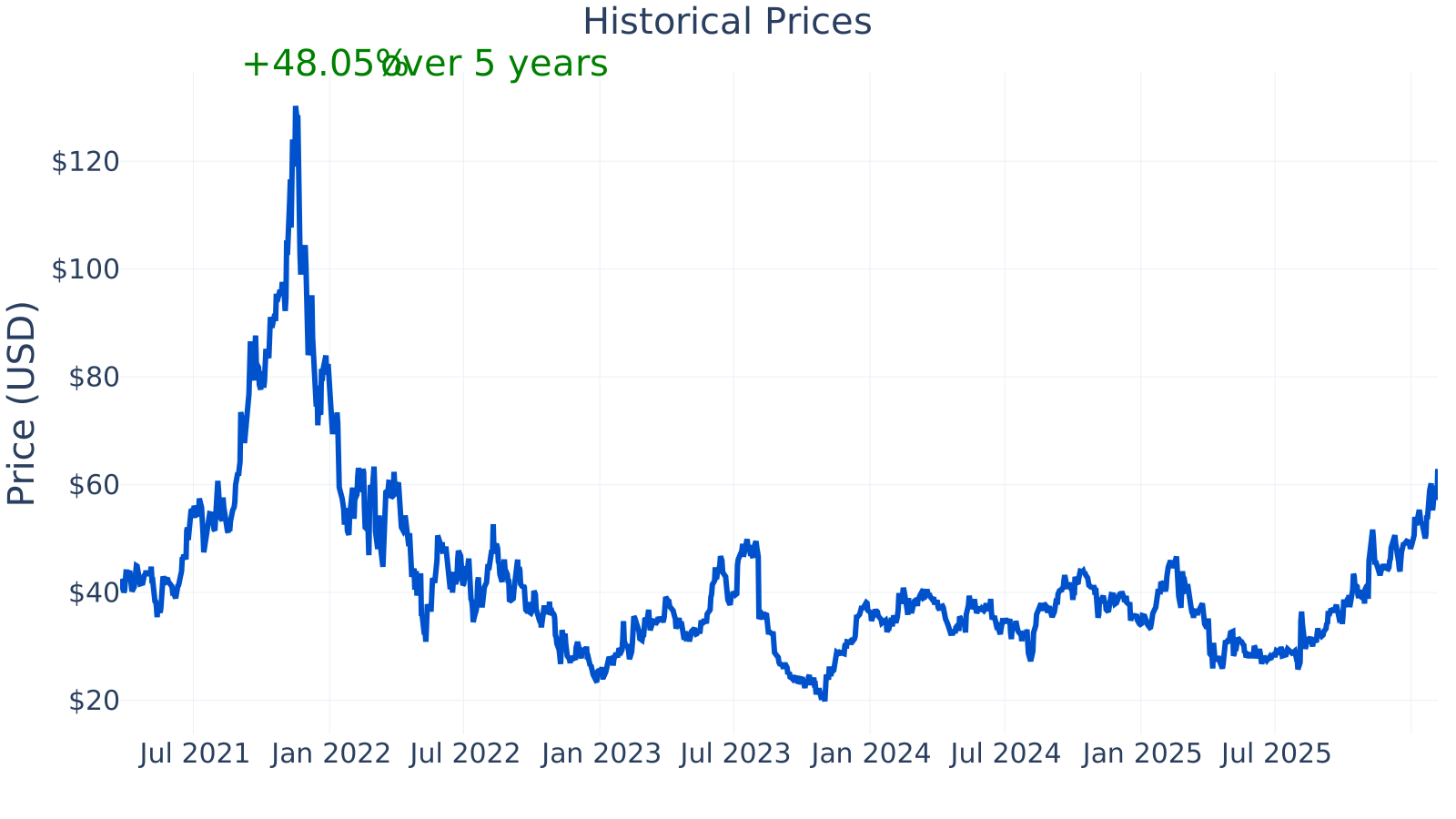
DigitalOcean’s market capitalization is about $5.76B. The stock’s beta of ~1.77 indicates it has tended to move more than the broader market (up and down), which is common for smaller, growth-oriented technology companies.
The latest table shows a P/E ratio of ~25.17, close to the industry median (~25.66). The company’s profit margin is ~29.15%, which is well above the listed industry median (~6.68%), and its year-over-year revenue growth is ~15.7%, roughly in line with the industry median (~15.2%). Free cash flow over the trailing twelve months is about $169.3M, indicating the business has recently been generating cash after operating expenses and capital spending (though this can vary over time).
Growth (Medium)
DigitalOcean operates in cloud computing, a long-running shift where organizations move workloads from on-premises servers to hosted infrastructure and managed services. While the overall cloud market is large and still expanding, competition is intense and growth rates can vary depending on customer segment. DigitalOcean’s focus on developers and smaller businesses targets a broad base of customers who often prioritize ease of use, predictable pricing, and quick setup.
Strategically, the company’s growth approach centers on expanding the capabilities of its platform (more products and deeper features), increasing adoption among existing customers (more services per customer), and attracting new developers and small teams through a straightforward user experience. In cloud businesses, growth can be supported when customers steadily increase their usage over time as their applications and traffic expand.
The year-over-year growth rate has moderated from very high levels earlier in the period (above 30% in several quarters in 2021–2022) to the mid-teens more recently (roughly 11%–16% across recent quarters shown). This can be consistent with a business maturing and scaling from a larger revenue base, but it also means future results may depend more on product expansion, customer retention, and competitive positioning rather than purely rapid market-share gains.
Free cash flow increased from relatively modest levels in 2021 to higher levels by 2024, then shows variability afterward (with a lower point in 2025 compared to 2024 in the values shown). For long-term business durability, sustained free cash flow can matter because it can help fund infrastructure and product development and provide flexibility in less favorable economic periods.
Risks (High)
This article is for informational purposes only and does not constitute financial advice. Some content is AI-generated. See Disclaimer


